

ISO Certification for MSME Manufacturing Companies Delhi
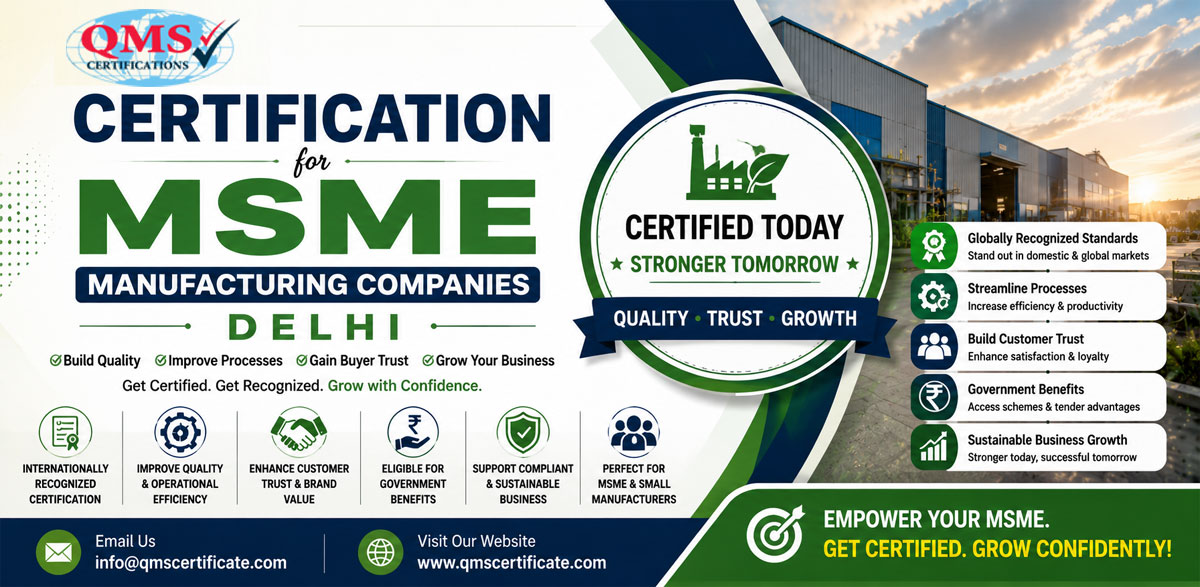
ISO Certification for MSME Manufacturing Companies Delhi
Introduction
For an MSME, quality management is not only about producing a good product. It is also about maintaining consistent processes, controlling defects, managing suppliers, meeting customer requirements and creating systems that can support business growth.
This makes ISO Certification for MSME Manufacturing Companies Delhi an important consideration for manufacturing businesses that want to strengthen their operations and credibility.
MSMEs are a major part of India's industrial ecosystem. The Ministry of MSME's current classification, applicable from 1 April 2025, uses a combined investment and annual-turnover criterion. A micro enterprise can have investment up to ₹2.5 crore and turnover up to ₹10 crore; for small enterprises the limits are ₹25 crore and ₹100 crore, while medium enterprises have limits of ₹125 crore and ₹500 crore respectively.
For a Delhi manufacturing MSME, ISO certification can provide a structured management framework that grows alongside the business.
What Is ISO Certification for MSME Manufacturing Companies?
ISO certification is an independent assessment that confirms whether a company's management system meets the requirements of a particular ISO standard.
For manufacturing MSMEs, ISO 9001 certification is often a practical starting point because it focuses on Quality Management Systems (QMS). ISO describes ISO 9001 as a standard suitable for organizations of different sizes and sectors, including manufacturers, and highlights areas such as customer focus, process management, performance and continual improvement.
Depending on the nature of the manufacturing business, other standards may also be relevant:
- ISO 9001 – Quality Management System
- ISO 14001 – Environmental Management System
- ISO 45001 – Occupational Health and Safety Management System
- ISO 22000 – Food Safety Management System
- ISO 13485 – Medical Device Quality Management System
- ISO 27001 – Information Security Management System
The right certification should be selected according to the MSME's products, processes, risks, customers and business objectives.
Why ISO Certification Matters for MSMEs in Delhi
A small manufacturing unit often operates with a lean team. One person may handle multiple responsibilities, and many processes may depend on experience rather than formally defined procedures.
That can work while the business is small. But as orders, employees and customers increase, informal processes can become difficult to control.
For example, consider a Delhi-based auto-component MSME supplying several customers. If different employees use different inspection methods, defects can become difficult to identify and recurring customer complaints may increase.
A QMS can help the business define responsibilities, establish process controls, monitor performance and systematically address problems.
ISO also notes that ISO 9001 can help organizations improve reliability, reduce errors, strengthen customer satisfaction and build confidence with customers and business partners.
Key Benefits of ISO Certification for MSME Manufacturers
1. Improved Quality Control
ISO 9001 encourages businesses to establish controlled and repeatable processes.
For an MSME manufacturer, this can mean better control over purchasing, production, inspection, packaging and delivery.
2. Greater Customer Confidence
Independent certification can demonstrate that the company's management system has been assessed against the applicable standard.
This can be particularly useful when approaching new B2B customers or participating in supplier evaluations.
3. Reduced Rework and Waste
When manufacturers identify the causes of recurring defects instead of repeatedly correcting the same problem, they can improve process efficiency.
4. Better Supplier Management
MSMEs often depend heavily on a limited number of suppliers. A structured supplier evaluation and monitoring process can help improve consistency in incoming materials and components.
5. Improved Internal Processes
Defined responsibilities, documented processes and performance monitoring can reduce dependence on individual employees.
6. Support for Tenders and Customer Requirements
Some tenders, contracts and supply-chain arrangements may specify ISO certification. ISO itself notes that certification can be requested in supplier approval, government tender and international partnership contexts.
However, an MSME should always check the specific eligibility conditions of each tender or customer rather than assuming ISO certification automatically guarantees eligibility.
7. Stronger Business Credibility
For a growing MSME, certification can be one element of a broader credibility strategy alongside product quality, regulatory compliance, customer service and delivery performance.
Which ISO Certification Is Best for MSME Manufacturing Companies?
There is no single ISO standard that is automatically best for every MSME.
ISO 9001 for Manufacturing MSMEs
ISO 9001 is generally the most broadly applicable choice when the primary goal is quality management and process improvement.
ISO 14001 for Environmentally Responsible Manufacturing
Manufacturers concerned with waste, resource consumption and environmental management may consider ISO 14001.
ISO 45001 for Workplace Safety
Manufacturing businesses with significant machinery, chemical, electrical or occupational safety risks may consider ISO 45001.
ISO 22000 for Food Manufacturers
Food-processing and food-manufacturing MSMEs may need a food-safety management system aligned with ISO 22000 and other applicable food regulations.
In some cases, an MSME may implement an integrated management system, combining standards such as ISO 9001, ISO 14001 and ISO 45001 where appropriate.
Step-by-Step ISO Certification Process for MSMEs in Delhi
The ISO certification process for MSME manufacturing companies in Delhi should be practical and proportionate to the organization's size and complexity.
Step 1: Understand the Business
The first stage is to understand the MSME's products, manufacturing processes, workforce, locations, customers and certification objectives.
Step 2: Select the Appropriate Standard
Choose the ISO standard that matches the business requirement.
For many manufacturing MSMEs, ISO 9001 is a logical starting point when quality management is the primary objective.
Step 3: Define the Certification Scope
The scope should accurately describe the activities and locations covered by the management system.
Step 4: Conduct a Gap Assessment
Existing processes are reviewed against the requirements of the selected standard.
Typical gaps may involve:
- Quality policy
- Process documentation
- Supplier controls
- Inspection procedures
- Employee responsibilities
- Risk management
- Internal audits
- Corrective actions
- Management review
Step 5: Prepare the Management System
Relevant policies, procedures, work instructions, objectives and records are developed or improved.
Documentation should be appropriate for the actual size and complexity of the MSME.
Step 6: Implement the System
Employees should understand their responsibilities and follow the defined processes.
Implementation is important because certification is not simply a document-purchase exercise.
Step 7: Internal Audit
The MSME checks whether the management system is being followed and identifies areas requiring corrective action.
Step 8: Management Review
Management reviews system performance, objectives, customer feedback, audit findings and improvement opportunities.
Step 9: Independent Certification Audit
An external certification body assesses the management system against the relevant ISO requirements.
Importantly, ISO itself does not issue ISO certificates. Certification is performed by independent certification bodies. ISO recommends evaluating certification bodies and considering relevant accreditation when choosing one.
Step 10: Certification and Continual Improvement
After successful completion of the certification assessment, the certification body issues the certificate.
The management system should then continue to be monitored and improved.
Documents Required for ISO Certification
The exact documentation depends on the selected ISO standard and the MSME's activities.
Commonly required information may include:
- Business registration details
- Udyam Registration details, where applicable
- Company profile
- Manufacturing activity details
- Certification scope
- Organization structure
- Quality or relevant management policy
- Objectives
- Process information
- Work instructions
- Supplier evaluation records
- Inspection and testing records
- Customer feedback
- Nonconformity records
- Corrective-action records
- Internal audit records
- Management review information
An important point for MSMEs is that documentation should be useful and relevant, not unnecessarily complicated.
The Udyam Registration portal is the Government of India's official MSME registration portal, and the government states that Udyam registration is free.
Why Choose QMS Certificate?
For an MSME, choosing the right ISO service provider can make the certification process easier to understand and manage.
QMS Certificate provides ISO certification services in Delhi and specifically discusses support for startups, MSMEs, manufacturers and established businesses. Its Delhi-focused content describes assistance with documentation, gap analysis, implementation, internal audit preparation and certification.
QMS Certificate's service portfolio includes standards such as ISO 9001, ISO 14001, ISO 45001 and ISO 22000, allowing manufacturing businesses to consider certification according to their specific requirements.
For an MSME, the priority should be a certification approach that matches the actual business rather than purchasing a generic document package.
ISO Certification for Different MSME Manufacturing Industries
ISO certification can be relevant to many types of manufacturing MSMEs in Delhi, including:
- Engineering manufacturing companies
- Auto-component manufacturers
- Electrical manufacturers
- Electronics manufacturers
- Plastic manufacturers
- Packaging manufacturers
- Machinery manufacturers
- Metal and steel manufacturers
- Textile manufacturers
- Chemical manufacturers
- Pharmaceutical manufacturers
- Food-processing manufacturers
- Construction-material manufacturers
- General production units
The certification scope should always reflect the company's real activities.
Common Mistakes MSMEs Should Avoid
Before choosing an ISO consultant or certification provider, manufacturers should avoid several common mistakes.
Choosing Only on Price
The cheapest option may not provide the level of implementation and certification support the business actually needs.
Using Generic Documentation
Copied procedures may not reflect your factory's actual processes.
Ignoring Implementation
Employees should understand and follow the management system rather than keeping documents unused.
Confusing Consultant and Certification Body
A consultant may help prepare the organization, while certification is independently assessed by a certification body. ISO clearly distinguishes these roles.
Making Unverified Certification Claims
A certificate should identify the applicable standard, scope and certification body. Businesses should not claim that they are “certified by ISO,” because ISO does not perform certification.
Frequently Asked Questions
1. What is ISO Certification for MSME Manufacturing Companies Delhi?
It is an independent assessment of an MSME manufacturer's management system against the requirements of a selected ISO standard. ISO 9001 is commonly used for quality management, while other standards address areas such as environment, occupational health and safety and food safety.
2. Which ISO certification is best for MSME manufacturing companies?
For many manufacturing MSMEs, ISO 9001 is a practical starting point because it focuses on quality management and process improvement. The right standard ultimately depends on the company's industry, risks, customer requirements and objectives.
3. Is ISO certification mandatory for MSME manufacturers?
ISO certification is generally voluntary. However, a particular tender, customer, contract or supply-chain arrangement may specify certification as a requirement. ISO describes ISO 9001 certification as voluntary while noting that it may be requested in specific commercial situations.
4. How much does ISO certification cost for an MSME in Delhi?
There is no single price for every MSME. Cost can depend on the standard selected, employee count, number of locations, certification scope, process complexity, documentation requirements and audit arrangements. A business-specific quotation is more reliable than a universal price.
5. Can a small manufacturing company get ISO certification?
Yes. ISO 9001 is designed for organizations of different sizes, including small and medium-sized enterprises. The management system should be appropriately scaled to the organization's actual operations.
Conclusion
ISO Certification for MSME Manufacturing Companies Delhi can help a growing manufacturing business move from informal processes toward a more structured and measurable management system.
Whether the objective is improving quality, strengthening customer confidence, preparing for specific tender requirements, improving environmental management or strengthening workplace safety, the appropriate ISO standard can support the business when it is properly implemented.
For most manufacturing MSMEs starting with quality management, ISO 9001 is a strong consideration. Other standards such as ISO 14001 and ISO 45001 can complement the system when environmental or occupational health and safety objectives are also important.
If you are planning ISO Certification in Delhi for your MSME manufacturing business, QMS Certificate can help you understand the applicable standard, certification scope, documentation and preparation requirements.
Contact QMS Certificate
Email: info@qmscertificate.com
Website: www.qmscertificate.com
Discuss your manufacturing activities and certification requirements with the QMS Certificate team.
Having any Query? Talk to our Experts
Our Projects are fully tested, background checked, license validated and insured
with a 100% satisfaction guarantee.
Contact Info
 qmscertify@gmail.com
 View Location Map