

ISO 14001 Certification for Manufacturing Companies Delhi
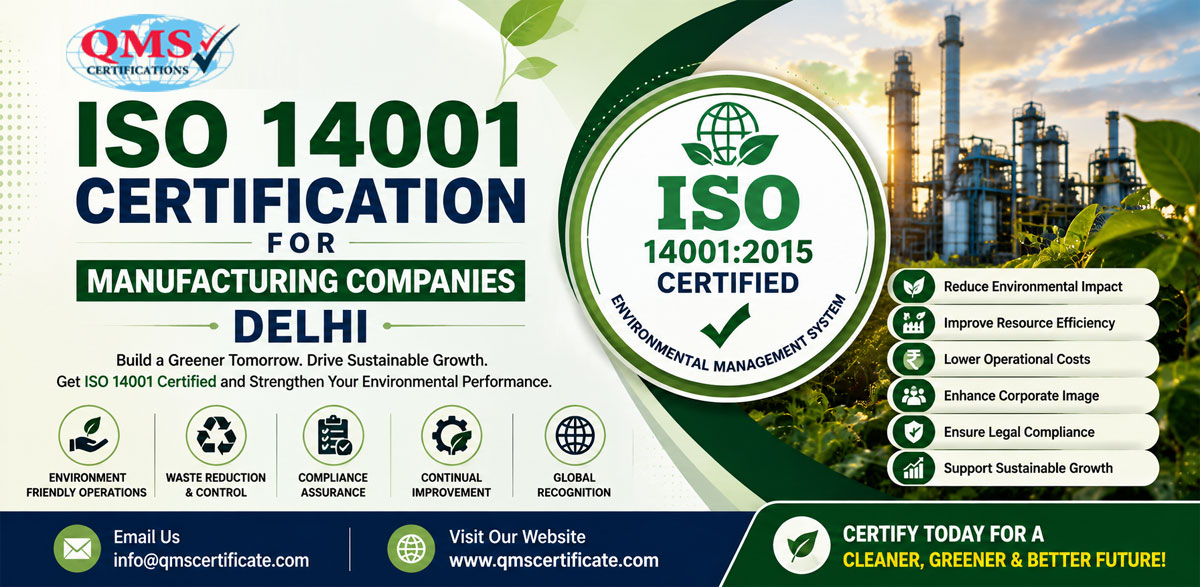
ISO 14001 Certification for Manufacturing Companies Delhi
Introduction
Manufacturing companies have a direct impact on the environment through energy consumption, water usage, raw materials, waste generation, emissions, packaging and other operational activities. Managing these impacts systematically is becoming increasingly important for businesses that want to improve efficiency, meet environmental obligations and build long-term customer confidence.
This is where ISO 14001 Certification for Manufacturing Companies Delhi becomes relevant.
ISO 14001 is the internationally recognized standard for an Environmental Management System (EMS). The current edition is ISO 14001:2026, which provides a structured framework for organizations to manage environmental responsibilities, improve environmental performance, meet compliance obligations and pursue environmental objectives. ISO states that the standard applies to organizations of all sizes and sectors, including manufacturing.
For a Delhi-based manufacturer, ISO 14001 can help turn environmental management from an informal activity into a documented, measurable and continuously improving business process.
What Is ISO 14001 Certification for Manufacturing Companies?
ISO 14001 certification involves an independent assessment of an organization's Environmental Management System against the applicable requirements of ISO 14001.
For manufacturers, an EMS can address environmental aspects associated with activities such as:
- Raw-material consumption
- Electricity and fuel usage
- Water consumption
- Waste generation
- Hazardous and non-hazardous waste
- Air emissions
- Wastewater and effluent management
- Chemical and material handling
- Packaging
- Environmental emergencies
- Supplier and purchasing activities
The standard does not prescribe one fixed environmental performance level for every company. Instead, it provides a management framework that allows an organization to identify relevant environmental aspects, understand applicable obligations, establish objectives and improve performance according to its own context.
Why ISO 14001 Matters for Manufacturers in Delhi
Delhi's manufacturing businesses operate in an environment where resource efficiency, waste management and environmental responsibility can influence operational risk, customer relationships and business reputation.
Consider a manufacturing unit that uses large amounts of electricity and water while generating production waste. Without defined monitoring and objectives, management may know that resources are being consumed but lack a systematic way to measure trends and identify improvement opportunities.
An EMS provides that structure.
ISO explains that ISO 14001 can help organizations improve environmental performance, optimize resource use, manage waste, strengthen compliance and build stakeholder confidence.
For manufacturers, this means environmental management can become part of routine business decisions rather than a separate compliance exercise.
Key Benefits of ISO 14001 Certification
1. Better Environmental Performance
ISO 14001 helps organizations identify environmental aspects and establish controls and objectives for improving their performance.
For a manufacturer, this could involve reducing material waste, improving energy efficiency or strengthening waste segregation.
2. Improved Resource Efficiency
Better monitoring of electricity, water, fuel and raw-material consumption can reveal areas where resources are being used inefficiently.
Reducing unnecessary consumption can support both environmental and operational goals.
3. Stronger Environmental Compliance
An effective EMS includes processes for identifying and managing applicable compliance obligations.
This helps businesses create a more systematic approach to environmental responsibilities rather than relying on ad-hoc checks.
4. Better Waste Management
Manufacturers can establish procedures for identifying, segregating, storing and monitoring different waste streams according to their operations and applicable requirements.
5. Reduced Environmental Risk
Environmental aspects and associated risks can be assessed systematically, helping management identify potential issues before they become larger operational problems.
6. Increased Customer Confidence
Customers, supply-chain partners and other stakeholders increasingly want evidence of responsible environmental practices.
ISO 14001 certification can provide independent confirmation that an organization's EMS has been assessed against the standard.
7. Support for Sustainable Business Growth
ISO identifies environmental performance, compliance, efficiency, stakeholder confidence and market opportunities among the potential benefits of implementing ISO 14001.
ISO 14001 Requirements for Manufacturing Companies
The requirements of ISO 14001:2026 cover the key elements needed to establish an effective Environmental Management System.
For manufacturers, these requirements can translate into practical activities such as:
Understanding Environmental Aspects
The organization identifies activities, products and services that can interact with the environment and determines which aspects it can control or influence.
Identifying Compliance Obligations
Relevant environmental laws, regulations and other obligations need to be identified and considered within the EMS.
Environmental Objectives
The organization establishes environmental objectives and plans actions to achieve them.
Examples might include:
- Reducing electricity consumption
- Improving water efficiency
- Reducing production waste
- Increasing recycling
- Improving environmental monitoring
- Reducing specific emissions
Operational Controls
Processes should include appropriate controls for significant environmental aspects.
Employee Awareness
Employees whose work can affect environmental performance should understand relevant responsibilities and environmental practices.
Monitoring and Measurement
Environmental performance should be monitored using appropriate indicators and information.
Corrective Action and Improvement
When problems or nonconformities occur, the organization should determine appropriate corrective actions and continue improving the EMS.
ISO 14001 follows a Plan-Do-Check-Act (PDCA) approach, creating a cycle of planning, implementation, evaluation and improvement.
ISO 14001 Certification Process in Delhi
The ISO 14001 certification process for manufacturing companies in Delhi can be organized into the following stages.
Step 1: Initial Consultation
First, the manufacturer's activities, products, locations, processes and environmental objectives are reviewed.
This helps establish an appropriate EMS scope.
Step 2: Gap Analysis
Existing environmental practices are compared with the applicable ISO 14001 requirements.
The assessment may identify gaps involving:
- Environmental policy
- Environmental aspects
- Compliance obligations
- Objectives and targets
- Waste management
- Operational controls
- Monitoring
- Internal audits
- Corrective actions
Step 3: EMS Documentation
Relevant environmental policies, procedures, records and process controls are developed or updated.
Documentation should reflect the company's real operations rather than relying on generic templates.
Step 4: Implementation
The EMS is introduced into day-to-day manufacturing activities.
Employees are made aware of relevant environmental responsibilities and operational controls.
Step 5: Internal Audit
An internal audit evaluates whether the EMS has been implemented effectively and identifies areas requiring correction or improvement.
Step 6: Management Review
Top management reviews EMS performance, objectives, audit findings, compliance information and improvement opportunities.
Step 7: Certification Audit
An independent certification body assesses the organization's EMS against ISO 14001 requirements.
ISO makes clear that ISO itself does not certify organizations; certification is carried out by independent certification bodies.
Step 8: Certification and Continual Improvement
After successful completion of the certification assessment, the organization receives its certificate from the certification body.
The EMS should then continue to be monitored and improved.
Documents Required for ISO 14001 Certification
The exact documentation depends on the manufacturer's activities, size, environmental aspects, locations and certification scope.
Commonly relevant information may include:
- Business registration proof
- Company profile
- Manufacturing activity details
- EMS scope
- Environmental policy
- Environmental aspects and impacts information
- Compliance obligations
- Environmental objectives and plans
- Waste-management procedures
- Resource-consumption records
- Environmental monitoring records
- Operational control information
- Emergency preparedness information
- Training and awareness records
- Internal audit records
- Corrective-action records
- Management review records
QMS Certificate's Delhi ISO service page also lists business registration proof, letterhead or visiting card, invoice details and business description among its commonly requested business information.
The final documentation should always be determined according to the organization's actual activities and applicable requirements.
Why Choose QMS Certificate?
QMS Certificate provides ISO certification services in Delhi and lists ISO 14001 Environmental Management System certification among its services. Its Delhi service information describes support involving consultation, gap analysis, implementation assistance, internal audit and certification.
QMS Certificate also has dedicated ISO 14001 content for Delhi NCR that addresses environmental management, documentation, implementation, audit preparation and certification.
For a manufacturing company, the important point is to select a certification-support partner that understands how environmental management connects with actual production processes.
A practical EMS should help your organization manage environmental responsibilities while supporting operational efficiency and continual improvement.
Which Manufacturing Companies Can Benefit from ISO 14001?
ISO 14001 can be applied to a broad range of manufacturing organizations, including:
- Engineering manufacturers
- Automobile and auto-component manufacturers
- Machinery manufacturers
- Electrical manufacturers
- Electronics manufacturers
- Plastic manufacturers
- Chemical manufacturers
- Pharmaceutical manufacturers
- Textile manufacturers
- Packaging manufacturers
- Metal and steel manufacturers
- Food manufacturers
- Construction-material manufacturers
- Production and process industries
ISO 14001:2026 is applicable to organizations regardless of size, type or sector.
The EMS should be customized according to the environmental aspects, risks, compliance obligations and operational context of each business.
ISO 14001 vs ISO 9001 for Manufacturers
These two standards address different management priorities.
ISO 9001 focuses on quality management, customer requirements, process consistency and continual improvement.
ISO 14001 focuses on environmental management, environmental aspects, compliance obligations, resource use, environmental objectives and environmental performance.
A manufacturer may implement both systems where appropriate. ISO 14001 is designed so that its management-system approach can be integrated with other ISO management standards.
Frequently Asked Questions
1. What is ISO 14001 Certification for Manufacturing Companies Delhi?
It is independent certification of a manufacturing company's Environmental Management System against ISO 14001 requirements. The system helps the organization systematically manage environmental responsibilities, compliance obligations and environmental performance.
2. Is ISO 14001 suitable for manufacturing companies?
Yes. ISO 14001 is designed for organizations of all sizes and sectors and is widely applicable to manufacturing and production businesses.
3. What are the benefits of ISO 14001 certification for manufacturers?
Key benefits can include improved environmental performance, better resource efficiency, stronger environmental management, improved compliance processes, reduced waste and increased stakeholder confidence.
4. Is ISO 14001 certification mandatory in India?
ISO 14001 certification itself is voluntary. However, particular customers, contracts, tenders or supply-chain arrangements may request or require environmental management certification. ISO describes ISO 14001 certification as a voluntary third-party conformity assessment.
5. How much does ISO 14001 certification cost in Delhi?
There is no single price applicable to every manufacturer. Cost can depend on the number of employees, locations, certification scope, manufacturing activities, environmental complexity and audit requirements. A company-specific quotation is therefore more useful than a generic fixed price.
Conclusion
ISO 14001 Certification for Manufacturing Companies Delhi provides manufacturers with a structured way to manage environmental responsibilities while improving environmental performance and supporting sustainable business practices.
The real value of certification is not simply having an environmental certificate. It comes from establishing an EMS that helps the organization understand its environmental aspects, manage compliance obligations, monitor performance, reduce waste and continually improve.
For Delhi manufacturers looking to strengthen environmental management, improve resource efficiency or meet customer and supply-chain expectations, ISO 14001 can be a valuable management framework.
If you are planning ISO 14001 Certification in Delhi, QMS Certificate can help you understand the certification requirements and prepare your organization for the assessment.
Contact QMS Certificate
Email: info@qmscertificate.com
Website: www.qmscertificate.com
Discuss your manufacturing activities, environmental objectives and certification scope with the QMS Certificate team.
Having any Query? Talk to our Experts
Our Projects are fully tested, background checked, license validated and insured
with a 100% satisfaction guarantee.
Contact Info
 qmscertify@gmail.com
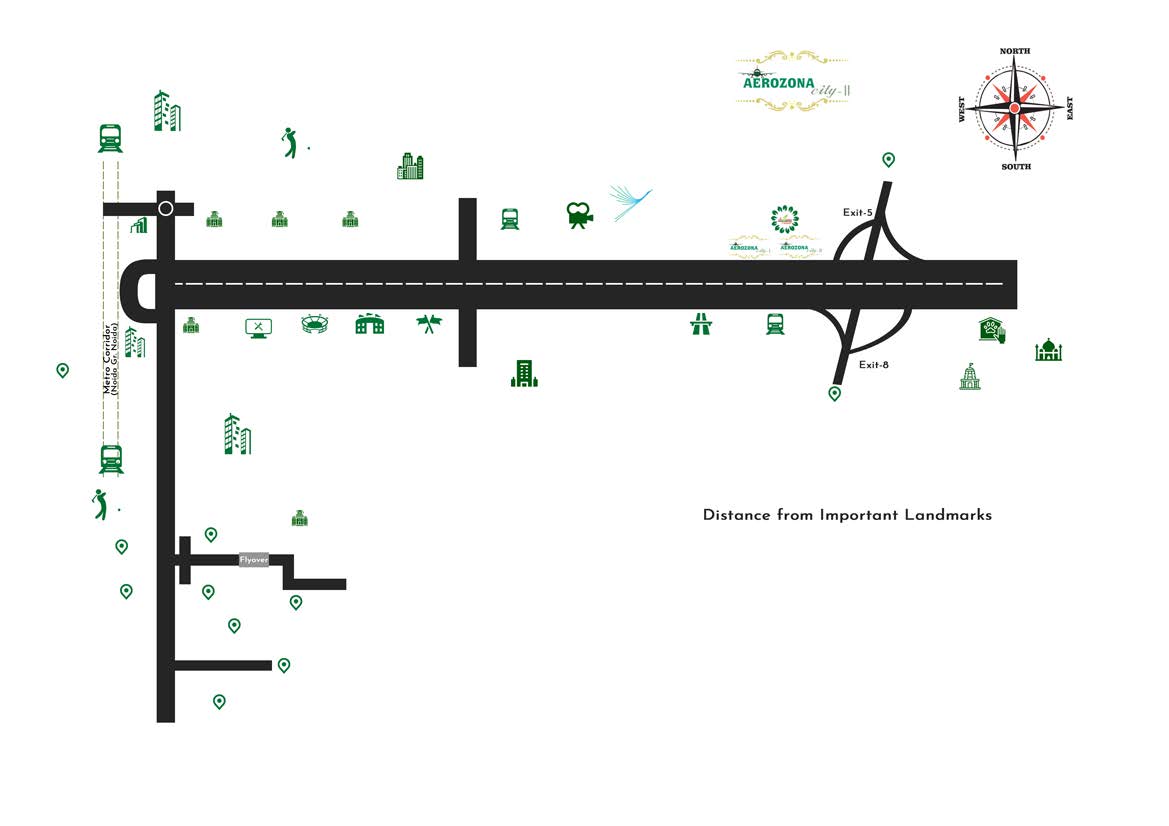 View Location Map