

ISO Certification for Textile Manufacturers Delhi
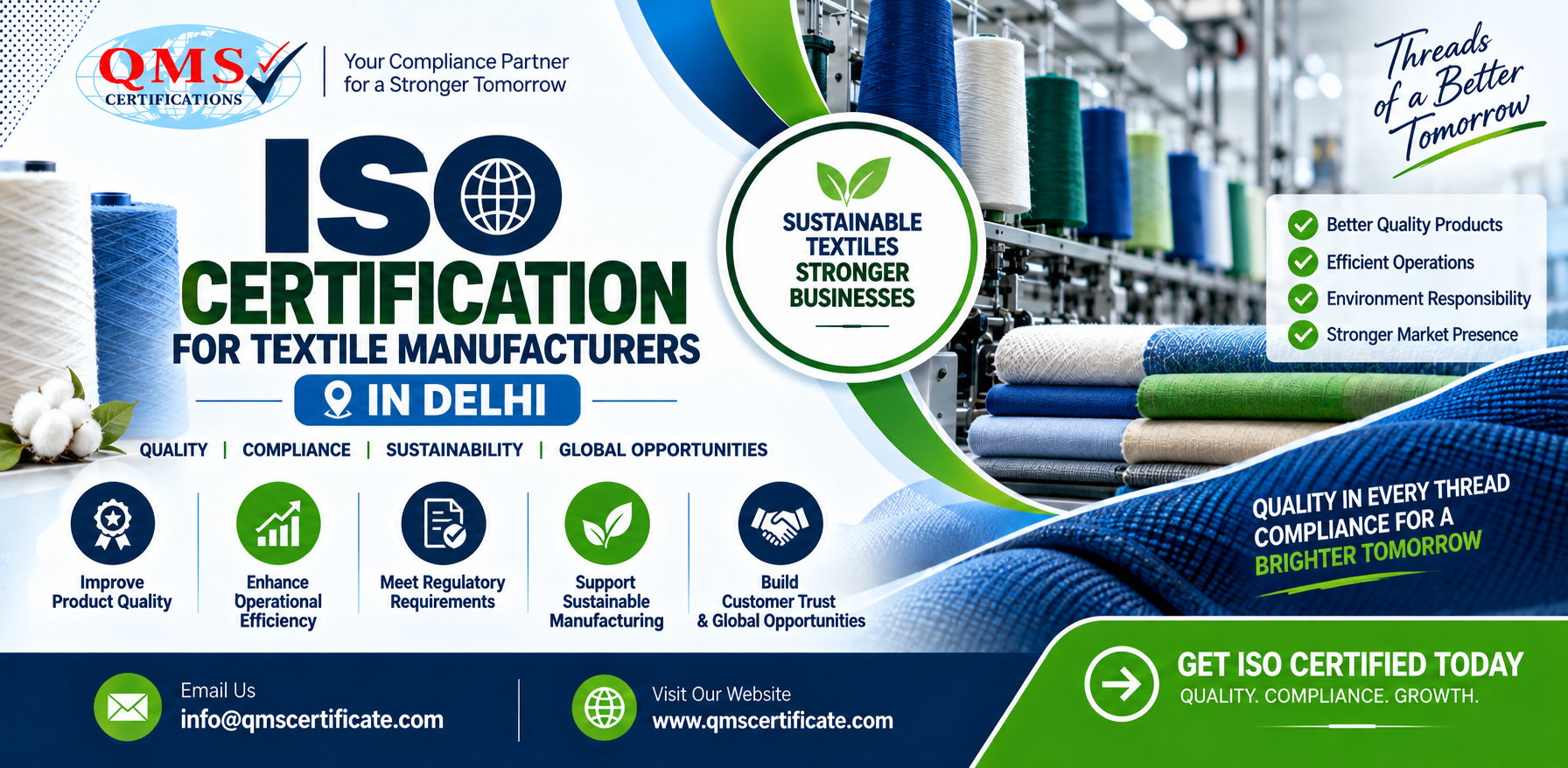
ISO Certification for Textile Manufacturers Delhi
Introduction
The textile industry is one of India's most competitive manufacturing sectors. From spinning and weaving to dyeing, processing, printing, garment manufacturing and finishing, every stage requires consistent process control.
A small variation in fabric quality, colour, GSM, dimensions, stitching, finishing or raw material can result in rejected orders and customer complaints. For manufacturers supplying large brands, exporters or institutional buyers, maintaining consistent quality is especially important.
This is where ISO certification for textile manufacturers in Delhi can provide a structured advantage.
ISO certification helps a textile company establish systematic processes for quality management, environmental performance, workplace safety and continual improvement. ISO 9001 is commonly selected for quality management, while ISO 14001 and ISO 45001 can be relevant for environmental and occupational health and safety management.
QMS Certificate provides ISO certification services in Delhi and supports businesses across manufacturing and other sectors. Its listed services include ISO 9001, ISO 14001, ISO 45001, ISO 22000, ISO 27001 and ISO 13485.
What Is ISO Certification for Textile Manufacturers?
ISO certification is an independent assessment of an organization's management system against the requirements of a particular ISO standard.
For a textile manufacturer, the management system may cover processes such as:
- Raw material procurement and inspection
- Yarn, fabric or fibre quality control
- Production planning
- Weaving, knitting or spinning
- Dyeing and processing
- Printing and finishing
- Garment manufacturing
- Product inspection
- Supplier evaluation
- Machinery maintenance
- Calibration, where applicable
- Employee training
- Customer complaint handling
- Non-conforming product control
- Corrective action
- Internal audits
- Management review
For example, a textile manufacturer in Delhi supplying fabric to a garment exporter may need to maintain consistent colour, composition, GSM and finishing specifications. A structured quality management system can help define how these requirements are received, controlled, inspected and reviewed.
The objective should not be to create paperwork simply for certification. The system should support the way the factory actually operates.
Which ISO Standards Are Suitable for Textile Manufacturers?
Different textile businesses have different priorities. The appropriate ISO standard depends on the company's activities, customers, risks and business objectives.
ISO 9001 Certification for Textile Manufacturers
ISO 9001 certification is one of the most relevant management-system certifications for textile manufacturing companies.
It focuses on quality management and provides a framework for controlling processes, understanding customer requirements, monitoring performance and pursuing continual improvement.
It can be particularly useful for textile companies involved in:
- Spinning
- Weaving
- Knitting
- Dyeing
- Textile processing
- Printing
- Fabric manufacturing
- Garment manufacturing
- Home textiles
- Industrial textiles
ISO 14001 Certification
Textile manufacturing can involve significant use of water, energy, dyes, chemicals and other resources.
ISO 14001 certification can help manufacturers establish a systematic environmental management approach. It can support better identification and management of relevant environmental aspects associated with manufacturing operations.
For textile businesses working toward more responsible production practices, environmental management can also become an important part of their long-term business strategy.
ISO 45001 Certification
Textile factories may involve machinery, electrical equipment, cutting operations, material handling, chemicals and other workplace hazards.
ISO 45001 certification provides a framework for managing occupational health and safety risks and improving workplace safety practices.
Integrated Management System
A growing textile company may benefit from combining:
ISO 9001 + ISO 14001 + ISO 45001
An integrated management system can bring quality, environmental and occupational health and safety controls under a coordinated framework.
Why Choose QMS Certificate?
Selecting an ISO certification partner is an important business decision. A good consultant should understand your processes rather than simply provide generic documents.
QMS Certificate describes its approach around consultation, documentation/policy preparation and certification. Its Delhi service also highlights cost-effective solutions, experienced professionals and support through the certification process.
Why textile businesses can choose QMS Certificate:
Industry-oriented guidance:
Your manufacturing activities and certification scope can be reviewed before selecting the appropriate ISO standard.
Documentation assistance:
Relevant policies, procedures and records can be prepared according to the organization's requirements.
Practical implementation:
The management system should be aligned with existing textile manufacturing activities.
Audit preparation:
Support can help your team understand what to expect during the certification assessment.
End-to-end assistance:
From initial consultation to certification, the process can be managed in a structured way.
QMS Certificate also lists customer satisfaction, cost-effective services, dedicated delivery and ongoing support among its service commitments.
Key Benefits of ISO Certification for Textile Manufacturers
1. Improve Product Quality
Defined production and inspection controls can help textile manufacturers achieve greater consistency between batches.
2. Reduce Defects and Rework
Identifying the causes of defects can help reduce repeated problems, reprocessing and unnecessary material consumption.
3. Strengthen Customer Confidence
ISO certification can demonstrate that the organization has established a formal management system for controlling relevant processes.
4. Better Supplier Management
Textile manufacturers depend on consistent raw materials such as yarn, fibres, dyes, chemicals, accessories and packaging materials. Supplier evaluation can help improve incoming material control.
5. Improve Production Efficiency
Clearly defined responsibilities and monitored processes can help identify bottlenecks and operational inefficiencies.
6. Support Export and B2B Opportunities
Large buyers and international customers may have specific supplier requirements. A recognized management system can strengthen a manufacturer's professional profile where certification is requested.
7. Support Sustainable Manufacturing
For businesses pursuing environmental improvement, ISO 14001 can provide a structured framework for managing relevant environmental aspects.
8. Improve Workplace Safety
ISO 45001 can help organizations take a systematic approach to identifying workplace hazards and controlling occupational health and safety risks.
Step-by-Step ISO Certification Process
Obtaining ISO certification for textile manufacturers in Delhi becomes easier when the company follows a structured process.
Step 1: Initial Consultation
The first step is to understand the company's products, manufacturing activities, number of employees, locations and business objectives.
This helps determine the appropriate ISO standard and certification scope.
Step 2: Gap Analysis
Existing practices are compared with the requirements of the selected ISO standard.
The purpose is to identify areas that need improvement before the certification audit.
Step 3: Documentation Preparation
Relevant policies, procedures, objectives, process controls and records are developed according to the company's operations.
Documentation should be practical and understandable for employees.
Step 4: Implementation
The management system is implemented throughout the relevant departments.
Employees should understand their responsibilities and follow the established processes.
Step 5: Internal Audit
An internal audit evaluates whether the management system is being implemented effectively.
Any identified non-conformities or weaknesses can then be addressed.
Step 6: Management Review
Management reviews the performance of the system, including objectives, customer feedback, audit findings, process performance and improvement opportunities.
Step 7: Certification Audit
An independent certification body conducts the certification assessment.
If the management system meets the applicable requirements, certification can be issued according to the certification body's procedures.
Documents Required for ISO Certification
The exact documents depend on the selected ISO standard, certification scope and complexity of the textile business.
Commonly required information may include:
- Business registration documents
- Company profile
- Certification scope
- Organization structure
- Relevant ISO policy
- Quality or environmental objectives
- Process information
- Supplier evaluation records
- Purchase records
- Incoming material inspection records
- Production records
- Product inspection reports
- Maintenance records
- Calibration records, where applicable
- Training and competency records
- Customer complaint records
- Non-conformity records
- Corrective-action records
- Internal audit records
- Management review records
- Applicable statutory and regulatory information
QMS Certificate's website lists basic business information such as registration proof, letterhead or visiting card, invoice details and business description among its document requirements.
ISO Certification for Different Textile Businesses
The certification scope can be tailored according to the actual business activity.
It may be relevant to:
- Textile mills
- Spinning mills
- Weaving units
- Knitting manufacturers
- Dyeing units
- Textile processing companies
- Fabric manufacturers
- Garment manufacturers
- Home textile manufacturers
- Technical textile companies
- Textile printing businesses
- Textile exporters
This is important because a textile manufacturer producing finished garments may have different process controls from a company specializing in yarn or fabric production.
Internal Linking Suggestions for QMS Certificate
For stronger topical SEO and better user navigation, add contextual internal links to relevant QMS Certificate pages:
- ISO Certification in Delhi —
/iso-certification-in-delhi - ISO 9001 Certification
- ISO 14001 Certification —
/iso-14001-2015.php - ISO 45001 Certification
- ISO Certification Cost in Delhi
- ISO Consultant in Delhi
- Contact QMS Certificate
The website currently has a dedicated Delhi ISO certification page covering ISO 9001, ISO 14001, ISO 45001 and other management-system standards.
External Authority Reference
For authoritative information about ISO standards, the article should reference the official International Organization for Standardization (ISO) website.
When discussing ISO 9001, use the official ISO source rather than relying solely on commercial certification websites. This strengthens the article's E-E-A-T signals and gives readers access to the standard owner's information.
Frequently Asked Questions
1. What is ISO certification for textile manufacturers in Delhi?
ISO certification for textile manufacturers in Delhi is an independent assessment of a textile company's management system against the requirements of an applicable ISO standard. ISO 9001 is commonly used for quality management, while ISO 14001 and ISO 45001 focus on environmental and occupational health and safety management.
2. Which ISO certification is best for textile manufacturers?
ISO 9001 certification is generally a strong starting point for textile manufacturers seeking better quality and process control. Companies with environmental or workplace safety objectives may also consider ISO 14001 and ISO 45001.
3. Is ISO certification mandatory for textile manufacturers in Delhi?
ISO certification is not universally mandatory for every textile manufacturer. However, particular customers, tenders, contracts or market requirements may request certification. Businesses should verify the requirements applicable to their specific products and customers.
4. How long does ISO certification take for a textile manufacturing company?
The timeline depends on factors such as company size, number of employees, certification scope, existing processes and management-system readiness. A company with established processes and organized records may be able to complete preparation more efficiently.
5. Can a small textile manufacturer obtain ISO certification?
Yes. ISO management systems can be implemented by organizations of different sizes. The system should be appropriate to the company's operations and complexity rather than unnecessarily complicated.
Conclusion
In textile manufacturing, consistent quality is directly connected to customer satisfaction, production efficiency and business reputation.
ISO certification for textile manufacturers in Delhi can help businesses establish more controlled processes, improve quality management, strengthen supplier controls and create a culture of continual improvement.
Whether you operate a spinning mill, weaving unit, dyeing facility, textile processing plant, garment factory or technical textile business, choosing the right ISO standard can help turn quality management into a practical business advantage.
The goal should not simply be to obtain a certificate. The real value comes from implementing processes that employees can follow, managers can measure and the business can continually improve.
Ready to Start Your ISO Certification?
Let QMS Certificate help you understand the appropriate ISO standard, certification scope, documentation requirements and next steps for your textile manufacturing business.
📧 Email: info@qmscertificate.com
🌐 Website: www.qmscertificate.com
Contact QMS Certificate today to discuss ISO certification for your textile manufacturing company in Delhi and take the next step toward stronger quality, compliance and business credibility.
Having any Query? Talk to our Experts
Our Projects are fully tested, background checked, license validated and insured
with a 100% satisfaction guarantee.
Contact Info
 qmscertify@gmail.com
 View Location Map