

ISO Certification for Steel Manufacturers Delhi
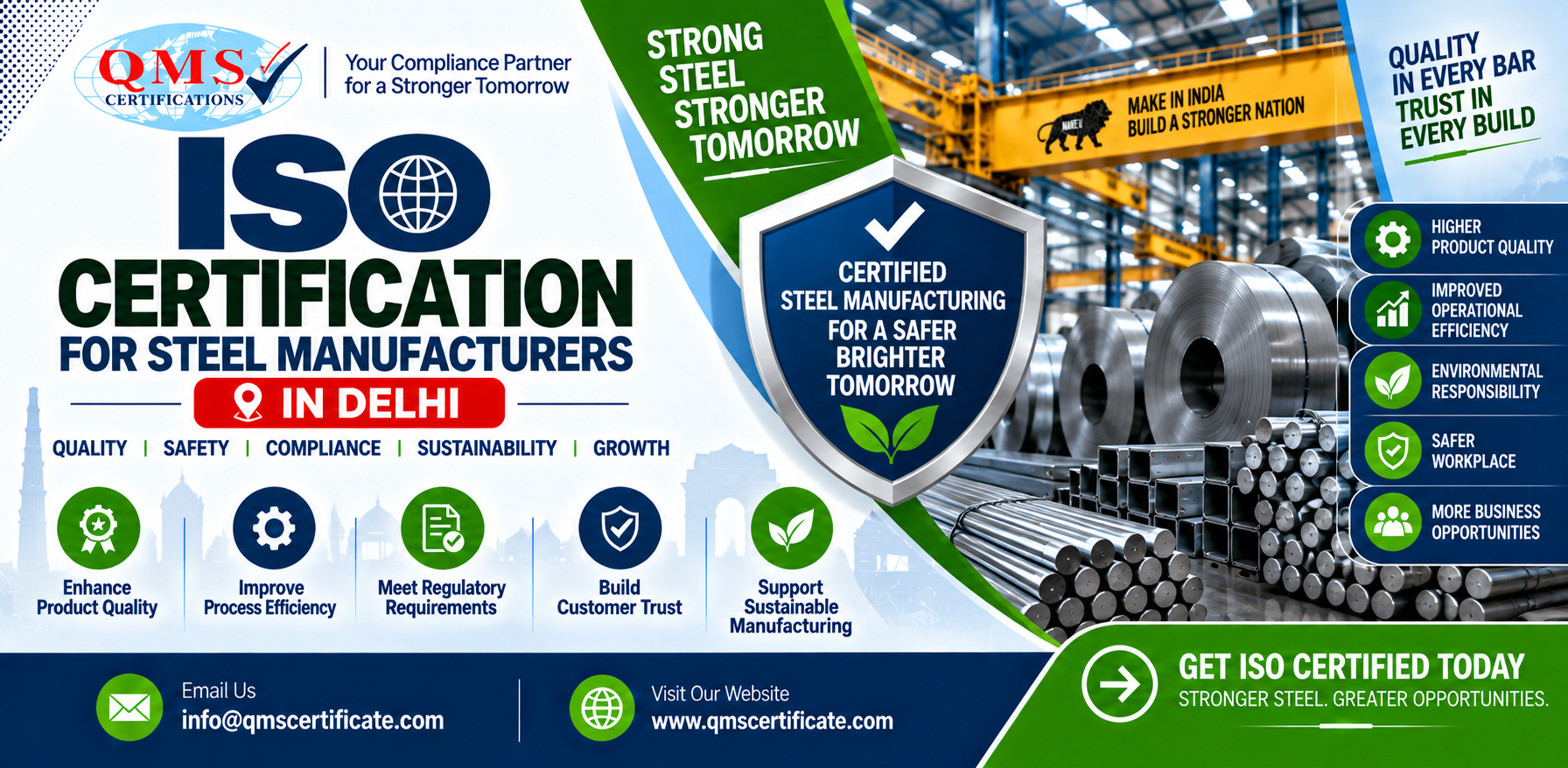
ISO Certification for Steel Manufacturers Delhi
Introduction
Steel manufacturing is an industry where quality, consistency, traceability and process control directly influence customer satisfaction. From raw material selection and melting to rolling, forming, finishing and final inspection, every stage needs reliable controls.
For steel manufacturers operating in Delhi and the NCR, these expectations become even more important when supplying construction companies, infrastructure projects, automotive businesses, engineering firms, fabricators and industrial buyers.
This makes ISO Certification for Steel Manufacturers in Delhi a valuable consideration for businesses that want to strengthen their management systems and demonstrate a structured approach to quality.
ISO 9001 is the internationally recognized quality management system standard. It provides a framework for establishing, implementing, maintaining and continually improving a quality management system. ISO states that the standard applies to organizations of all sizes and sectors.
For a steel manufacturer, ISO certification should not be treated as paperwork alone. The real value comes from applying systematic controls to purchasing, production, inspection, maintenance, customer requirements and continual improvement.
What Is ISO Certification for Steel Manufacturers?
ISO certification is an independent assessment of an organization's management system against the requirements of a selected ISO standard.
For a steel manufacturing business, the management system may cover activities such as:
- Raw material procurement
- Supplier selection and evaluation
- Incoming material inspection
- Production planning
- Melting and processing
- Rolling and forming
- Heat treatment, where applicable
- Cutting and finishing
- Product inspection and testing
- Equipment maintenance
- Calibration
- Material identification and traceability
- Employee training
- Customer complaint management
- Non-conformity control
- Corrective action
- Internal audits
- Management review
The precise requirements depend on the selected standard and the company's certification scope.
It is also important to understand that ISO does not directly issue certificates to companies. Certification is performed by independent certification bodies. ISO explains that certification can provide stakeholders with confidence that an organization's management system conforms to the applicable requirements.
Which ISO Standards Are Suitable for Steel Manufacturers?
ISO 9001 – Quality Management System
For many steel manufacturers, ISO 9001 certification is the primary quality-management standard to consider.
It can help establish consistent controls for customer requirements, purchasing, production, inspection, testing, complaints and corrective actions.
For example, a steel manufacturer supplying structural sections to an infrastructure contractor can use a quality management system to establish clearer controls over material specifications, production processes, inspection records and customer requirements.
ISO 14001 – Environmental Management System
Steel manufacturing can have significant environmental considerations, including energy consumption, emissions, waste, scrap, water usage and material handling.
ISO 14001 provides a systematic framework for identifying environmental aspects and improving environmental performance.
ISO 45001 – Occupational Health & Safety
Steel plants involve activities such as high-temperature operations, heavy material handling, machinery, welding and maintenance.
ISO 45001 provides a structured approach to identifying workplace hazards and managing occupational health and safety risks.
Integrated Management System
A manufacturer may choose to combine ISO 9001, ISO 14001 and ISO 45001 into an integrated management system where appropriate. This can make quality, environmental and safety processes more coordinated.
Why Choose QMS Certificate?
For a manufacturing company, certification support should be practical and aligned with actual production activities.
QMS Certificate provides ISO certification support in Delhi and helps businesses understand applicable requirements, prepare documentation and get ready for certification assessment. Its Delhi service information highlights consultation, policy/document preparation and certification support. QMS Certificate – ISO Certification in Delhi
Our approach focuses on:
- Understanding your steel manufacturing activities
- Defining the appropriate certification scope
- Reviewing existing processes
- Identifying management-system gaps
- Supporting required documentation
- Organizing relevant records
- Preparing employees for the audit
- Supporting corrective-action activities
- Guiding the organization through the certification process
The objective is to make ISO implementation useful to your business instead of creating unnecessary administrative work.
Key Benefits of ISO Certification for Steel Manufacturers
1. Improve Steel Product Quality
Steel customers expect products to meet defined specifications consistently. A structured quality system can strengthen process controls and inspection practices.
2. Reduce Defects and Rework
When non-conformities are recorded, investigated and corrected systematically, manufacturers can address recurring problems at their source.
3. Strengthen Raw Material Control
The quality of incoming materials can influence the finished product. Supplier evaluation, purchasing controls and incoming inspection can provide better control over material quality.
4. Improve Production Process Control
Clearly defined procedures can help coordinate activities between production, quality, stores, maintenance, purchasing and dispatch departments.
5. Enhance Traceability
For many steel products, being able to connect materials and production information with inspection or testing records can improve operational control and customer confidence.
6. Build Customer Trust
ISO certification can demonstrate that a company follows a recognized management-system framework. This can strengthen credibility with OEMs, infrastructure companies, engineering firms and other B2B buyers.
7. Support Tenders and Business Opportunities
Some customers and procurement processes may specify ISO certification as part of their supplier requirements. Appropriate certification can therefore support a manufacturer's commercial credentials.
8. Encourage Continual Improvement
Internal audits, performance reviews, customer feedback and corrective actions give management a structured way to identify opportunities for improvement.
ISO identifies customer confidence, process improvement, complaint resolution, productivity and continual optimization among the potential benefits of ISO 9001.
Step-by-Step ISO Certification Process
Obtaining ISO Certification for Steel Manufacturers in Delhi can be managed through a structured process.
Step 1: Initial Consultation
The process begins with understanding your company, manufacturing activities, products, locations and intended certification scope.
Step 2: Gap Assessment
Existing practices are compared with the applicable ISO requirements. This helps identify gaps before the certification assessment.
Step 3: Documentation
Relevant policies, objectives, procedures, process controls, forms and records are prepared or refined according to actual operations.
Step 4: Implementation
The management system is put into practice. Employees understand their responsibilities and appropriate records are maintained.
Step 5: Internal Audit
An internal audit checks whether the management system is being implemented effectively and identifies areas requiring corrective action.
Step 6: Management Review
Top management evaluates system performance, customer feedback, objectives, audit results, risks and improvement opportunities.
Step 7: Certification Audit
An independent certification body assesses the management system against the applicable ISO standard. Where conformity is demonstrated, certification proceeds according to the certification body's process.
Documents Required for ISO Certification
The exact documentation depends on the selected standard, certification scope and complexity of the steel manufacturing operation.
Common documents and records may include:
- Business registration proof
- Company profile
- Defined certification scope
- Organization chart
- Quality policy
- Environmental or safety policy, where applicable
- Quality objectives
- Manufacturing process information
- Supplier evaluation records
- Purchase records
- Raw material inspection records
- Production records
- Inspection and testing reports
- Equipment maintenance records
- Calibration records, where applicable
- Employee training records
- Customer complaint records
- Non-conformity reports
- Corrective-action records
- Internal audit records
- Management review records
- Applicable legal and regulatory information
The important point is not to create documents simply for the audit. Records should reflect the way the organization actually operates.
Which Steel Businesses Can Benefit from ISO Certification?
ISO Certification for Steel Manufacturers in Delhi can be relevant to a wide range of businesses, including:
- Steel manufacturing companies
- Steel rolling mills
- Steel pipe manufacturers
- Steel tube manufacturers
- Structural steel manufacturers
- Steel sheet manufacturers
- Steel coil manufacturers
- Steel bar and rod manufacturers
- Stainless steel manufacturers
- Alloy steel manufacturers
- Steel fabrication companies
- Steel component manufacturers
- Engineering steel product manufacturers
The certification scope should accurately describe the organization's products, processes and locations.
Internal Linking Suggestions
For stronger topical SEO and improved user navigation, this article can link naturally to relevant QMS Certificate pages:
- ISO Certification in Delhi: https://www.qmscertificate.com/iso-certification-in-delhi
- ISO 9001 Certification: https://www.qmscertificate.com/iso-9001-2015
- ISO 14001 Certification: https://www.qmscertificate.com/iso-14001-2015.php
- ISO 45001 Certification
- ISO Certification Cost in Delhi
- ISO Consultant in Delhi
- Contact/ISO Certification enquiry page
Use contextual anchors such as “ISO 9001 certification in Delhi”, “ISO certification for manufacturing companies” and “ISO consultant in Delhi.”
External Authority Reference
For authoritative information about ISO 9001 requirements, certification and its benefits, use the official ISO resource:
ISO 9001 – Quality Management Systems
2026 update: ISO currently lists ISO 9001:2026 as under publication and says it is expected to replace ISO 9001:2015 in September 2026. Organizations certified to ISO 9001:2015 should confirm transition requirements with their certification body.
Frequently Asked Questions
1. What is ISO Certification for Steel Manufacturers in Delhi?
ISO Certification for Steel Manufacturers in Delhi is independent certification of a steel manufacturer's management system against the requirements of a selected ISO standard, such as ISO 9001.
2. Which ISO certification is best for steel manufacturers?
ISO 9001 is commonly used for quality management. Depending on the organization's objectives, ISO 14001 can address environmental management and ISO 45001 can address occupational health and safety.
3. Is ISO 9001 certification mandatory for steel manufacturers?
ISO 9001 certification is generally voluntary. However, individual customers, contracts, tenders or supplier-approval processes may require ISO certification.
4. What documents are required for ISO certification for steel manufacturers?
Typical documentation includes business registration details, company information, certification scope, policies, manufacturing processes, supplier records, inspection records, maintenance records, training records, internal audits and corrective-action records.
5. How long does ISO certification take for a steel manufacturing company?
The timeframe depends on factors such as company size, certification scope, existing management practices, documentation and audit readiness. A certification provider should assess the organization before giving a realistic timeline rather than promising the same timeframe to every manufacturer.
Conclusion
In steel manufacturing, consistent quality starts long before the finished product reaches the customer. Raw material control, production discipline, inspection, competent employees, supplier performance and corrective action all contribute to reliable results.
A well-implemented ISO management system can bring these activities together under a structured framework. It can help manufacturers improve process control, strengthen customer confidence and create a culture of continual improvement.
If you are searching for ISO Certification for Steel Manufacturers in Delhi, QMS Certificate can help you understand the applicable requirements and prepare your organization for the certification journey.
Get Started With QMS Certificate
📧 Email: info@qmscertificate.com
🌐 Website: www.qmscertificate.com
Contact QMS Certificate today to discuss your steel manufacturing operations and find the right ISO certification approach for your business.
Having any Query? Talk to our Experts
Our Projects are fully tested, background checked, license validated and insured
with a 100% satisfaction guarantee.
Contact Info
 qmscertify@gmail.com
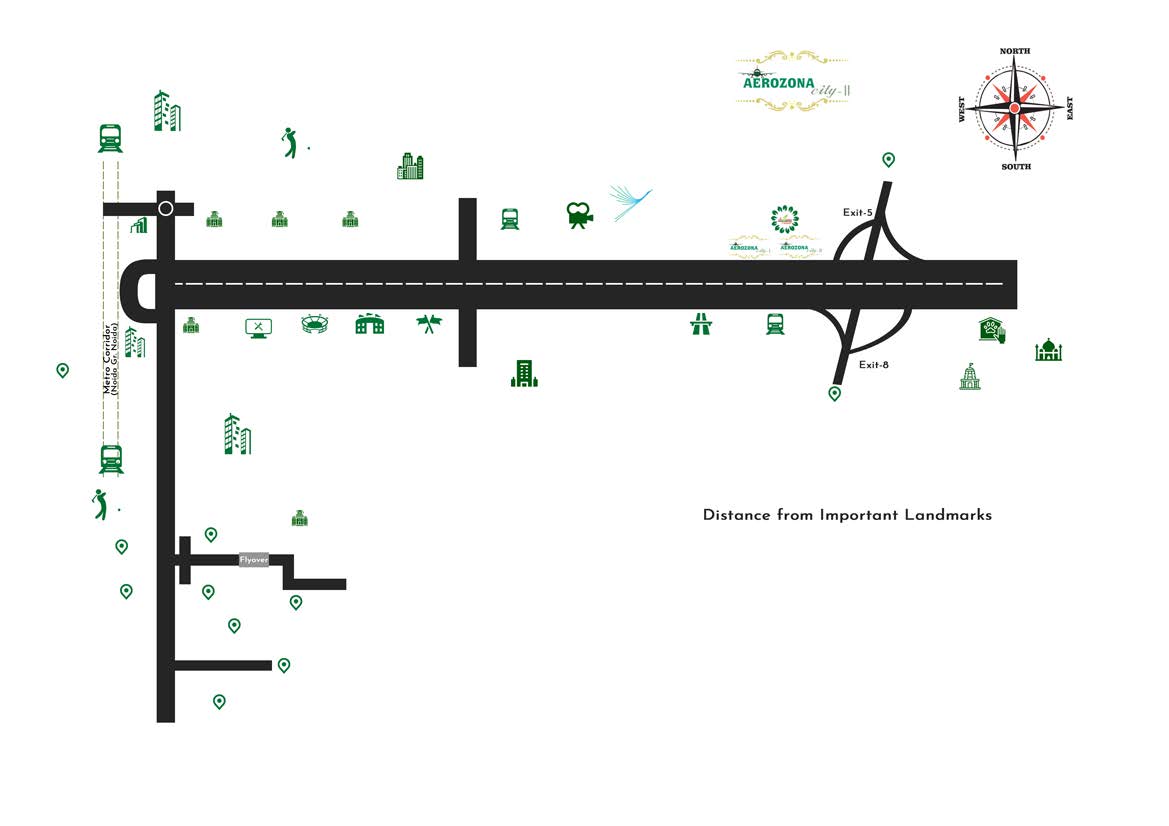 View Location Map