

ISO Certification for Medical Device Manufacturers
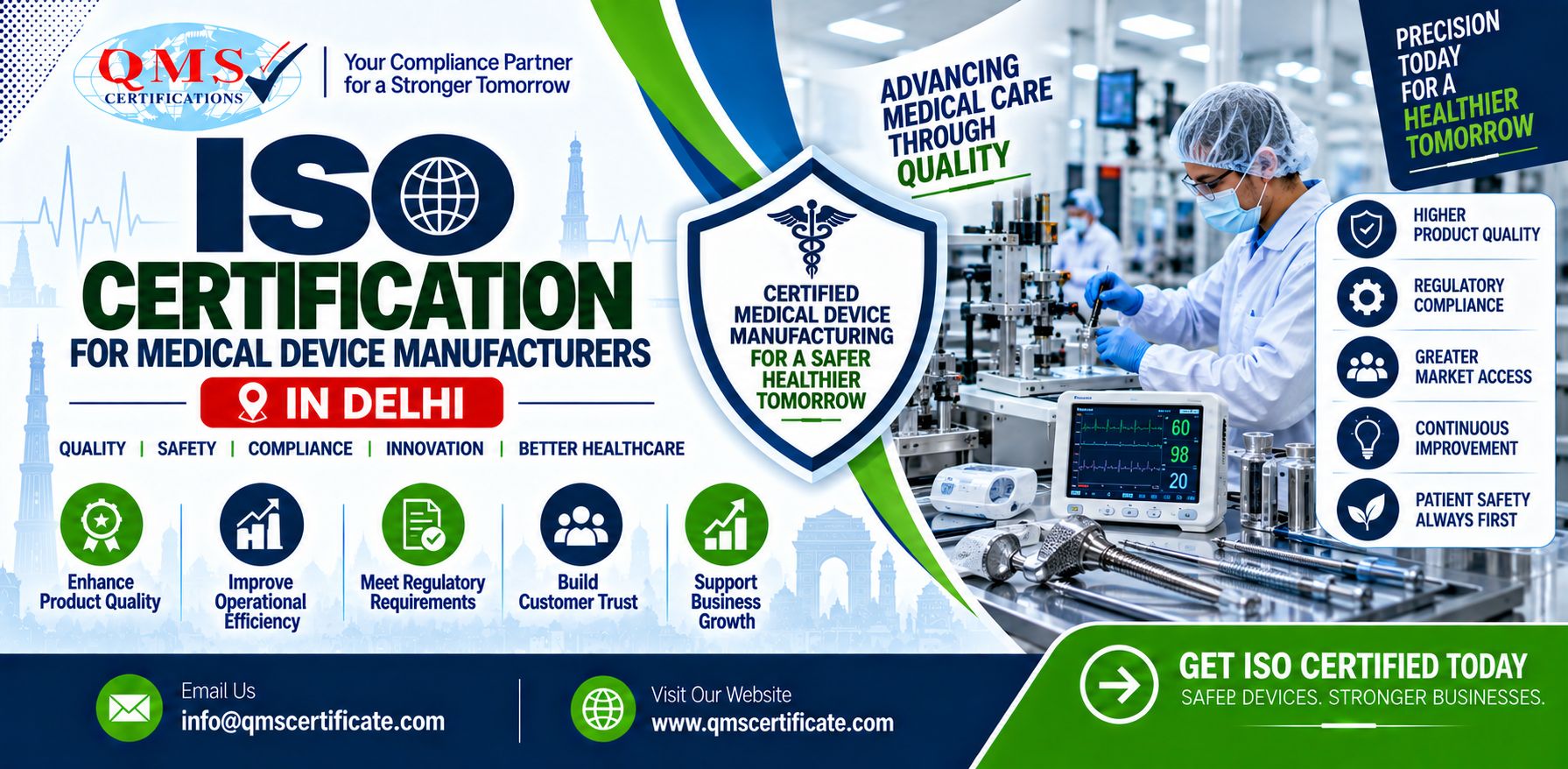
ISO Certification for Medical Device Manufacturers
Introduction
Medical device manufacturing is an industry where quality, safety, traceability, and regulatory compliance cannot be treated as optional priorities.
A manufacturer may produce surgical instruments, diagnostic equipment, implants, hospital equipment, medical disposables, monitoring devices, or other healthcare products. In every case, customers and regulators expect controlled processes and reliable product quality.
This is why ISO certification for medical device manufacturers in Delhi can be an important part of building a strong quality management system.
The standard most closely associated with the medical device industry is ISO 13485:2016 – Medical devices — Quality management systems — Requirements for regulatory purposes. ISO describes it as an internationally recognized QMS standard specifically designed for organizations involved in the medical device sector.
For example, consider a Delhi manufacturer producing disposable medical components. Controlling raw materials alone is not enough. The company also needs appropriate procedures for production, inspection, equipment maintenance, supplier management, complaints, traceability, documentation, and corrective actions.
A properly implemented QMS brings these activities together in a controlled framework.
What Is ISO 13485 Certification for Medical Device Manufacturers?
ISO 13485 certification demonstrates that an organization's quality management system has been independently assessed against the requirements of ISO 13485.
The standard is specifically intended for organizations involved in areas such as:
- Design and development of medical devices
- Manufacturing and production
- Installation
- Servicing
- Related medical device activities
- Suppliers and service providers supporting medical device organizations
ISO 13485 places particular emphasis on regulatory requirements, risk management, process control, and maintaining product quality throughout relevant stages of the medical device life cycle.
It is important to understand that ISO itself does not certify companies. Certification is performed by independent third-party certification bodies.
ISO certification should also not be confused with statutory medical-device licensing. In India, medical devices are regulated under the applicable regulatory framework administered by authorities including CDSCO. The Medical Devices Rules, 2017 contain specific quality-management requirements for manufacturers.
Why Choose QMS Certificate for Medical Device ISO Certification?
Medical device businesses often have more complex quality requirements than a general manufacturing company. A generic documentation package may not properly reflect the organization's actual processes.
QMS Certificate focuses on helping businesses understand the applicable management-system requirements and prepare their processes for certification.
Our approach can support manufacturers with:
- Understanding the applicable ISO standard
- Defining an appropriate certification scope
- Reviewing existing processes
- Identifying documentation gaps
- Developing required management-system documentation
- Implementation guidance
- Audit preparation
- Corrective-action guidance
- Certification coordination
The goal is not simply to create documents. The objective is to help establish a usable quality management system that fits the company's real operations.
Key Benefits of ISO Certification for Medical Device Manufacturers in Delhi
1. Better Product Quality and Consistency
Medical device manufacturing requires consistency from one batch or production cycle to the next.
ISO 13485 provides a framework for controlling processes so that quality requirements are systematically addressed rather than handled informally.
This can be particularly valuable for manufacturers managing multiple products, suppliers, production stages, or customer specifications.
2. Stronger Regulatory Readiness
Medical device manufacturers operate in a highly regulated environment.
A structured QMS can help organizations organize regulatory requirements, responsibilities, records, process controls, and evidence of conformity.
India's Medical Devices Rules include QMS requirements covering areas such as design and development, manufacturing, packaging, labelling, testing, installation, and servicing, where applicable.
3. Improved Risk Management
Risk-based thinking is an important part of ISO 13485.
Manufacturers can use structured processes to identify and control risks associated with products and processes.
This helps shift quality management from simply reacting to problems toward preventing problems wherever practical.
4. Better Traceability
Traceability can be critical when dealing with medical devices.
Clear records can help organizations understand:
- What was manufactured
- Which materials were used
- Which processes were performed
- Who performed or approved relevant activities
- What inspections were completed
- How nonconformities were handled
5. Greater Customer Confidence
Hospitals, distributors, healthcare organizations, OEM customers, importers, and international buyers often want evidence of a manufacturer's quality commitment.
ISO 13485 certification can strengthen the credibility of a medical device manufacturer during supplier evaluation and business discussions.
6. Support for Market Expansion
A recognized medical-device quality management system can help organizations demonstrate a structured approach to quality and regulatory requirements.
ISO notes that ISO 13485 can support organizations seeking to meet regulatory expectations and facilitate market access.
However, certification should not be presented as a substitute for individual country or product-specific regulatory approvals.
Step-by-Step ISO Certification Process for Medical Device Manufacturers
The exact process depends on the organization, device category, scope, regulatory requirements, and certification body. A typical process includes the following stages.
Step 1: Identify the Applicable Requirements
Start by understanding your products, manufacturing activities, locations, outsourced processes, and applicable regulatory obligations.
ISO 13485 is generally the key QMS standard to evaluate for medical device organizations.
Step 2: Define the Certification Scope
The certification scope should clearly identify the relevant products, processes, activities, and locations covered by the QMS.
A clear scope helps prevent confusion during implementation and certification audits.
Step 3: Conduct a Gap Assessment
Existing systems are compared with applicable ISO 13485 requirements.
The assessment may identify gaps involving documentation, supplier controls, production processes, training, equipment, validation, complaints, risk management, or records.
Step 4: Develop the QMS Documentation
Depending on the organization, documentation may include policies, procedures, work instructions, quality objectives, records, process controls, risk-related documentation, and other required information.
The documentation should match the manufacturer's actual activities.
Step 5: Implement the System
The QMS must move from paper into daily operations.
Employees should understand their responsibilities, follow approved procedures, maintain records, and report problems through defined channels.
Step 6: Internal Audit and Management Review
The organization evaluates whether the system is implemented effectively and identifies areas requiring corrective action.
Internal audits can help uncover weaknesses before the external certification audit.
Step 7: Certification Audit
An independent certification body conducts the relevant assessment of the QMS.
If the applicable requirements are satisfactorily addressed, certification can proceed according to the certification body's process.
Documents Required for ISO 13485 Certification
The exact documents depend on the manufacturer's products, processes, regulatory classification, organization size, and certification scope.
Common documentation may include:
- Company registration and business details
- Organization structure
- Product and process information
- Quality policy
- Quality objectives
- QMS procedures
- Process documentation
- Production and inspection records
- Supplier evaluation records
- Purchasing controls
- Equipment maintenance records
- Calibration records, where applicable
- Training and competency records
- Risk-management documentation
- Design and development records, where applicable
- Validation records, where applicable
- Product traceability records
- Nonconformity records
- Corrective and preventive action records
- Complaint-handling records
- Internal audit records
- Management review records
- Regulatory and applicable statutory documentation
Not every document applies to every manufacturer. The QMS should be designed around the organization's actual activities and applicable requirements.
Which Medical Device Businesses Can Benefit?
ISO 13485 certification can be relevant to a wide range of organizations, including manufacturers of:
- Surgical instruments
- Medical disposables
- Diagnostic equipment
- Laboratory equipment
- Patient monitoring devices
- Hospital equipment
- Dental equipment
- Orthopaedic products
- Medical implants
- Sterile medical devices
- In-vitro diagnostic products
- Medical device components and accessories
- Healthcare equipment and related products
ISO specifically states that ISO 13485 is designed for organizations involved in the design, production, installation, servicing, and related activities associated with medical devices.
ISO 13485 vs ISO 9001 for Medical Device Companies
A common question among Delhi manufacturers is whether they should choose ISO 9001 or ISO 13485.
The main distinction is industry-specific requirements.
ISO 9001 is a general quality management standard applicable across industries. ISO 13485 is specifically designed around medical-device quality and regulatory requirements.
ISO explains that ISO 13485 places greater emphasis on regulatory requirements, risk management, and controls relevant to medical devices.
Therefore, medical device manufacturers should assess their regulatory and customer requirements before selecting the appropriate certification approach.
Internal Linking Suggestions for QMS Certificate
For better topical authority and user navigation, this article can internally link to relevant pages on the QMS Certificate website:
- ISO Certification in Delhi: https://www.qmscertificate.com/iso-certification-in-delhi
- ISO 13485 Certification: https://www.qmscertificate.com/delhi/delhi/iso-13485-certification
- ISO 9001:2015 Certification: https://www.qmscertificate.com/iso-9001-2015
- ISO 14001 Certification: https://www.qmscertificate.com/iso-14001-2015.php
- QMS Certificate Homepage: https://www.qmscertificate.com/
Use descriptive anchor text such as “ISO 13485 certification in Delhi”, “ISO certification in Delhi”, and “ISO 9001 certification” rather than repeatedly using the exact same anchor.
Frequently Asked Questions
1. What is ISO certification for medical device manufacturers in Delhi?
ISO certification for medical device manufacturers in Delhi generally refers to independent certification of a medical device organization's quality management system against an applicable ISO standard. ISO 13485:2016 is the principal ISO QMS standard specifically designed for medical devices.
2. Which ISO standard is used for medical device manufacturers?
ISO 13485:2016 is the key international quality management system standard specifically developed for medical devices. It addresses quality management requirements relevant to regulatory purposes.
3. Is ISO 13485 certification mandatory for medical device manufacturers in India?
ISO 13485 certification itself is not a universal requirement of the ISO standard. However, Indian medical device manufacturers must comply with applicable regulatory requirements, and the relevant Indian regulatory framework contains QMS requirements for medical device manufacturers. The exact obligations depend on the device, classification, activities, and applicable regulations.
4. What documents are needed for ISO 13485 certification?
Documents can include the quality policy, QMS procedures, production records, supplier controls, risk-management records, training records, equipment and calibration records, traceability information, complaints, corrective actions, internal audits, and management reviews, depending on the applicable scope.
5. How can I get ISO 13485 certification in Delhi?
Begin by defining your products and QMS scope, reviewing applicable requirements, conducting a gap assessment, implementing the required system, completing internal review activities, and preparing for an independent certification audit. QMS Certificate can provide guidance throughout this certification preparation process.
Get ISO 13485 Certified with QMS Certificate
For a medical device manufacturer, quality management is directly connected to product reliability, regulatory confidence, customer trust, and patient safety.
If your organization is planning ISO certification for medical device manufacturers in Delhi, QMS Certificate can help you understand the applicable requirements and prepare a practical management system around your business operations.
Start Your Certification Journey
📧 Email: info@qmscertificate.com
🌐 Website: www.qmscertificate.com
Contact QMS Certificate today to discuss your medical device QMS and ISO 13485 certification requirements.
Conclusion
Medical device manufacturers cannot afford inconsistent processes or weak quality controls. From supplier management and production to traceability, risk management, complaints, and corrective actions, every part of the quality system matters.
ISO 13485:2016 provides a specialized framework for medical device organizations seeking to establish and maintain a quality management system aligned with regulatory and customer expectations.
For Delhi-based manufacturers, certification can be a valuable step toward stronger process control, improved customer confidence, better regulatory readiness, and broader business opportunities.
Having any Query? Talk to our Experts
Our Projects are fully tested, background checked, license validated and insured
with a 100% satisfaction guarantee.
Contact Info
 qmscertify@gmail.com
 View Location Map