

ISO Certification for Machinery Manufacturers Delhi
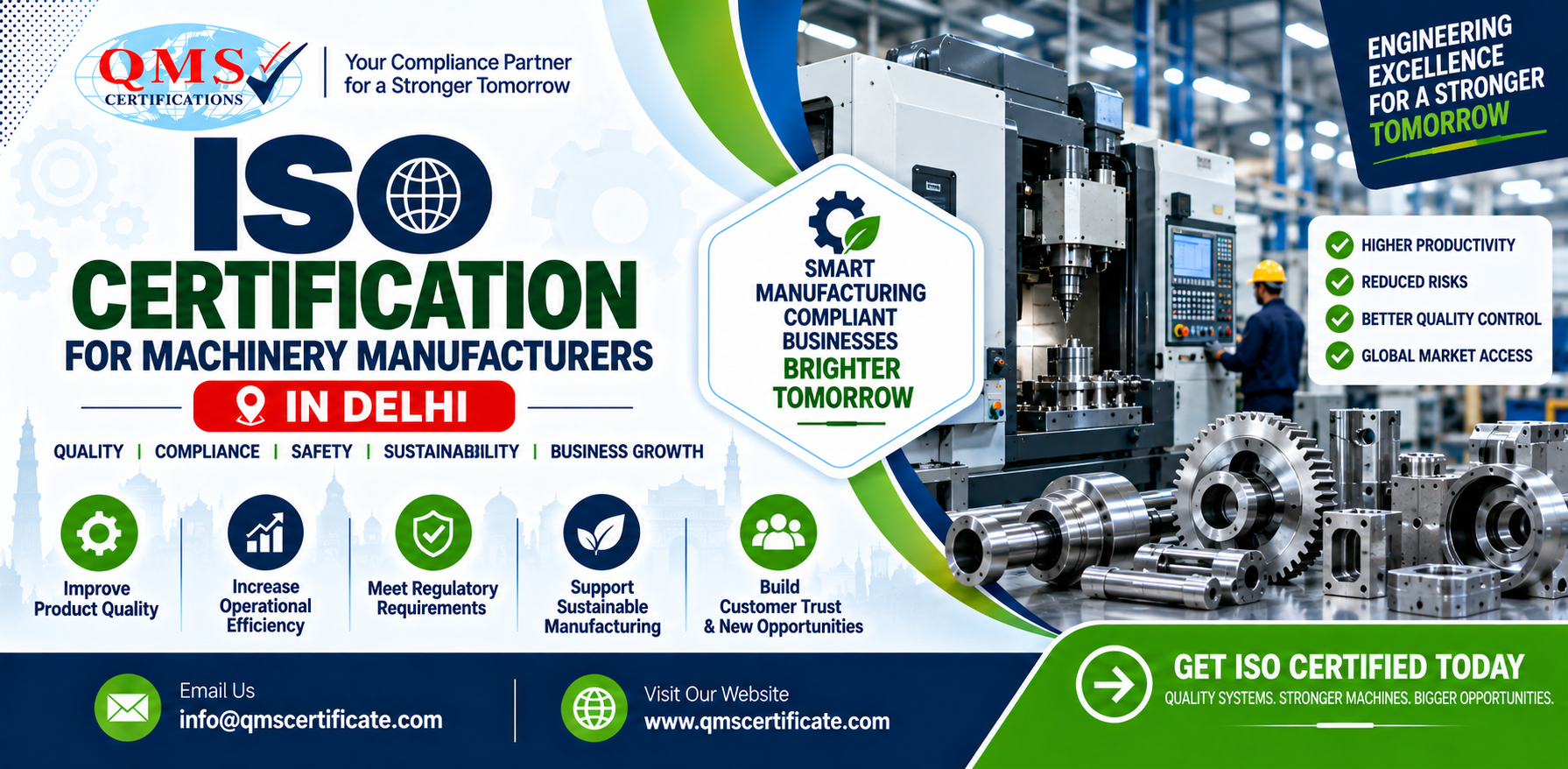
ISO Certification for Machinery Manufacturers Delhi
Introduction
Machinery manufacturers work in an environment where precision, reliability and safety matter every day. A small mistake in design, fabrication, assembly, inspection or testing can lead to equipment failure, customer complaints, production delays and costly rework.
For machinery manufacturers in Delhi and the NCR, having a structured management system can provide an important competitive advantage. This is why ISO Certification for Machinery Manufacturers in Delhi is becoming an important consideration for businesses supplying industrial equipment, engineering products, machines and components.
ISO certification is not simply about displaying a certificate. A properly implemented management system helps an organization control its processes, understand customer requirements, manage suppliers, maintain records, identify risks and continually improve performance.
ISO 9001 is the most widely used quality management standard and applies to organizations of different sizes and sectors. ISO states that its requirements cover areas including leadership, planning, support, operations, performance evaluation and improvement.
At QMS Certificate, the focus is on helping businesses understand these requirements and prepare their management systems around their actual operations.
What Is ISO Certification for Machinery Manufacturers?
ISO certification means that an organization's management system has been independently assessed against the requirements of a particular ISO standard.
For a machinery manufacturer, this may involve evaluating processes such as:
- Customer requirement review
- Product design and development, where applicable
- Production planning
- Raw material purchasing
- Supplier evaluation
- Fabrication and machining
- Assembly
- Inspection and testing
- Equipment maintenance
- Calibration
- Employee training
- Product traceability
- Customer complaints
- Non-conformity handling
- Corrective action
- Internal audits
- Management review
The appropriate ISO standard depends on the organization's activities, risks, customers and objectives.
It is also important to understand that ISO does not directly issue certificates to companies. Certification is performed by independent certification bodies. An accredited certification body can provide an additional level of confidence in the certification process.
Which ISO Standards Are Suitable for Machinery Manufacturers?
ISO 9001 – Quality Management System
For most machinery and engineering manufacturers, ISO 9001 certification is a logical starting point.
It provides a framework for managing quality consistently across business processes. For example, a manufacturer producing CNC machinery can establish controls for customer specifications, procurement, machining, assembly, inspection, testing and final delivery.
ISO 14001 – Environmental Management System
Machinery manufacturing may involve metal scrap, energy consumption, oils, chemicals, packaging waste and other environmental aspects.
ISO 14001 can help organizations systematically identify and manage environmental impacts while improving environmental performance.
ISO 45001 – Occupational Health & Safety
Manufacturing facilities can involve welding, machining, lifting equipment, electrical systems, cutting operations and other workplace hazards.
ISO 45001 provides a structured framework for managing occupational health and safety risks.
Integrated Management System
Some businesses may benefit from combining ISO 9001, ISO 14001 and ISO 45001 into an integrated management system. This can make quality, environmental and safety management more coordinated.
Why Choose QMS Certificate for ISO Certification?
Selecting the right certification support partner can make the process much easier for a growing manufacturing company.
QMS Certificate provides ISO certification support in Delhi and works with businesses across manufacturing and other industrial sectors. Its service approach focuses on consultation, policy/document preparation and certification support.
Our practical approach includes:
- Understanding your manufacturing activities
- Defining the appropriate certification scope
- Identifying relevant ISO requirements
- Supporting documentation preparation
- Helping organize required records
- Preparing employees for audit requirements
- Identifying gaps before certification assessment
- Supporting corrective-action preparation
- Coordinating the certification process
The objective is to create a management system that fits the business rather than burdening employees with unnecessary documentation.
Key Benefits of ISO Certification for Machinery Manufacturers
1. Better Product Quality
Machinery buyers expect consistent performance. A structured quality management system can help control manufacturing processes and reduce avoidable variation.
2. Fewer Defects and Rework
Defined procedures, inspections and corrective-action processes help manufacturers identify the causes of recurring problems instead of repeatedly correcting the same issue.
3. Stronger Production Control
Clear responsibilities and documented processes can improve coordination between design, purchase, stores, production, quality and dispatch teams.
4. Improved Supplier Management
Machinery manufacturers often depend on steel, bearings, motors, electrical components, fasteners and other purchased items. Supplier evaluation and monitoring can help maintain better incoming material control.
5. Better Customer Confidence
ISO certification can demonstrate that the company follows a recognized management-system framework. This can be valuable when dealing with OEMs, industrial buyers, distributors and institutional customers.
6. Support for Tenders and B2B Opportunities
Some customers and procurement processes may request evidence of quality management practices or ISO certification. Having appropriate certification can therefore support business development, although specific tender requirements should always be checked individually.
7. Improved Operational Efficiency
When processes, responsibilities and records are organized properly, manufacturers can identify bottlenecks, reduce duplication and make better decisions using performance information.
8. Continual Improvement
ISO management systems encourage organizations to review performance, investigate problems and implement improvements rather than treating quality as a one-time activity.
ISO identifies customer confidence, process improvement, complaint resolution and continual optimization among the business benefits associated with ISO 9001.
Step-by-Step ISO Certification Process
Getting ISO Certification for Machinery Manufacturers in Delhi can be approached through a clear series of stages.
Step 1: Initial Consultation
The first step is understanding your machinery manufacturing activities, products, locations, workforce and intended certification scope.
Step 2: Gap Assessment
Existing processes are compared with the requirements of the selected ISO standard. This identifies areas that need attention before the certification audit.
Step 3: Documentation
Relevant policies, procedures, objectives, process controls, forms and records are prepared or refined according to the organization's actual activities.
Step 4: Implementation
The documented system is put into practice. Employees understand their responsibilities, processes are followed and appropriate records are maintained.
Step 5: Internal Audit
An internal audit helps identify non-conformities and improvement opportunities before the independent certification assessment.
Step 6: Management Review
Management reviews the performance of the system, including objectives, customer feedback, audit findings, process performance and improvement opportunities.
Step 7: Certification Audit
An independent certification body assesses the management system against the applicable ISO requirements. Where conformity is demonstrated, certification is issued according to the certification body's process.
Documents Required for ISO Certification
The exact documentation depends on the ISO standard, business size, activities and certification scope.
Common information and records may include:
- Business registration documents
- Company profile
- Defined certification scope
- Organization structure
- Quality/environment/health & safety policies, as applicable
- Quality objectives
- Process flow information
- Supplier evaluation records
- Purchase records
- Incoming material inspection records
- Production records
- Inspection and testing records
- Equipment maintenance records
- Calibration records, where applicable
- Employee training records
- Customer complaint records
- Non-conformity records
- Corrective-action records
- Internal audit records
- Management review records
- Applicable legal and regulatory information
QMS Certificate also identifies basic business registration proof, business description and related business information among the initial documentation requirements for its ISO certification services.
Which Machinery Businesses Can Apply for ISO Certification?
ISO management systems can be relevant to a wide range of machinery and engineering businesses, including:
- Industrial machinery manufacturers
- CNC machine manufacturers
- Packaging machinery manufacturers
- Textile machinery manufacturers
- Food processing machinery manufacturers
- Material handling equipment manufacturers
- Agricultural machinery manufacturers
- Construction equipment manufacturers
- Machine tool manufacturers
- Automation equipment manufacturers
- Fabrication and engineering companies
- Industrial equipment manufacturers
- Custom machinery manufacturers
The certification scope should accurately describe the organization's actual activities and locations.
Internal Linking Opportunities
For better topical authority and user navigation, this article can internally link to relevant QMS Certificate pages such as:
- ISO Certification in Delhi: https://www.qmscertificate.com/iso-certification-in-delhi
- ISO 9001 Certification: https://www.qmscertificate.com/iso-9001-2015
- ISO 14001 Certification: https://www.qmscertificate.com/iso-14001-2015.php
- ISO 45001 Certification
- ISO Certification Cost in Delhi
- ISO Consultant in Delhi
- Contact/ISO Certification enquiry page
Use descriptive anchor text such as “ISO 9001 certification in Delhi” rather than repeatedly using generic anchors like “click here.”
External Authority Reference
For authoritative information about ISO 9001 requirements, benefits and the current revision, reference the official International Organization for Standardization page for ISO 9001. Official ISO 9001 information
Current edition note: ISO currently lists ISO 9001:2026 as under publication, with publication scheduled for September 2026, replacing ISO 9001:2015. Organizations should confirm the applicable edition and transition arrangements with their certification body.
Frequently Asked Questions
1. What is ISO Certification for Machinery Manufacturers in Delhi?
ISO Certification for Machinery Manufacturers in Delhi is independent certification of a manufacturer's management system against the requirements of an applicable ISO standard, such as ISO 9001.
2. Which ISO certification is best for machinery manufacturers?
ISO 9001 is commonly suitable for managing quality and operational processes. Depending on business needs, machinery manufacturers may also consider ISO 14001 for environmental management and ISO 45001 for occupational health and safety.
3. Is ISO 9001 mandatory for machinery manufacturers in Delhi?
ISO 9001 certification is generally voluntary. However, individual customers, contracts, tenders or supply-chain arrangements may specify ISO certification as a requirement.
4. What documents are required for ISO certification for machinery manufacturers?
Typical requirements include business registration information, organizational details, certification scope, policies, process information and operational records such as inspection, maintenance, training, internal audit and corrective-action records.
5. How can a machinery manufacturer prepare for an ISO audit?
Start by defining the certification scope, understanding the applicable requirements, reviewing existing processes, preparing necessary documentation, implementing the system, conducting an internal audit and resolving identified gaps.
Conclusion
For machinery manufacturers, quality cannot depend on individual effort alone. It needs to be supported by controlled processes, competent employees, reliable suppliers, effective inspections and continual improvement.
A well-implemented ISO management system can help bring these elements together while strengthening customer confidence and operational discipline.
If you are looking for ISO Certification for Machinery Manufacturers in Delhi, QMS Certificate can help you understand the applicable certification requirements and prepare your organization for the certification journey.
Ready to take the next step?
Email: info@qmscertificate.com
Website: www.qmscertificate.com
Contact QMS Certificate today to discuss your machinery manufacturing business and ISO certification requirements.
Having any Query? Talk to our Experts
Our Projects are fully tested, background checked, license validated and insured
with a 100% satisfaction guarantee.
Contact Info
 qmscertify@gmail.com
 View Location Map