

ISO Certification for Production Companies Delhi
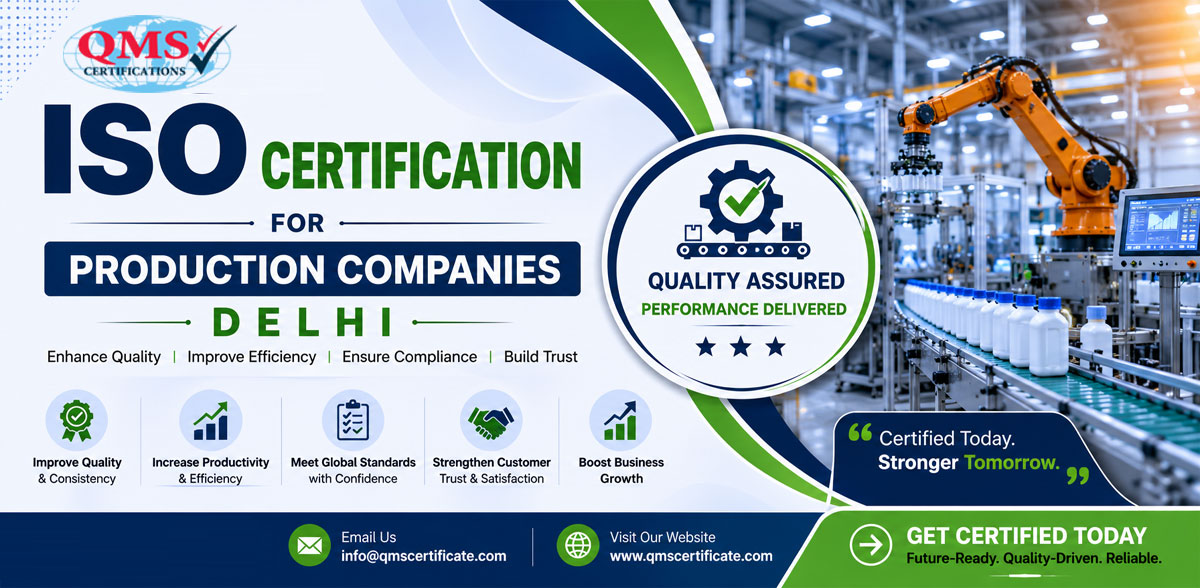
ISO Certification for Production Companies Delhi
Production companies operate around one core requirement: consistent output with controlled quality, cost and delivery. Whether a business manufactures engineering components, electrical products, packaging materials, machinery, plastics, textiles or other industrial products, production problems can quickly lead to rejection, rework, customer complaints and lost business.
This is why ISO Certification for Production Companies Delhi can be an important step for businesses looking to establish stronger processes and demonstrate a structured approach to quality management.
For many production companies, ISO 9001 is the most relevant starting point. It provides a framework for establishing, implementing, maintaining and continually improving a Quality Management System (QMS). ISO 9001 is applicable across sectors and is designed for organizations of different sizes.
Depending on the production environment, companies may also consider ISO 14001 for environmental management or ISO 45001 for occupational health and safety.
What Is ISO Certification for Production Companies?
ISO certification is an independent assessment of a company's management system against the requirements of a selected ISO standard.
For a production company, the management system can cover the complete flow of operations, including:
- Customer requirements
- Production planning
- Raw-material purchasing
- Supplier evaluation
- Incoming material inspection
- Production processes
- Machine and equipment controls
- In-process inspection
- Final product inspection
- Product identification and traceability
- Storage and dispatch
- Customer feedback
- Nonconformity management
- Corrective action
- Internal audits
- Management review
The exact scope depends on the organization's products, processes, locations and business objectives.
A useful QMS does not tell every employee how to perform every task in the same way. Instead, it establishes controlled processes that help the organization consistently meet applicable requirements.
ISO explains that ISO 9001 provides a framework for delivering consistent products and services, improving efficiency and meeting customer and regulatory expectations.
Why ISO Certification Matters for Production Companies in Delhi
Production environments can contain many connected processes. A problem at one stage can affect the entire production cycle.
For example, imagine a Delhi-based manufacturer producing industrial components. If incoming raw material is not checked properly, the problem may not become visible until machining or final inspection. By that stage, production time and material may already have been wasted.
A structured quality management system helps the company identify where controls are required and how problems should be handled.
This can help production companies move from “find the defect at the end” toward “control the process throughout production.”
ISO 9001 identifies benefits including stronger quality control, improved customer satisfaction, process improvement, cost savings and continual improvement.
Key Benefits of ISO Certification for Production Companies
1. Consistent Production Quality
A structured QMS helps establish controlled production and inspection processes.
This is especially useful when multiple employees, shifts or production lines are involved.
2. Better Production Process Control
Defined procedures and responsibilities can help employees understand what needs to be controlled at each stage.
3. Reduced Rework and Rejection
When production problems are documented, analyzed and corrected systematically, companies can work toward preventing recurring defects.
4. Improved Raw-Material Control
Supplier evaluation and incoming inspection can help production companies maintain better control over purchased materials and components.
5. Better Customer Satisfaction
Consistent product quality and reliable delivery can contribute to stronger customer relationships.
ISO 9001 specifically emphasizes customer focus and the ability to consistently meet customer and applicable requirements.
6. Improved Traceability
Production records can help businesses identify what was produced, when it was produced, which materials were used and what inspections were performed, where such traceability is relevant to the business.
7. Stronger Corrective Action
Instead of repeatedly fixing the same problem, companies can investigate causes and implement corrective actions.
8. Support for Business Growth
As production volumes increase, informal systems can become difficult to control.
A management system creates a more structured foundation for managing employees, suppliers, processes and customer requirements.
9. Support for Tenders and Customer Approvals
Some customers, tenders or supply-chain programs may request ISO certification. ISO notes that certification can be useful for supplier approval and procurement situations.
Which ISO Certification Is Suitable for Production Companies?
The appropriate ISO standard depends on what the production company wants to achieve.
ISO 9001 for Production Quality
ISO 9001 certification for production companies is generally relevant when the primary objective is improving quality management and process consistency.
It can address areas such as:
- Production planning
- Process control
- Inspection
- Supplier management
- Customer requirements
- Nonconformities
- Corrective actions
- Continual improvement
ISO 14001 for Environmental Management
Production companies may consider ISO 14001 when their operations involve significant environmental aspects such as waste, resource consumption, emissions or other environmental impacts.
ISO describes ISO 14001 as an environmental management standard used across manufacturing and other sectors.
ISO 45001 for Workplace Safety
Production environments involving machinery, electrical systems, chemicals, material handling or other workplace hazards may consider ISO 45001.
ISO 45001 focuses on occupational health and safety management and can be used by organizations seeking independent confirmation of their OH&S management system.
Integrated Management System
A production company may implement ISO 9001, ISO 14001 and ISO 45001 together when quality, environmental and workplace-safety objectives all form part of its business strategy.
Step-by-Step ISO Certification Process for Production Companies in Delhi
The ISO certification process for production companies in Delhi should reflect the company's actual production activities.
Step 1: Understand the Production Operations
The first stage is to review products, processes, locations, employees, production capacity and customer requirements.
Step 2: Select the Appropriate ISO Standard
Choose the standard that matches the organization's objectives.
For quality-focused production companies, ISO 9001 is often the logical starting point.
Step 3: Define the Certification Scope
The scope should accurately identify the products, production activities, services and locations covered by the management system.
Step 4: Conduct a Gap Assessment
Existing systems are compared with the requirements of the selected ISO standard.
Typical gaps may involve:
- Production procedures
- Quality objectives
- Supplier controls
- Inspection records
- Equipment controls
- Customer requirements
- Nonconformity management
- Internal audits
- Corrective actions
- Management review
Step 5: Develop the Management System
Relevant policies, procedures, process controls, work instructions and records are prepared or improved.
The documentation should match the company's real production processes.
Step 6: Implement the System
The system is put into daily practice.
Employees should understand their responsibilities and maintain relevant records.
Step 7: Conduct an Internal Audit
An internal audit evaluates whether the management system is implemented effectively and identifies areas requiring correction or improvement.
Step 8: Management Review
Management reviews quality performance, customer feedback, audit findings, objectives and improvement opportunities.
Step 9: Certification Audit
An independent certification body assesses the management system against the applicable ISO standard.
It is important to understand that ISO itself does not issue ISO certificates. Certification is carried out by independent certification bodies. ISO recommends evaluating certification bodies and checking accreditation where relevant.
Step 10: Certification and Continual Improvement
After successful completion of the assessment, the certification body issues the certificate.
The production company should continue monitoring and improving its management system after certification.
Documents Required for ISO Certification
Documentation requirements vary according to the selected standard, production activities, company size and certification scope.
Commonly relevant information may include:
- Business registration details
- Company profile
- Production activity details
- Certification scope
- Organization structure
- Quality or relevant management policy
- Quality objectives
- Production process information
- Work instructions
- Supplier evaluation records
- Incoming inspection records
- Production records
- In-process inspection records
- Final inspection records
- Customer feedback
- Nonconformity records
- Corrective-action records
- Internal audit records
- Management review records
Additional documentation may be relevant for environmental or occupational health and safety standards.
The objective should be to create usable management-system information, not unnecessary paperwork.
Why Choose QMS Certificate?
For a production company, the right ISO support should focus on understanding the actual manufacturing workflow rather than simply preparing generic documents.
QMS Certificate provides ISO certification-related services for organizations in Delhi and can support businesses with areas such as:
- ISO standard selection
- Certification scope
- Gap assessment
- Documentation support
- Management-system implementation
- Internal audit preparation
- Certification audit preparation
For production businesses searching for ISO Certification in Delhi, the certification approach should be aligned with the organization's products, processes, workforce and customer expectations.
A production company's QMS should make sense to the people actually working on the production floor.
ISO Certification for Different Production Companies
ISO certification can be relevant to many types of production and manufacturing businesses, including:
- Engineering production companies
- Automobile component manufacturers
- Machinery production companies
- Electrical product manufacturers
- Electronics manufacturers
- Plastic production companies
- Packaging manufacturers
- Metal production companies
- Steel-related industries
- Textile production companies
- Chemical manufacturers
- Pharmaceutical manufacturers
- Food production companies
- Industrial equipment manufacturers
- General manufacturing companies
The certification scope should always reflect the actual activities of the organization.
ISO Certification Cost for Production Companies in Delhi
There is no fixed ISO certification cost for production companies in Delhi.
The total cost can vary depending on:
- Selected ISO standard
- Number of employees
- Number of production locations
- Certification scope
- Production complexity
- Existing management system
- Audit requirements
- Documentation and implementation support
A single-location production unit and a multi-location manufacturer will naturally have different certification requirements.
Therefore, production companies should request a business-specific quotation rather than relying only on a generic advertised price.
Common Mistakes Production Companies Should Avoid
1. Treating ISO as a Certificate-Only Exercise
The management system should be implemented in actual production operations.
2. Using Generic Documents
Copied procedures may not match your machines, products, processes or workforce.
3. Ignoring Production-Floor Employees
Employees involved in production often understand practical process risks better than anyone. Their involvement can make implementation more effective.
4. Focusing Only on Final Inspection
Quality control should be considered throughout the production process.
5. Choosing a Certification Body Without Due Diligence
ISO recommends evaluating certification bodies and considering accreditation as an independent confirmation of competence.
Frequently Asked Questions
1. What is ISO Certification for Production Companies Delhi?
It is independent certification of a production company's management system against the requirements of a selected ISO standard. ISO 9001 is commonly used for quality management, while ISO 14001 and ISO 45001 address environmental and occupational health and safety management.
2. Which ISO certification is best for production companies?
For companies primarily focused on production quality and process consistency, ISO 9001 is generally the most relevant starting point. Production businesses may also consider ISO 14001 or ISO 45001 depending on their environmental and workplace-safety objectives.
3. How can a production company get ISO certification in Delhi?
The company generally selects an appropriate ISO standard, defines its scope, evaluates existing processes, develops and implements the management system, conducts an internal audit and management review, and then undergoes an independent certification assessment.
4. How much does ISO certification cost for production companies in Delhi?
The cost depends on the selected standard, number of employees, production locations, certification scope, process complexity and audit requirements. A customized quotation is therefore more appropriate than a universal price.
5. Is ISO certification mandatory for production companies?
ISO certification itself is generally voluntary. However, specific customers, tenders or contracts may require certification. Businesses should check the exact requirements applicable to each commercial opportunity.
Conclusion
ISO Certification for Production Companies Delhi can help production businesses create stronger quality controls, improve process consistency and build greater confidence among customers and business partners.
The real value of certification comes from implementation. A useful management system can help control suppliers, monitor production, manage inspection, investigate nonconformities and continually improve business processes.
Whether your company manufactures engineering components, machinery, electrical products, plastics, packaging, textiles, metal products or other industrial goods, the right ISO standard can be aligned with your production environment.
If you are planning ISO Certification in Delhi, QMS Certificate can help you understand the applicable standard, certification scope, documentation requirements and preparation process.
Contact QMS Certificate
Email: info@qmscertificate.com
Website: www.qmscertificate.com
Contact QMS Certificate to discuss your production activities and ISO certification requirements.
Having any Query? Talk to our Experts
Our Projects are fully tested, background checked, license validated and insured
with a 100% satisfaction guarantee.
Contact Info
 qmscertify@gmail.com
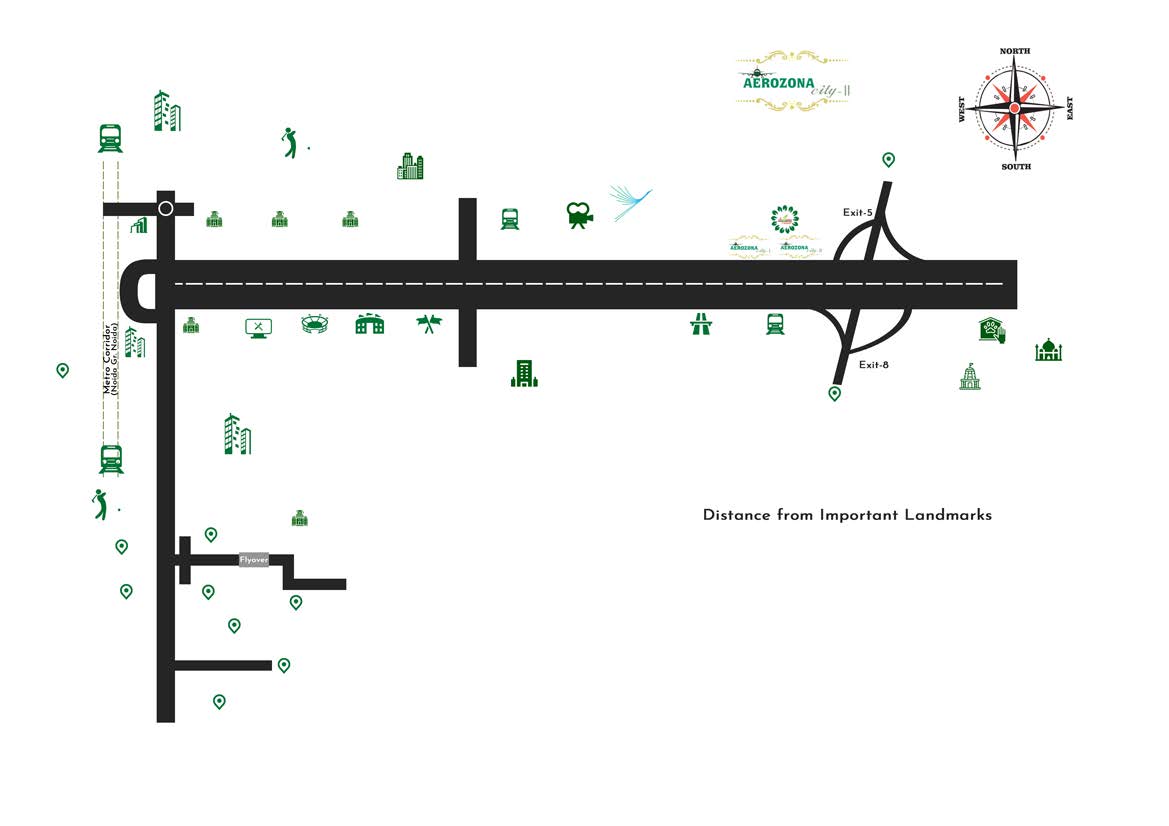 View Location Map