

ISO Certification for Pharmaceutical Manufacturers Delhi
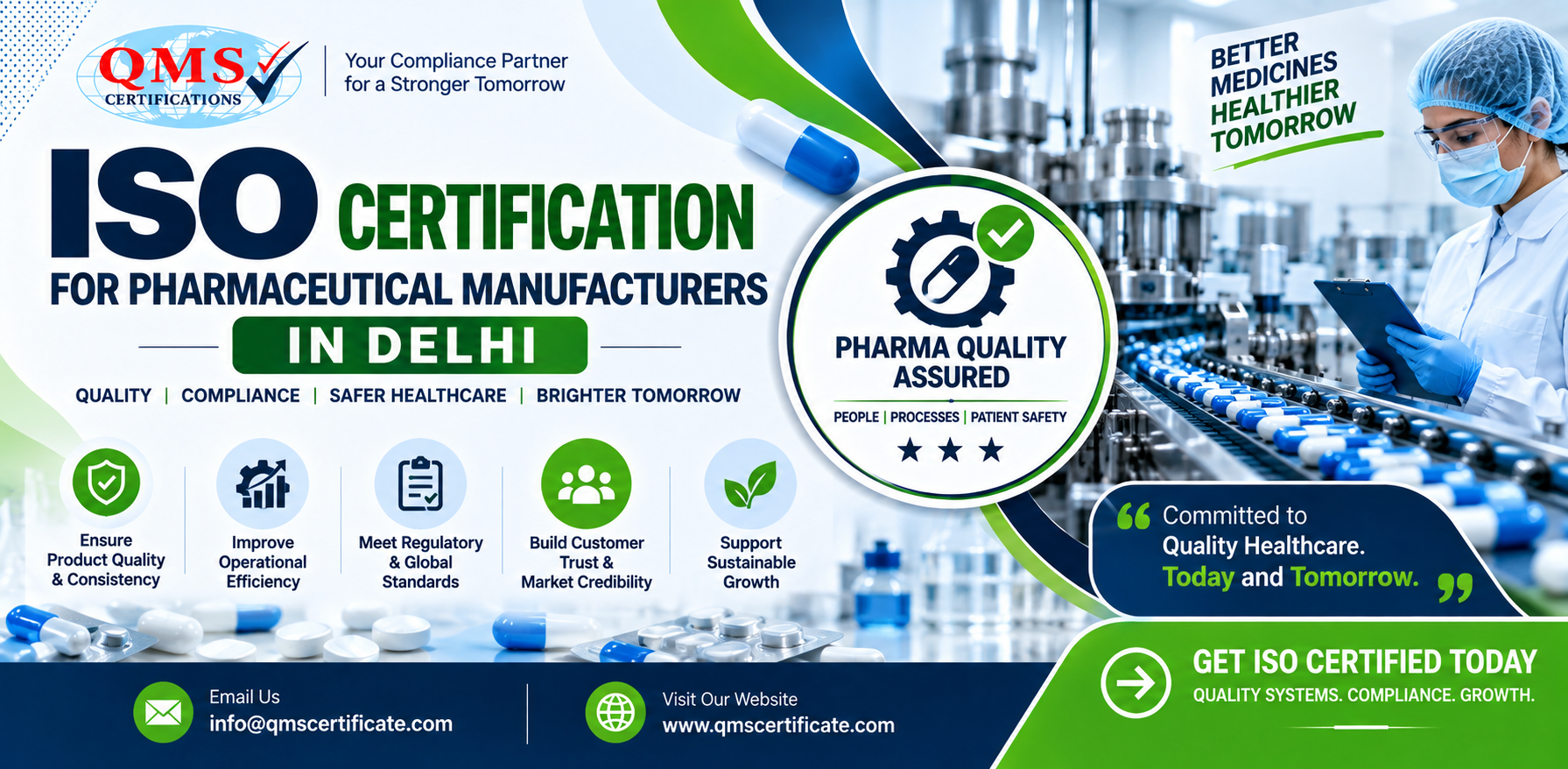
ISO Certification for Pharmaceutical Manufacturers Delhi
Introduction
For a pharmaceutical manufacturer, quality is not simply a business objective—it is part of protecting patients, meeting regulatory expectations, and maintaining market confidence.
Manufacturers in Delhi and the wider NCR region operate in a highly competitive environment. Whether a company produces formulations, APIs, pharmaceutical packaging, laboratory products, or other healthcare-related products, customers and business partners increasingly expect reliable processes and documented quality systems.
This is where ISO certification for pharmaceutical manufacturers in Delhi can add real business value.
ISO certification provides a structured management framework for controlling processes, managing risks, monitoring performance, and continually improving operations. For example, a Delhi-based pharmaceutical manufacturer may already have quality checks in place but struggle with inconsistent documentation, supplier evaluation, corrective actions, or internal audits. A properly implemented management system can bring these activities together in a more systematic way.
ISO 9001 is the internationally recognized quality management standard. ISO explains that it helps organizations establish, implement, maintain, and continually improve a quality management system.
For pharmaceutical businesses, the appropriate ISO standard depends on the company's activities, products, customers, and regulatory requirements.
Why Choose QMS Certificate for Pharmaceutical ISO Certification?
Choosing the right certification support is important because pharmaceutical operations involve more than simply preparing documents.
At QMS Certificate, we focus on understanding your business processes before recommending a certification approach.
Our support can include:
- Understanding your business activities and certification scope
- Identifying applicable ISO standards
- Gap assessment of existing processes
- Documentation and policy guidance
- Quality management system implementation support
- Internal audit preparation
- Corrective-action guidance
- Certification audit preparation
- Support throughout the certification journey
Our approach is designed to make ISO certification practical for pharmaceutical manufacturers rather than turning it into a paperwork exercise.
QMS Certificate also provides ISO certification services in Delhi across different industries and standards.
Key Benefits of ISO Certification for Pharmaceutical Manufacturers in Delhi
1. Improve Product and Process Quality
A structured quality management system helps pharmaceutical manufacturers define, monitor, and improve important processes.
Better process control can help reduce avoidable errors, inconsistencies, rework, and customer complaints.
2. Strengthen Regulatory and Compliance Practices
Pharmaceutical businesses operate under significant regulatory expectations. ISO-based management systems can help organizations organize responsibilities, records, monitoring activities, and compliance processes more effectively.
ISO certification should complement—not replace—applicable pharmaceutical regulations and statutory requirements.
3. Build Customer Confidence
Hospitals, distributors, institutional buyers, exporters, and corporate customers often look for evidence that a supplier follows controlled and repeatable processes.
An appropriate ISO certification can strengthen your company's credibility during supplier evaluation and business discussions.
4. Improve Supplier Management
Pharmaceutical manufacturers depend on reliable suppliers for raw materials, packaging materials, equipment, and other inputs.
A structured system can support supplier evaluation, monitoring, purchasing controls, and performance reviews.
5. Reduce Errors and Operational Waste
When processes are clearly defined and monitored, management can identify recurring problems and address their root causes.
This can contribute to:
- Less rework
- Better resource utilization
- Improved documentation
- More consistent production
- Faster corrective action
6. Support Business Growth and Market Opportunities
Certification can strengthen your company's profile when approaching new customers, institutional buyers, tenders, distributors, and supply-chain partners.
It can also demonstrate that your organization takes quality and continual improvement seriously.
7. Improve Workplace Health and Safety
Pharmaceutical manufacturing may involve chemicals, machinery, controlled environments, laboratories, and other workplace hazards.
ISO 45001 provides a framework for managing occupational health and safety risks, including hazard identification, risk assessment, worker participation, emergency planning, and continual improvement.
Which ISO Standards Are Relevant to Pharmaceutical Manufacturers?
There is no single ISO certificate that automatically covers every pharmaceutical requirement. Your certification scope should be based on your actual operations and business objectives.
ISO 9001 – Quality Management
ISO 9001 is generally the most relevant starting point for organizations seeking a structured quality management system.
It focuses on consistent processes, customer requirements, performance evaluation, risk-based thinking, and continual improvement.
ISO 14001 – Environmental Management
Pharmaceutical manufacturing can involve waste, energy consumption, water use, emissions, and other environmental aspects.
ISO 14001 provides a framework for managing environmental responsibilities and improving environmental performance. The current edition is ISO 14001:2026, which replaced ISO 14001:2015.
ISO 45001 – Occupational Health & Safety
ISO 45001 helps organizations systematically manage workplace health and safety risks and improve OH&S performance.
Depending on your products and operations, other standards or regulatory frameworks may also be relevant.
Step-by-Step ISO Certification Process for Pharmaceutical Manufacturers
Step 1: Understand Your Certification Requirements
First, identify your products, manufacturing activities, locations, employees, processes, and customer requirements.
This helps determine the appropriate certification scope.
Step 2: Conduct a Gap Assessment
Existing systems are reviewed against the selected ISO standard.
The objective is to identify what is already working and where improvements are required.
Step 3: Prepare Documentation
Depending on the standard and business scope, documentation may include policies, procedures, objectives, risk assessments, process controls, records, and monitoring arrangements.
Step 4: Implement the Management System
Documentation alone is not enough.
The procedures need to be applied in actual business operations, with employees understanding their responsibilities.
Step 5: Internal Audit and Management Review
An internal audit helps identify nonconformities and improvement opportunities before the external certification audit.
Management review then evaluates the overall effectiveness and performance of the system.
Step 6: Certification Audit
An independent certification body assesses whether the organization's management system meets the applicable standard.
If the audit requirements are successfully addressed, certification can be issued.
Documents Required for ISO Certification
The exact documents depend on your selected standard, scope, and existing management system. Commonly requested information may include:
- Business registration or incorporation documents
- Company profile
- Certification scope
- Organization structure
- Quality and other applicable policies
- Process flow information
- Objectives and performance indicators
- Risk and opportunity assessments
- Supplier evaluation records
- Purchase and material records
- Production and inspection records
- Equipment maintenance records
- Calibration records, where applicable
- Employee training records
- Customer complaint records
- Nonconformity and corrective-action records
- Internal audit records
- Management review records
- Applicable legal and regulatory information
For pharmaceutical manufacturers, the documentation should reflect the company's actual processes rather than using generic templates that do not match operations.
Who Can Benefit from Pharmaceutical ISO Certification in Delhi?
ISO certification may be relevant to businesses such as:
- Pharmaceutical manufacturers
- Formulation manufacturers
- API-related manufacturing organizations
- Pharmaceutical packaging manufacturers
- Healthcare product manufacturers
- Contract manufacturing organizations
- Laboratory and testing-related businesses
- Pharmaceutical suppliers
- Medical and healthcare product companies
The appropriate standard and certification scope should always be evaluated according to the organization's activities and applicable requirements.
Internal Linking Suggestions
For stronger website SEO and topical authority, consider linking this article to relevant QMS Certificate pages:
- ISO Certification in Delhi – https://www.qmscertificate.com/iso-certification-in-delhi
- ISO 9001 Certification – https://www.qmscertificate.com/iso-9001-2015
- ISO 13485 Certification in Delhi – https://www.qmscertificate.com/delhi/delhi/iso-13485-certification
- ISO 14001 Certification in Delhi NCR – https://www.qmscertificate.com/newsdetail/iso-14001-2015-certification-in-delhi-ncr
External authority reference: For authoritative information about ISO standards, link to the official International Organization for Standardization (ISO) website, particularly its ISO 9001, ISO 14001, and ISO 45001 standard pages.
Frequently Asked Questions
1. What is ISO certification for pharmaceutical manufacturers in Delhi?
ISO certification for pharmaceutical manufacturers in Delhi confirms that an organization has implemented a management system that meets the requirements of a specific ISO standard within a defined scope. ISO 9001 is commonly used for quality management, while other standards may address environmental or occupational health and safety management.
2. Which ISO certification is best for a pharmaceutical manufacturer?
There is no single answer for every pharmaceutical company. ISO 9001 is commonly relevant to quality management, while ISO 14001 and ISO 45001 may be appropriate for environmental and occupational health and safety management. The correct combination depends on your operations and requirements.
3. What documents are required for pharmaceutical ISO certification?
Common requirements include business registration documents, organization details, policies, procedures, process information, risk assessments, supplier records, production and inspection records, training records, internal audit reports, management reviews, and corrective-action records.
4. How long does ISO certification take for a pharmaceutical manufacturer?
The timeline varies according to company size, number of employees, certification scope, process complexity, existing documentation, and system readiness. A company with an established management system may require less preparation than a business starting from scratch.
5. Does ISO certification replace pharmaceutical regulatory compliance?
No. ISO certification is a management-system certification and does not automatically replace applicable pharmaceutical laws, regulations, licenses, inspections, or product-specific requirements. Businesses should identify and comply with all requirements applicable to their operations.
Conclusion: Build a Stronger Pharmaceutical Quality System
For pharmaceutical manufacturers, ISO certification should be viewed as more than a certificate on the wall. When properly implemented, it can help bring greater structure to quality management, supplier controls, documentation, risk management, employee responsibilities, and continual improvement.
If you are looking for ISO certification for pharmaceutical manufacturers in Delhi, QMS Certificate can help you understand the applicable standard, prepare your management system, organize documentation, and get ready for the certification audit.
Ready to strengthen your pharmaceutical business with ISO certification?
📧 Email: info@qmscertificate.com
🌐 Website: www.qmscertificate.com
Contact QMS Certificate today for professional guidance on your ISO certification requirements.
Having any Query? Talk to our Experts
Our Projects are fully tested, background checked, license validated and insured
with a 100% satisfaction guarantee.
Contact Info
 qmscertify@gmail.com
 View Location Map