

ISO Certification for Manufacturers in Delhi
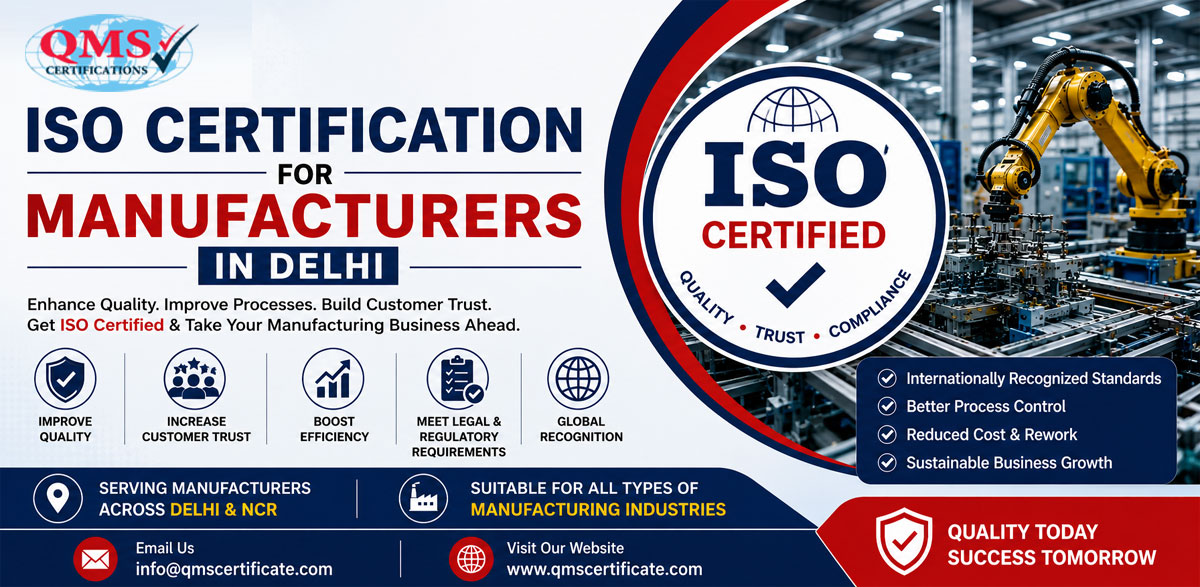
ISO Certification for Manufacturers in Delhi
Introduction
For a manufacturing business, quality is not limited to checking the finished product. It starts with raw-material selection and continues through production, inspection, storage, delivery, customer feedback and continual improvement.
This is why ISO Certification for Manufacturers in Delhi has become an important consideration for businesses that want to establish structured processes and demonstrate their commitment to quality.
ISO certification is not simply about displaying a certificate. The real objective is to establish a management system that fits the company's actual operations and helps employees consistently follow effective processes.
Among the different ISO standards, ISO 9001 is particularly relevant to manufacturers because it provides requirements for a Quality Management System (QMS). ISO explains that ISO 9001 can help organizations deliver consistent products and services, improve efficiency, meet customer expectations and support continual improvement.
For manufacturers operating in Delhi and its industrial areas, a structured quality management system can support stronger customer confidence, better process control and more consistent business operations.
What Is ISO Certification for Manufacturers?
ISO certification is an independent assessment of a company's management system against the requirements of a particular ISO standard.
For example, a manufacturer seeking ISO 9001 certification needs to establish and maintain a Quality Management System that addresses relevant processes, customer requirements, performance evaluation and improvement.
It is important to make one distinction clear: ISO develops and publishes standards, but ISO itself does not issue certificates to companies. Certification is performed by independent certification bodies.
The certification scope should also accurately reflect the activities and locations covered by the manufacturer's management system.
Why Do Manufacturers in Delhi Need ISO Certification?
Delhi has a diverse manufacturing ecosystem covering engineering, electrical products, packaging, machinery, plastics, chemicals, textiles, food products and other industrial activities.
A manufacturer may have good products but still face operational problems if processes depend too heavily on individual employees or informal practices.
For example, an engineering company may experience repeated customer complaints because inspection methods differ between shifts. A structured QMS can define responsibilities, process controls, inspection requirements, records and corrective actions.
Similarly, a packaging manufacturer may need stronger supplier controls because inconsistent raw materials can directly affect the finished product.
ISO 9001 encourages organizations to understand their processes, customer requirements, risks, responsibilities, performance and opportunities for improvement.
The result should be a system that helps the business work more consistently rather than adding unnecessary paperwork.
Key Benefits of ISO Certification for Manufacturers
1. Better Quality Control
A properly implemented QMS helps manufacturers identify processes that influence product quality and establish suitable controls.
2. Improved Customer Confidence
ISO certification can provide independent evidence that the organization's management system has been assessed against the applicable standard.
This can be valuable when dealing with B2B customers, supplier evaluations and quality-sensitive buyers.
3. Reduced Errors and Rework
A process-based approach helps organizations identify nonconformities, investigate causes and implement corrective action instead of repeatedly fixing the same problem.
4. Improved Operational Efficiency
Defined responsibilities, process monitoring and documented information can make manufacturing operations more organized.
5. Stronger Supplier Management
Manufacturers often depend on multiple suppliers for raw materials, components and services. A systematic supplier evaluation process can improve control over externally provided inputs.
6. Better Customer Satisfaction
ISO 9001 places significant emphasis on understanding customer requirements and monitoring customer satisfaction.
7. Support for Business Opportunities
ISO certification may be requested or preferred by certain customers, tenders or supply-chain partners. However, requirements differ, so manufacturers should always check the specific tender or contract conditions.
8. Continual Improvement
Internal audits, performance evaluation, corrective action and management review provide mechanisms for identifying opportunities to improve the QMS.
Which ISO Certification Is Suitable for Manufacturers?
There is no single ISO certification that applies identically to every manufacturing business.
The appropriate standard depends on the organization's industry, products, processes, risks and customer requirements.
Common standards include:
-
ISO 9001 – Quality Management System
-
ISO 14001 – Environmental Management System
-
ISO 45001 – Occupational Health and Safety Management System
-
ISO 22000 – Food Safety Management System
-
ISO 13485 – Quality Management System for medical devices
-
ISO 27001 – Information Security Management System
For a general manufacturing organization looking to strengthen quality management, ISO 9001 is often the most relevant starting point.
A food manufacturer may have additional food-safety requirements, while an organization with significant environmental or occupational health and safety responsibilities may consider ISO 14001 or ISO 45001.
ISO Certification Process for Manufacturers in Delhi
The ISO certification process for manufacturers in Delhi should be planned around the organization's actual manufacturing activities.
Step 1: Select the Appropriate ISO Standard
First, identify the standard that matches your business objectives and customer requirements.
Step 2: Define the Certification Scope
The scope should clearly identify the products, services, processes, activities and locations covered by the management system.
Step 3: Conduct a Gap Assessment
Existing processes are compared with the applicable ISO requirements.
This helps identify gaps in areas such as documentation, responsibilities, monitoring, supplier management, internal audits and corrective action.
Step 4: Develop the Management System
Relevant policies, procedures, process controls, objectives and documented information are established according to the company's actual operations.
Step 5: Implement the System
Employees need to understand their responsibilities and follow the established processes.
Implementation is important because certification is about the management system in operation, not just the existence of documents.
Step 6: Conduct an Internal Audit
An internal audit evaluates whether the QMS is being implemented effectively and identifies areas requiring correction or improvement.
Step 7: Management Review
Top management reviews relevant QMS information, such as performance results, audit findings, customer feedback, objectives, risks and improvement opportunities.
Step 8: Certification Audit
An independent certification body assesses the organization's management system against the applicable ISO requirements. ISO confirms that certification is a third-party conformity-assessment activity rather than something ISO itself performs.
Step 9: Certification and Continual Improvement
After successfully completing the certification process, the organization receives its certificate from the certification body.
The work does not end with certification. The QMS should continue to be monitored, reviewed and improved.
Documents Required for ISO Certification
Documentation requirements vary according to the ISO standard, certification scope, business size and complexity.
For manufacturers, commonly relevant information can include:
-
Business registration details
-
Company profile
-
Manufacturing activity details
-
Product information
-
Organization structure
-
Certification scope
-
Quality policy
-
Quality objectives
-
Process information
-
Work instructions
-
Supplier evaluation records
-
Inspection and testing records
-
Equipment and measurement records
-
Customer feedback records
-
Nonconformity records
-
Corrective-action records
-
Internal audit records
-
Management review records
The objective should be to maintain useful documented information that supports the organization's processes rather than creating paperwork that employees do not use.
Why Choose QMS Certificate for ISO Certification in Delhi?
Selecting an experienced ISO service provider can make the certification journey easier to understand, particularly for manufacturers that are implementing a formal management system for the first time.
QMS Certificate focuses on ISO certification services and supports organizations across different sectors. Its website lists ISO 9001, ISO 14001, ISO 45001, ISO 22000, ISO 27001 and ISO 13485 among its certification services.
For manufacturers looking for ISO Certification in Delhi, professional guidance can help with understanding the applicable standard, preparing the QMS, organizing relevant documentation and getting ready for the certification audit.
The focus should remain on building a management system that works for the business.
ISO Certification for Different Manufacturing Industries
ISO certification can be relevant to manufacturers across many industries, including:
-
Engineering manufacturers
-
Automobile manufacturers
-
Auto-component manufacturers
-
Machinery manufacturers
-
Electrical manufacturers
-
Electronics manufacturers
-
Plastic manufacturers
-
Chemical manufacturers
-
Pharmaceutical manufacturers
-
Textile manufacturers
-
Packaging manufacturers
-
Food manufacturers
-
Metal and steel manufacturers
-
Construction-material manufacturers
Each business should determine its certification scope based on its actual activities rather than copying a generic scope from another company.
Frequently Asked Questions
1. What is ISO Certification for Manufacturers in Delhi?
ISO certification is an independent assessment of a manufacturer's management system against the requirements of a selected ISO standard. ISO 9001 is commonly used for quality management and can be applied to manufacturing organizations of different sizes.
2. Which ISO certification is best for manufacturers?
ISO 9001 is a widely applicable standard for quality management. However, the appropriate certification depends on the manufacturer's industry, processes, risks and customer requirements. Other standards may be relevant for environmental management, occupational safety, food safety, medical devices or information security.
3. How can manufacturers get ISO certification in Delhi?
A manufacturer generally needs to select the applicable standard, define the scope, assess existing processes, establish and implement the management system, conduct internal audits and management review, and complete an independent certification audit.
4. What documents are required for ISO certification for manufacturers?
Requirements vary according to the standard and certification scope. Common information can include company details, scope, policies, objectives, process documentation, supplier records, inspection records, internal audit records, corrective actions and management review information.
5. How much does ISO certification cost for manufacturers in Delhi?
There is no universal price for ISO certification. Cost can depend on the selected standard, company size, number of employees, locations, certification scope, process complexity and audit requirements. A customized assessment is more useful than quoting one fixed price for every manufacturer.
Conclusion
ISO Certification for Manufacturers in Delhi can be an important step for businesses that want to establish stronger quality systems, improve process control and demonstrate their commitment to consistent performance.
The greatest value comes from implementing a QMS that employees actually use. When processes are clearly defined, performance is monitored and problems are addressed systematically, quality management becomes part of everyday business operations rather than a one-time certification exercise.
If you are planning ISO Certification in Delhi for your manufacturing business, QMS Certificate can help you understand the applicable requirements and prepare for the certification journey.
Contact QMS Certificate
Email: info@qmscertificate.com
Website: www.qmscertificate.com
Discuss your manufacturing activities, certification scope and ISO requirements with the QMS Certificate team before beginning the process.
Having any Query? Talk to our Experts
Our Projects are fully tested, background checked, license validated and insured
with a 100% satisfaction guarantee.
Contact Info
 qmscertify@gmail.com
 View Location Map