

ISO Certification for Export Businesses in India: Standards, Benefits and Process
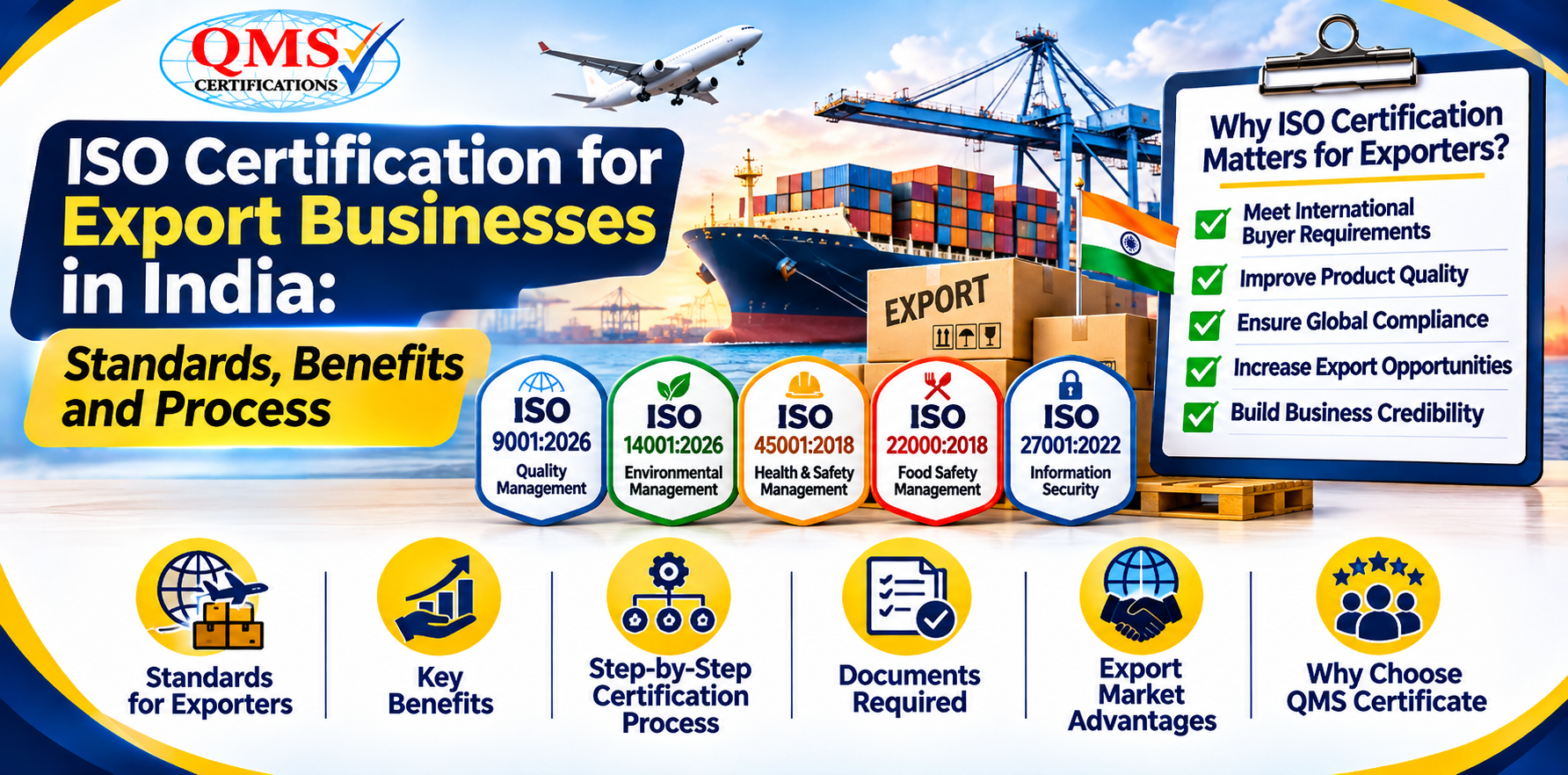
ISO Certification for Export Businesses in India: Standards, Benefits and Process
Introduction
India is one of the world's important manufacturing and exporting destinations. Businesses across sectors such as textiles, engineering, pharmaceuticals, food processing, chemicals and electronics are exploring international markets to expand their operations.
However, entering the global market is not just about finding international buyers. Exporters must also demonstrate product quality, reliable processes, regulatory compliance and the ability to meet customer expectations.
This is where ISO Certification for Export Businesses in India becomes valuable.
ISO certification helps businesses establish structured management systems and demonstrate their commitment to consistent quality, safety, environmental responsibility and information security.
For example, a textile manufacturer in Tiruppur supplying garments to European buyers may use ISO 9001 to improve quality control. Similarly, a food processing company in Gujarat may implement ISO 22000 to strengthen its food safety management system.
Although ISO certification is not compulsory for every exporter, certain buyers, contracts, industry regulations and export-related requirements may make specific certifications necessary.
Let's understand the most relevant ISO standards, their benefits, documentation and the certification process for Indian exporters.
Which ISO Certifications Are Suitable for Export Businesses?
Selecting the correct ISO standard depends on your products, industry, destination market and buyer requirements.
1. ISO 9001:2026 – Quality Management System
ISO 9001:2026 is the latest quality management system standard, published in September 2026.
It helps export businesses establish consistent processes, monitor product quality, manage customer complaints and improve operational performance.
It is suitable for:
-
Engineering and machinery exporters.
-
Textile and garment manufacturers.
-
Automobile component suppliers.
-
Electronics manufacturers.
-
Industrial product exporters.
2. ISO 14001:2026 – Environmental Management System
ISO 14001:2026 helps businesses manage their environmental responsibilities, reduce waste and improve environmental performance.
It is particularly useful for manufacturers exporting to markets where buyers evaluate environmental management practices.
3. ISO 22000:2018 – Food Safety Management System
ISO 22000 is designed for organisations involved in the food supply chain.
It is suitable for:
-
Food processing companies.
-
Packaged food manufacturers.
-
Agricultural product exporters.
-
Food packaging businesses.
-
Storage and distribution companies.
4. ISO 45001:2018 – Occupational Health and Safety
ISO 45001 helps businesses identify workplace hazards, control safety risks and improve employee protection.
It is relevant to engineering units, construction companies and industrial exporters.
5. ISO/IEC 27001:2022 – Information Security Management System
Export businesses handling international customer information, commercial contracts and sensitive digital records can benefit from ISO 27001.
It is particularly relevant to IT exporters, software companies and business process outsourcing organisations.
Is ISO Certification Mandatory for Export Businesses in India?
ISO certification is not automatically mandatory for every Indian exporter.
However, it may be required or strongly preferred in specific situations, including:
-
International buyer agreements.
-
Supplier registration and vendor approval.
-
Government or institutional export contracts.
-
Industry-specific regulatory conditions.
-
Destination-country compliance requirements.
-
Product-specific quality and safety schemes.
For example, a European buyer may ask an Indian food supplier to demonstrate a recognised food safety management system.
Similarly, an engineering company supplying components to an international manufacturer may be asked to provide ISO 9001 certification.
Exporters should also remember that ISO management system certification does not replace mandatory product approvals, testing, licences or destination-country regulations.
Depending on the product and market, additional requirements may include CE marking, applicable food safety approvals, phytosanitary documentation, product testing or other conformity assessments.
The applicable requirements should always be checked before shipment.
Key Benefits of ISO Certification for Export Businesses
Obtaining the right ISO certification can provide several advantages to Indian exporters.
1. Improved International Business Credibility
ISO certification demonstrates that a business follows a defined management system that has been independently assessed.
This can strengthen confidence among foreign buyers, distributors and business partners.
2. Better Product and Service Quality
ISO 9001 encourages businesses to monitor production, identify defects and improve processes.
For example, an auto-component exporter in Pune can use quality management procedures to reduce manufacturing errors and maintain consistent specifications.
3. Increased Buyer Confidence
International customers often prefer suppliers with documented quality and management practices.
Having relevant certification can support vendor registration and supplier evaluation.
4. Improved Export Market Opportunities
ISO certification can help exporters meet specific buyer or tender requirements and compete for suitable international business opportunities.
5. Better Risk Management
Standards such as ISO 14001 and ISO 45001 help organisations identify environmental and workplace risks.
6. Stronger Operational Efficiency
Defined procedures, employee responsibilities and performance monitoring can reduce process delays, wastage and avoidable expenses.
7. Support for Long-Term Business Growth
A structured management system helps exporters prepare for larger orders, additional locations and more demanding international customers.
Step-by-Step ISO Certification Process for Export Businesses in India
The certification process generally involves the following steps.
Step 1: Identify the Appropriate ISO Standard
Select the ISO standard according to your export products, industry and buyer expectations.
For example, a garment exporter may consider ISO 9001, while a food exporter may require ISO 22000.
Step 2: Define the Certification Scope
Determine which manufacturing activities, services, departments and locations will be covered under certification.
Step 3: Submit the Certification Application
Provide company details, employee strength, business activities and other information required by the certification body.
Step 4: Conduct a Gap Analysis
Review existing business procedures and identify areas that need improvement to meet the selected ISO standard.
Step 5: Prepare ISO Documentation
Develop relevant policies, procedures, objectives, risk assessments and operational records.
Step 6: Implement the Management System
Train employees and ensure that documented procedures are followed in daily business operations.
Step 7: Conduct an Internal Audit
Evaluate the management system, identify non-conformities and complete corrective actions.
Step 8: Complete the External Certification Audit
An independent certification body conducts the applicable audit stages to assess compliance with the selected ISO standard.
Step 9: Certification Decision and Issuance
After successful audit completion and closure of required findings, the certification body reviews the results and makes the certification decision.
Documents Required for ISO Certification for Export Businesses
The documentation depends on the ISO standard, business activities and operational complexity.
Commonly required documents include:
-
Company incorporation or business registration certificate.
-
PAN card of the organisation.
-
GST registration certificate, where applicable.
-
Import Export Code (IEC), where applicable.
-
Business address proof.
-
Company profile and export business details.
-
Employee details and organisational structure.
-
Quality or relevant management system policy.
-
Management system objectives.
-
Standard operating procedures (SOPs).
-
Risk assessment records.
-
Supplier evaluation records, where applicable.
-
Product inspection and quality control records.
-
Employee training records.
-
Internal audit reports.
-
Management review records.
-
Corrective action records.
Additional documentation may be required for food, pharmaceutical, chemical, engineering and other specialised export industries.
Why Choose QMS Certificate?
Selecting the right ISO certification support provider can make the certification journey easier for exporters, manufacturers, startups and MSMEs.
At QMS Certificate, we assist businesses in understanding the applicable ISO standards, documentation requirements and certification procedures.
Our services include:
-
Guidance on selecting suitable ISO standards.
-
ISO certification application assistance.
-
Quality management documentation support.
-
SOP and policy preparation.
-
Management system implementation guidance.
-
Internal audit preparation.
-
Certification audit coordination.
-
Support for manufacturing and export businesses.
-
Guidance on certification and accreditation requirements.
We focus on understanding your business activities and export requirements before suggesting an appropriate certification approach.
Our objective is to make the certification process practical, transparent and professionally managed.
Frequently Asked Questions (FAQs)
1. Is ISO certification mandatory for export businesses in India?
No. ISO certification is not universally mandatory for Indian exporters. However, certain international buyers, supplier agreements, tenders and industry-specific requirements may require particular ISO certifications.
2. Which ISO certification is best for export businesses in India?
ISO 9001:2026 is a common choice for exporters because it focuses on quality management. Food exporters may consider ISO 22000, while manufacturing businesses may also benefit from ISO 14001 and ISO 45001.
3. How does ISO 9001 certification help Indian exporters?
ISO 9001 helps exporters improve production processes, maintain consistent quality, reduce defects, improve customer satisfaction and demonstrate their commitment to quality management to international buyers.
4. What documents are required for ISO certification for exporters?
Common documents include company registration, PAN, GST details, IEC where applicable, company profile, employee information, management system policies, SOPs, risk assessments and internal audit records.
5. Does ISO certification guarantee international export orders?
No. ISO certification does not guarantee export orders or automatic entry into international markets. However, it can strengthen business credibility and help exporters meet specific buyer and supplier requirements.
Conclusion
International buyers expect more than competitive prices. They want reliable suppliers who can maintain product quality, manage business risks and follow consistent operational processes.
ISO Certification for Export Businesses in India can help exporters build these capabilities and strengthen their position in global markets.
Whether you are a textile manufacturer, engineering exporter, food processing company or industrial supplier, selecting the right ISO standard can support your international business goals.
Start by understanding your buyer requirements, selecting the appropriate standard and implementing a management system that supports your actual business operations.
Get ISO Certification Assistance from QMS Certificate
Planning to obtain ISO 9001:2026, ISO 14001:2026, ISO 45001, ISO 22000 or ISO 27001 certification for your export business?
Connect with QMS Certificate for professional guidance on ISO requirements, documentation and the certification process.
QMS Certificate
Website: https://www.qmscertificate.com/
Email: info@qmscertificate.com
Contact our team today to discuss your export business requirements and take the next step towards strengthening your international business credibility.
Having any Query? Talk to our Experts
Our Projects are fully tested, background checked, license validated and insured
with a 100% satisfaction guarantee.
Contact Info
 qmscertify@gmail.com
 View Location Map


