

ISO Certification for Chemical Manufacturers Delhi
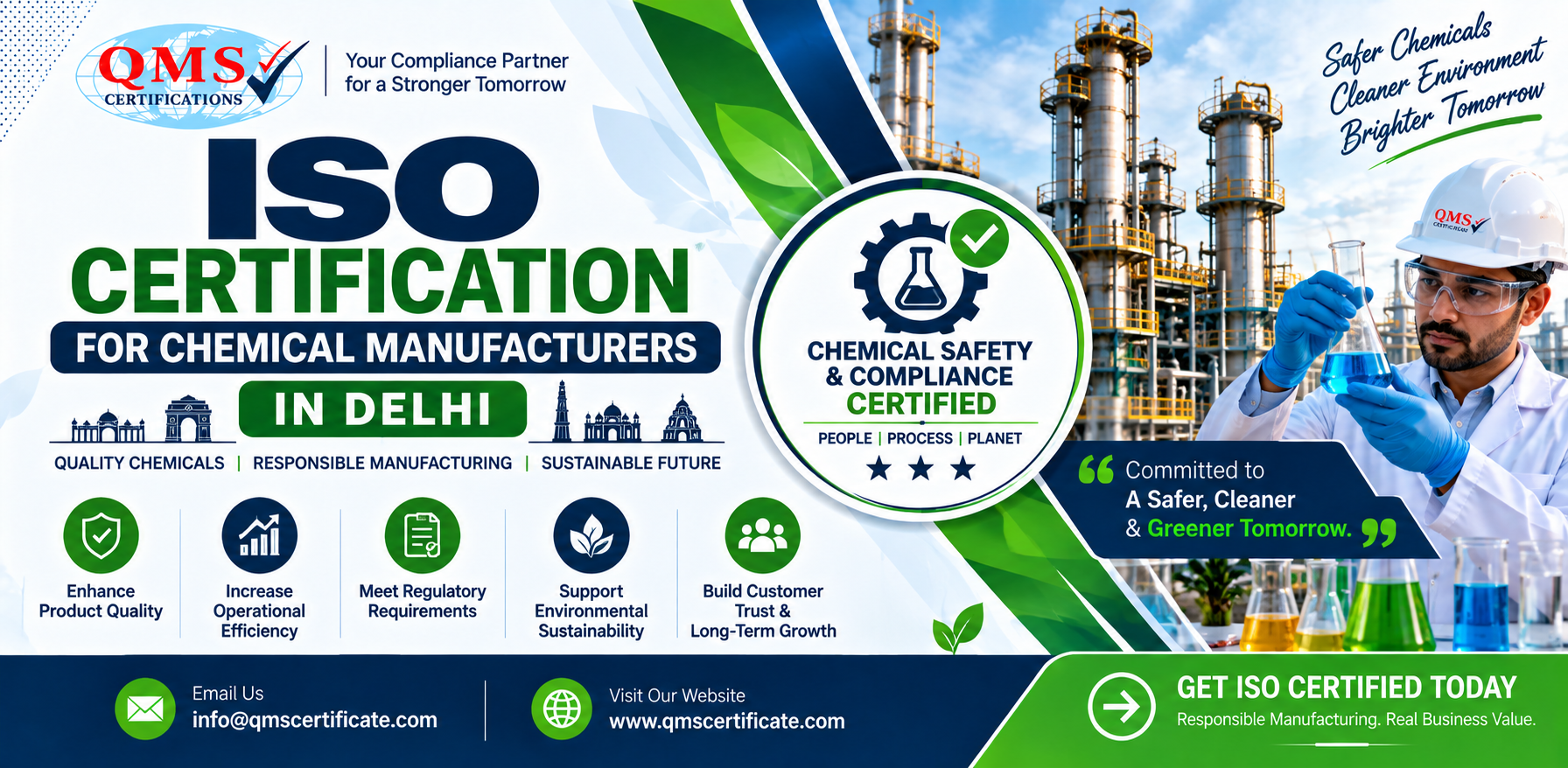
ISO Certification for Chemical Manufacturers Delhi
Introduction
Chemical manufacturing requires careful control at almost every stage. Raw materials, production conditions, storage, testing, equipment, employee safety, waste management, and customer requirements all need proper attention.
For chemical manufacturers in Delhi and the wider NCR region, maintaining consistent processes can become challenging as the business grows. A small process gap can lead to product inconsistency, excessive waste, safety concerns, customer complaints, or compliance difficulties.
This is where ISO certification for chemical manufacturers in Delhi can provide a structured approach.
ISO certification helps organizations establish management systems for quality, environmental performance, occupational health and safety, and continual improvement. For example, a chemical manufacturer in Delhi may have experienced production staff and good quality practices but lack consistent procedures, documented risk controls, supplier evaluation, or internal audits. An appropriate ISO management system brings these activities into a more organized framework.
ISO 9001 is the internationally recognized quality management standard. ISO states that it helps organizations establish, implement, maintain, and continually improve a quality management system while improving performance and meeting customer expectations.
The right certification, however, depends on the company's manufacturing activities, risks, customers, environmental responsibilities, and applicable legal requirements.
Why Choose QMS Certificate for Chemical ISO Certification?
Chemical manufacturing is different from a typical service business. Certification support should therefore begin with understanding how your plant or production operation actually works.
At QMS Certificate, our approach focuses on practical implementation rather than simply preparing paperwork.
We can assist chemical manufacturers with:
- Understanding the appropriate ISO standard
- Defining the certification scope
- Reviewing existing processes
- Conducting a gap assessment
- Developing required documentation
- Supporting management-system implementation
- Preparing teams for internal audits
- Identifying and addressing nonconformities
- Preparing for the certification audit
- Providing guidance throughout the certification process
QMS Certificate provides ISO certification services in Delhi and supports businesses across multiple industries and management-system standards.
The goal is simple: make your management system useful to your business, not just useful for an audit.
Key Benefits of ISO Certification for Chemical Manufacturers in Delhi
1. Improve Product Quality and Consistency
Chemical products often require controlled specifications and repeatable manufacturing processes.
An effective quality management system helps define responsibilities, monitor processes, control changes, evaluate results, and address problems systematically.
This can help manufacturers improve consistency and reduce avoidable errors.
2. Strengthen Production Process Control
As production volumes increase, informal processes can become difficult to manage.
ISO-based systems encourage organizations to establish clear processes for:
- Production planning
- Quality inspection
- Process monitoring
- Equipment maintenance
- Material control
- Product release
- Nonconformity handling
- Corrective action
Better process visibility allows management to identify problems before they become recurring issues.
3. Improve Chemical Safety and Workplace Practices
Chemical manufacturing can involve hazardous substances, machinery, heat, pressure, emissions, and other occupational risks.
ISO 45001 provides a framework for managing occupational health and safety risks, including hazard identification, risk assessment, emergency planning, incident investigation, and continual improvement.
Certification does not replace statutory safety requirements, but it can help establish a more systematic safety-management approach.
4. Strengthen Environmental Management
Chemical manufacturing may generate waste, emissions, wastewater, or other environmental impacts.
ISO 14001 provides a framework for organizations to manage environmental responsibilities, improve environmental performance, manage resources and waste, and address relevant legal requirements.
Important current update: ISO 14001:2026 was published in April 2026 and replaced ISO 14001:2015.
5. Build Customer Confidence
B2B chemical buyers often want confidence that their suppliers have controlled and repeatable processes.
An appropriate ISO certification can strengthen your company's credibility when dealing with:
- Industrial buyers
- Distributors
- Export customers
- OEMs
- Institutional clients
- Large corporate procurement teams
6. Reduce Rework, Waste and Process Inefficiencies
When processes are clearly defined and monitored, recurring problems become easier to identify.
This can contribute to better material utilization, fewer process errors, improved productivity, and more informed management decisions.
7. Support Business Expansion
For a growing chemical manufacturer, certification can strengthen the company's quality credentials when entering new markets or responding to customer qualification requirements.
It can also support a more mature management structure as the organization expands its workforce, product range, or production capacity.
Which ISO Standards Are Relevant to Chemical Manufacturers?
There is no universal "chemical industry ISO certificate." The appropriate standard depends on your business objectives and operations.
ISO 9001 – Quality Management System
ISO 9001 focuses on quality management, customer requirements, process control, performance evaluation, risk-based thinking, and continual improvement.
For many chemical manufacturers, this is an important foundation for establishing a structured quality management system.
Current standards note: ISO 9001:2015 remains the current published edition while ISO 9001:2026 is under publication and expected to replace it in September 2026. Organizations planning certification should confirm the applicable edition and transition arrangements with their certification body.
ISO 14001 – Environmental Management System
This is particularly relevant where environmental impacts such as waste, emissions, resource consumption, or wastewater are significant.
The current edition is ISO 14001:2026.
ISO 45001 – Occupational Health & Safety
ISO 45001 helps organizations systematically manage workplace hazards and occupational health and safety risks. The current published edition is ISO 45001:2018, although ISO has a new revision under development.
A chemical manufacturer may implement one or more of these standards depending on its requirements.
Step-by-Step ISO Certification Process
Step 1: Understand Your Business Scope
The first step is identifying what your organization actually manufactures and which processes should fall within the certification scope.
For example, the scope may cover manufacturing, testing, storage, packaging, or other activities depending on the organization.
Step 2: Conduct a Gap Assessment
Your existing systems are compared with the requirements of the selected ISO standard.
This identifies areas that need improvement before the certification audit.
Step 3: Prepare Documentation
Required documentation may include policies, procedures, objectives, process controls, risk assessments, records, and monitoring arrangements.
The documentation should reflect your actual chemical manufacturing processes.
Step 4: Implement the System
Employees need to follow the defined processes in day-to-day operations.
This is the stage where ISO requirements become part of normal business activities rather than remaining documents.
Step 5: Conduct Internal Audit
An internal audit helps identify weaknesses and nonconformities before the external audit.
Corrective actions can then be taken to address identified issues.
Step 6: Management Review
Management evaluates the performance and effectiveness of the management system, including objectives, audit results, customer feedback, risks, and opportunities for improvement.
Step 7: Certification Audit
An independent certification body evaluates the implemented management system against the applicable ISO standard.
If the requirements are successfully met and any findings are appropriately addressed, certification can be issued.
Documents Required for ISO Certification
The exact requirements vary according to the ISO standard, company size, certification scope, and complexity of operations.
Common information and records may include:
- Business registration documents
- Company profile
- Certification scope
- Organization chart
- Quality, environmental, or safety policies
- Process flow information
- Quality objectives and performance indicators
- Risk and opportunity assessments
- Chemical/material specifications
- Supplier evaluation records
- Purchase and incoming-material records
- Production records
- Inspection and testing records
- Equipment maintenance records
- Calibration records, where applicable
- Employee training records
- Safety procedures and emergency arrangements
- Waste-management records
- Environmental compliance information
- Customer complaint records
- Nonconformity reports
- Corrective-action records
- Internal audit reports
- Management review records
- Applicable legal and regulatory information
A good ISO system should be evidence-based and relevant to the organization's real activities. Using generic documents that do not match the actual production process can create problems during implementation and auditing.
Who Should Consider ISO Certification?
ISO certification for chemical manufacturers in Delhi can be relevant to businesses involved in:
- Industrial chemical manufacturing
- Specialty chemicals
- Chemical intermediates
- Solvents and chemical formulations
- Paint and coating manufacturing
- Adhesive and sealant manufacturing
- Industrial chemicals
- Chemical raw materials
- Cleaning and treatment chemicals
- Chemical processing
- Chemical storage and related operations
The appropriate certification scope should be determined according to the organization's actual activities and applicable requirements.
Frequently Asked Questions
1. What is ISO certification for chemical manufacturers in Delhi?
ISO certification for chemical manufacturers in Delhi demonstrates that an organization has established a management system meeting the requirements of a particular ISO standard within a defined scope. ISO 9001 is commonly associated with quality management, while ISO 14001 and ISO 45001 address environmental and occupational health and safety management.
2. Which ISO certification is best for a chemical manufacturing company?
There is no single ISO standard that is best for every chemical manufacturer. ISO 9001 may be appropriate for quality management, ISO 14001 for environmental management, and ISO 45001 for occupational health and safety. The right choice depends on your operations, risks, customer requirements, and business objectives.
3. What documents are required for ISO certification for chemical manufacturers?
Typical requirements include business documents, organization details, policies, process information, risk assessments, supplier records, production and inspection records, training records, maintenance and calibration records, internal audit records, management reviews, and corrective-action evidence.
4. Does ISO certification replace chemical industry regulations in India?
No. ISO certification does not replace applicable laws, licenses, permits, pollution-control requirements, safety regulations, or other statutory obligations. It provides a management-system framework that can help an organization manage its responsibilities more systematically.
5. How long does ISO certification take for a chemical manufacturer in Delhi?
The timeline depends on factors such as company size, employee count, production complexity, certification scope, existing management systems, documentation, and audit readiness. A company with established processes may require less preparation than an organization building its management system from the beginning.
Conclusion: Build a Safer, More Reliable Chemical Manufacturing Business
For chemical manufacturers, ISO certification should be more than a certificate displayed in the office. A properly implemented management system can bring greater consistency to production, stronger quality controls, improved risk management, better environmental practices, safer workplaces, and increased customer confidence.
If you are searching for ISO certification for chemical manufacturers in Delhi, QMS Certificate can help you understand your certification requirements and prepare your organization for the certification process.
Ready to strengthen your chemical manufacturing business?
QMS Certificate provides professional guidance for organizations seeking ISO certification in Delhi and beyond.
📧 Email: info@qmscertificate.com
🌐 Website: www.qmscertificate.com
Contact QMS Certificate today and take the next step toward stronger quality, safer processes, improved compliance, and sustainable business growth.
Internal Linking Suggestions
For stronger topical SEO, add contextual internal links to relevant QMS Certificate pages:
- ISO Certification in Delhi — QMS Certificate – ISO Certification in Delhi
- ISO 9001 Certification — QMS Certificate – ISO 9001 Certification
- ISO 14001 Certification — QMS Certificate – ISO 14001 Certification
- ISO 13485 Certification in Delhi — QMS Certificate – ISO 13485 Certification in Delhi
These pages are already part of the QMS Certificate website and can help create stronger internal topical relationships.
External Authority Reference
For authoritative information, link to the official International Organization for Standardization (ISO) pages for ISO 9001, ISO 14001, and ISO 45001. ISO's own resources explain the purpose and application of these management-system standards.
Having any Query? Talk to our Experts
Our Projects are fully tested, background checked, license validated and insured
with a 100% satisfaction guarantee.
Contact Info
 qmscertify@gmail.com
 View Location Map