

ISO Certification for Automobile Manufacturers Delhi
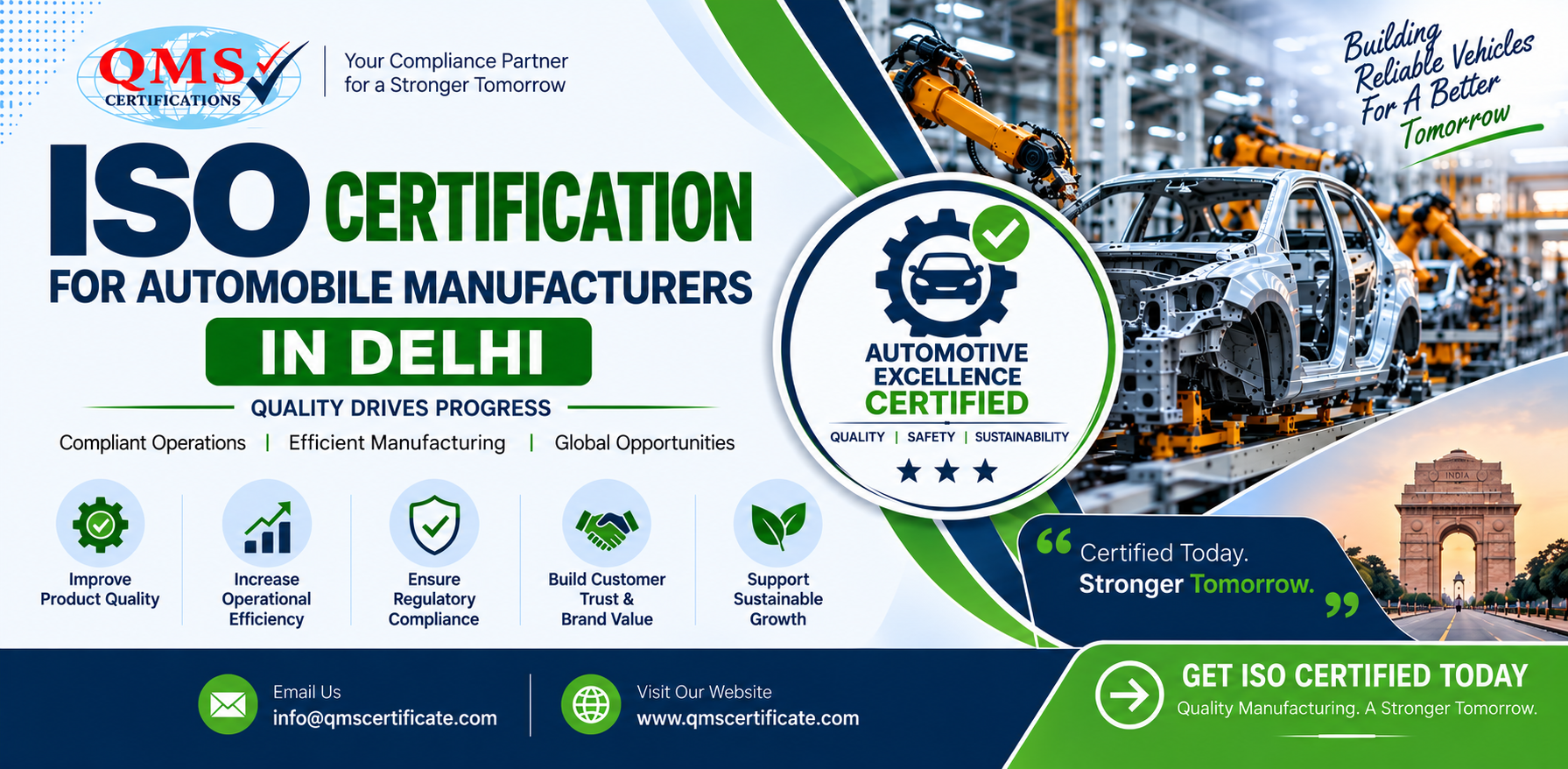
ISO Certification for Automobile Manufacturers Delhi
Introduction
The automobile industry depends on precision, consistency, safety, and reliable supply chains. A small issue in a component, production process, inspection activity, or supplier relationship can affect delivery schedules and customer satisfaction.
For automobile manufacturers operating in Delhi and the wider NCR region, a structured management system can help bring greater control to these areas.
This is where ISO certification for automobile manufacturers in Delhi becomes valuable.
ISO certification demonstrates that a company has established a management system based on the requirements of a particular ISO standard. It is not simply a certificate for display. When properly implemented, an ISO management system can help an automobile business define processes, manage risks, monitor performance, address nonconformities, and pursue continual improvement.
For example, an automotive component manufacturer supplying parts to larger companies may need consistent controls over raw materials, production, inspection, equipment, suppliers, employee competence, and customer requirements. A quality management system helps organize these activities into a more controlled framework.
The appropriate ISO standard depends on the company's activities and objectives. ISO 9001 is particularly relevant to quality management, while ISO 14001 addresses environmental management and ISO 45001 focuses on occupational health and safety. ISO's management-system standards are designed for organizations across different sectors and sizes.
Why Choose QMS Certificate?
Selecting the right certification support partner can make the ISO journey easier to understand and manage.
QMS Certificate provides ISO certification-related services for organizations across different industries, including automotive and manufacturing sectors. The company's website highlights support covering consultation, documentation, certification preparation, and audit-related activities.
Our approach is focused on understanding the organization's actual operations rather than treating every business the same.
For an automobile manufacturer, this may include understanding areas such as:
- Production and assembly processes
- Incoming material inspection
- Supplier evaluation
- Quality inspection and testing
- Equipment and measurement controls
- Customer requirements
- Non-conforming products
- Corrective actions
- Employee competency and training
- Process monitoring
- Internal audits and management review
The goal is to help your organization understand what is required, prepare appropriate documentation, implement relevant controls, and become ready for the certification assessment.
Key Benefits of ISO Certification for Automobile Manufacturers
1. Improved Product and Process Quality
Automobile manufacturers need consistent output across production batches.
An ISO 9001-based quality management system helps organizations establish controlled processes for monitoring quality, handling customer requirements, managing nonconformities, and improving processes.
ISO describes ISO 9001 as a framework for establishing, implementing, maintaining, and continually improving a quality management system.
2. Better Supplier Management
Automotive manufacturers often work with multiple suppliers for metals, plastics, electrical components, packaging, tools, and other materials.
A structured supplier-management process can help the organization evaluate suppliers, communicate requirements, monitor performance, and respond to supplier-related quality issues.
3. Increased Customer Confidence
Automotive customers often expect suppliers to demonstrate consistent processes and quality controls.
ISO certification can provide an additional trust signal when approaching new customers, responding to supplier requirements, or expanding business relationships.
4. Reduced Errors and Rework
Uncontrolled processes can result in rejected components, production delays, rework, material wastage, and customer complaints.
A management system encourages businesses to identify risks, monitor processes, investigate problems, and implement corrective actions.
5. Improved Workplace Safety
Automobile manufacturing involves machinery, material handling, welding, fabrication, chemicals, electrical equipment, and other potential workplace hazards.
ISO 45001 provides a management-system framework for occupational health and safety. It can help organizations systematically identify hazards, assess risks, establish controls, and improve safety performance.
6. Better Environmental Performance
Automotive manufacturing can involve energy consumption, waste generation, emissions, chemicals, water use, and other environmental considerations.
ISO 14001 provides a framework for environmental management and continual improvement. The current ISO 14001 edition is ISO 14001:2026.
7. Stronger Business Competitiveness
A well-managed quality system can help an automobile manufacturer demonstrate professionalism and process discipline.
This can be particularly useful for companies seeking to grow their customer base, strengthen supplier relationships, or enter more demanding supply chains.
Which ISO Standards Are Relevant to Automobile Manufacturers?
The right standard depends on the organization's activities.
ISO 9001 – Quality Management
ISO 9001 certification is highly relevant to automobile manufacturers and automotive component suppliers that want a structured quality management system.
It covers areas such as:
- Customer focus
- Process management
- Risk-based thinking
- Quality objectives
- Supplier controls
- Monitoring and measurement
- Corrective action
- Continual improvement
ISO 9001 applies across industries rather than being limited to automotive businesses.
ISO 14001 – Environmental Management
Manufacturers seeking stronger control over environmental aspects can consider ISO 14001.
It can support systematic management of environmental impacts, resource use, waste, compliance obligations, and environmental objectives.
ISO 45001 – Occupational Health & Safety
For factories and manufacturing facilities where employees operate machinery or work in potentially hazardous environments, ISO 45001 can provide a structured approach to occupational health and safety management.
What About IATF 16949?
Automotive businesses should also distinguish between general ISO 9001 certification and IATF 16949, which is an automotive-sector quality management system standard.
A company should determine its customer and supply-chain requirements before selecting the appropriate certification route. Do not assume that ISO 9001 automatically replaces automotive-specific requirements.
Step-by-Step ISO Certification Process
Step 1: Identify the Applicable Standard
First, determine whether your organization requires ISO 9001, ISO 14001, ISO 45001, or another applicable standard.
Step 2: Define the Certification Scope
The scope should clearly describe the activities, products, services, and locations covered by the management system.
Step 3: Conduct a Gap Assessment
Existing business processes are compared with the requirements of the selected standard.
This helps identify what is already working and where improvements are required.
Step 4: Prepare Documentation
Relevant policies, procedures, process information, records, objectives, and controls are prepared according to the organization's actual operations.
Step 5: Implement the Management System
The documented processes need to be put into practice.
Employees should understand their responsibilities and follow the applicable controls in their daily work.
Step 6: Conduct Internal Audit
An internal audit helps identify nonconformities and improvement opportunities before the external certification audit.
Step 7: Management Review
Management reviews system performance, objectives, audit results, customer feedback, risks, and opportunities for improvement.
Step 8: Certification Audit
An independent certification body assesses the management system against the applicable requirements.
Step 9: Certification
If the assessment requirements are successfully met and applicable findings are addressed, the organization can receive its certificate.
The exact duration and audit requirements depend on factors such as company size, scope, number of locations, complexity, and the selected standard.
Documents Required for ISO Certification
The exact documentation varies according to the ISO standard and the nature of the automobile manufacturing business.
Commonly requested information and records may include:
- Business registration details
- Company profile
- Certification scope
- Organization structure
- Quality/environment/safety policy, as applicable
- Process descriptions
- Risk and opportunity assessment
- Quality or operational objectives
- Supplier evaluation records
- Purchase and supplier-control records
- Production records
- Inspection and testing records
- Equipment maintenance records
- Calibration records, where applicable
- Employee training and competency records
- Customer complaint records
- Nonconformity and corrective-action records
- Internal audit records
- Management review records
- Applicable statutory and regulatory information
QMS Certificate's website also lists basic business information such as registration proof, letterhead or visiting card, invoice details, and business description among its document requirements.
The important principle is relevance. Documentation should support your actual manufacturing processes rather than creating unnecessary paperwork.
ISO Certification for Automobile Manufacturers in Delhi: Who Can Benefit?
This certification approach can be relevant to many types of automotive businesses, including:
- Automobile manufacturers
- Automotive component manufacturers
- Auto-part suppliers
- Engineering and fabrication units
- Vehicle assembly businesses
- Precision machining companies
- Sheet-metal component manufacturers
- Plastic automotive component manufacturers
- Electrical and electronic automotive component suppliers
- Automotive aftermarket manufacturers
For example, a Delhi-NCR automotive component supplier that wants to work with a larger manufacturer may benefit from having clearly defined processes for incoming inspection, production control, final inspection, supplier management, and corrective actions.
The exact certification scope should always match the organization's actual activities.
Frequently Asked Questions
1. What is ISO certification for automobile manufacturers in Delhi?
ISO certification for automobile manufacturers in Delhi means certification of a management system against the requirements of a specific ISO standard. Depending on business needs, an automobile manufacturer may consider ISO 9001 for quality, ISO 14001 for environmental management, or ISO 45001 for occupational health and safety.
2. Which ISO certification is best for an automobile manufacturer?
ISO 9001 is commonly relevant for automobile manufacturers because it focuses on quality management. Businesses may also consider ISO 14001 and ISO 45001 depending on their environmental and occupational safety objectives.
3. Is ISO 9001 enough for an automotive manufacturer?
It depends on the company's customers, products, supply-chain requirements, and business objectives. ISO 9001 provides a general quality management framework, while automotive organizations may have additional sector-specific requirements such as IATF 16949.
4. What documents are needed for ISO certification in the automobile industry?
Documents and records may include company information, management policies, process details, risk assessments, supplier records, production and inspection records, training records, calibration information, internal audit reports, management reviews, and corrective-action records.
5. How long does ISO certification take for an automobile manufacturer in Delhi?
There is no single timeline for every manufacturer. The duration depends on the company's size, certification scope, number of locations, existing management system, process complexity, documentation, and audit readiness.
Internal Linking Opportunities
For this article, add contextual internal links to relevant QMS Certificate pages rather than placing a block of unrelated links.
Recommended links include:
- ISO Certification in Delhi — anchor: ISO certification in Delhi ISO Certification in Delhi
- ISO 9001 Certification — anchor: ISO 9001 certification for automobile manufacturers ISO 9001 Certification
- ISO 14001 Certification — anchor: ISO 14001 environmental management certification ISO 14001 Certification
- ISO 45001 Certification — anchor: ISO 45001 certification for manufacturing companies — link this to the relevant ISO 45001 page on your website if available.
Your website already presents ISO 9001, ISO 14001, ISO 45001, ISO 22000, ISO 27001 and ISO 13485 among its service offerings.
External Authority References
For factual references about ISO standards, use authoritative sources rather than commercial blogs.
A strong reference is the official International Organization for Standardization (ISO) information on ISO 9001 and its management-system standards. ISO explains that ISO 9001 provides a quality-management framework and can be applied across sectors.
You can also reference ISO's official information on ISO 14001:2026 when discussing the current environmental management standard.
Conclusion
For automobile manufacturers, quality cannot depend only on final inspection. It needs to be supported by controlled processes throughout the organization—from purchasing and supplier management to production, inspection, employee competence, customer feedback, and continual improvement.
ISO certification for automobile manufacturers in Delhi can help businesses establish a more systematic approach to these activities while demonstrating their commitment to quality, safety, environmental responsibility, and customer satisfaction.
Whether you operate an automotive manufacturing plant, component unit, precision engineering facility, or auto-part supply business, choosing the right ISO standard is an important first step.
Ready to discuss your ISO certification requirements?
Get in touch with QMS Certificate for guidance based on your business activities and certification scope.
📧 Email: info@qmscertificate.com
🌐 Website: www.qmscertificate.com
Connect with QMS Certificate today and take the next step toward a stronger, quality-driven automotive business.
Having any Query? Talk to our Experts
Our Projects are fully tested, background checked, license validated and insured
with a 100% satisfaction guarantee.
Contact Info
 qmscertify@gmail.com
 View Location Map