

ISO Certification for Auto Component Manufacturers
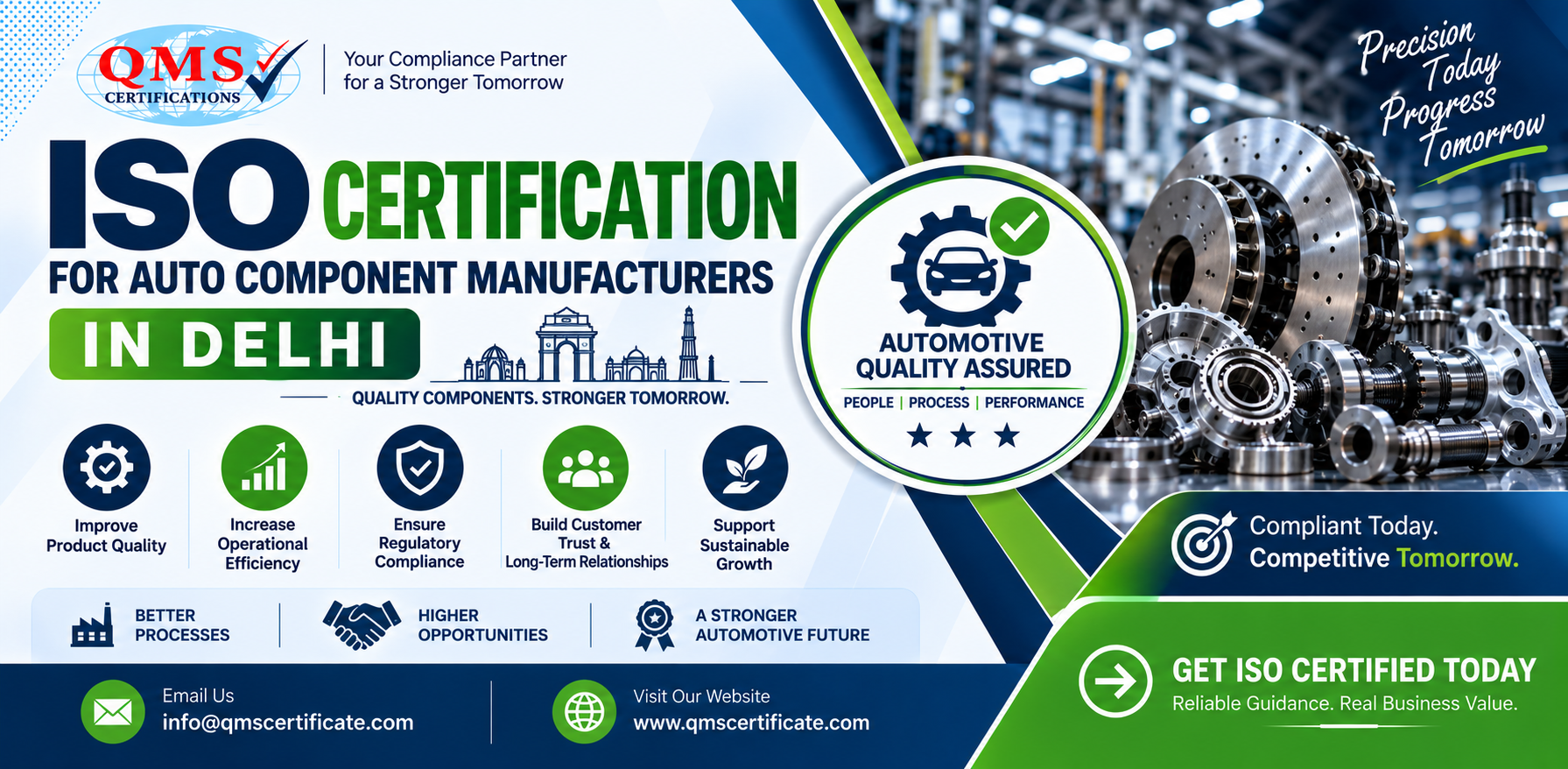
ISO Certification for Auto Component Manufacturers
Introduction
Auto component manufacturers operate in a highly demanding supply chain. Customers expect components to meet specifications consistently, deliveries to remain on schedule, and manufacturing processes to be properly controlled.
For a component manufacturer in Delhi or the wider NCR region, even a small quality issue can lead to rejection, rework, delayed deliveries, or loss of customer confidence.
This makes a structured management system especially valuable.
ISO certification for auto component manufacturers in Delhi provides a systematic framework for managing important business processes. Depending on the organization's requirements, standards such as ISO 9001, ISO 14001, and ISO 45001 can support quality, environmental, and occupational health and safety management.
ISO 9001 is particularly relevant when an organization wants to establish a quality management system focused on consistent processes, customer requirements, performance evaluation, and continual improvement.
For example, consider a Delhi-based manufacturer producing precision-machined automotive parts. Its performance depends not only on the final inspection but also on raw-material purchasing, supplier quality, machine maintenance, measurement equipment, production controls, employee skills, and corrective actions.
An effective ISO management system connects these activities instead of treating quality as the responsibility of the inspection department alone.
Why Choose QMS Certificate?
Choosing an ISO certification support partner should be about more than getting documentation prepared.
QMS Certificate provides ISO certification services across industries and specifically lists automotive, industrial and manufacturing among the sectors it serves.
Our approach is designed to make the certification journey easier to understand and manage.
What QMS Certificate Can Help With
- Understanding the applicable ISO standard
- Defining the certification scope
- Gap assessment
- Documentation and policy support
- Management-system implementation guidance
- Internal audit preparation
- Certification audit readiness
- Corrective-action guidance
- Ongoing certification-related support
The website's Delhi ISO service also describes a process involving consultation, policy/document preparation, and certification.
For an auto component manufacturer, the process should be aligned with real operations. A machining unit, casting manufacturer, sheet-metal supplier, plastic component manufacturer, and electrical component producer may have very different operational risks and controls.
That is why generic documentation should not replace an understanding of the actual business.
Key Benefits of ISO Certification for Auto Component Manufacturers
1. Consistent Product Quality
Automotive customers expect components to conform to agreed specifications.
An ISO 9001-based quality management system can help manufacturers establish consistent controls around production, inspection, customer requirements, nonconforming outputs, and corrective action.
This can create greater consistency from one production batch to another.
2. Better Production Process Control
A component may pass final inspection, but that does not necessarily mean the underlying process is stable.
ISO-based process management encourages manufacturers to identify process risks, establish appropriate controls, monitor performance, and investigate recurring problems.
This can help reduce avoidable rework and production disruptions.
3. Stronger Supplier Management
Auto component manufacturers frequently purchase steel, aluminium, polymers, electronic parts, fasteners, chemicals, packaging materials, and other inputs.
Supplier controls can help businesses:
- Define purchasing requirements
- Evaluate suppliers
- Monitor supplier performance
- Address supplier-related quality issues
- Maintain relevant supplier records
4. Increased Customer Confidence
Automotive customers often assess suppliers carefully before entering or expanding a business relationship.
ISO certification can demonstrate that the manufacturer has established a formal management system and is committed to controlled processes and continual improvement.
It can therefore strengthen credibility during customer evaluations where ISO certification is relevant.
5. Reduced Rejection and Rework
Poor process controls can result in defective components reaching inspection or, worse, the customer.
A structured approach to nonconformity management helps organizations identify problems, investigate causes, implement corrective actions, and verify whether those actions were effective.
6. Improved Workplace Safety
Auto component manufacturing can involve presses, CNC machines, welding, cutting, grinding, chemicals, material handling, and other workplace hazards.
ISO 45001 can provide a systematic approach to occupational health and safety management, including hazard identification, risk assessment, operational controls, and continual improvement.
7. Better Environmental Management
Manufacturing processes can generate scrap, waste, emissions, wastewater, and chemical-related environmental impacts.
ISO 14001 can help organizations establish an environmental management framework and systematically address relevant environmental aspects and compliance obligations.
8. Greater Business Opportunities
A professional management system can help an auto component manufacturer present a stronger profile when approaching new customers, participating in supplier assessments, or expanding into more demanding markets.
However, ISO certification should be viewed as one part of supplier qualification—not a guarantee that a customer will award a contract.
Which ISO Standards Are Relevant to Auto Component Manufacturers?
The appropriate standard depends on your business activities and customer requirements.
ISO 9001 – Quality Management System
For many auto component manufacturers, ISO 9001 certification is a logical starting point.
It focuses on creating a systematic quality management framework covering areas such as:
- Customer requirements
- Process control
- Risk and opportunity management
- Supplier controls
- Monitoring and measurement
- Nonconformity management
- Corrective action
- Continual improvement
QMS Certificate currently promotes ISO 9001:2015 certification among its services.
ISO 14001 – Environmental Management System
Manufacturers concerned with environmental performance can consider ISO 14001.
It can help organizations manage environmental aspects associated with production, resource consumption, waste, and other relevant activities.
QMS Certificate also offers ISO 14001 certification services in Delhi NCR.
ISO 45001 – Occupational Health & Safety
For component manufacturing facilities involving machinery, welding, fabrication, chemicals, or material-handling activities, ISO 45001 can support a systematic occupational health and safety management approach.
What About IATF 16949?
Automotive businesses should distinguish between ISO 9001 and IATF 16949.
ISO 9001 is a general quality management standard applicable across industries. IATF 16949 is specifically associated with automotive quality management and may be required or expected within particular automotive supply chains.
Therefore, an auto component manufacturer should first understand its customer's supplier requirements before deciding which certification or combination of standards is appropriate.
Step-by-Step ISO Certification Process
Step 1: Identify the Applicable Standard
Determine whether ISO 9001, ISO 14001, ISO 45001, or another applicable standard fits your business requirements.
Step 2: Define the Certification Scope
The scope should accurately describe the manufacturing activities, products, services, and locations covered by the management system.
Step 3: Conduct a Gap Assessment
Existing processes are compared with the applicable ISO requirements.
This identifies strengths, weaknesses, missing controls, and areas requiring improvement.
Step 4: Prepare Required Documentation
Policies, procedures, process information, objectives, records, and controls are developed or updated according to the organization's actual activities.
Step 5: Implement the System
The documented management system is put into practice.
Employees should understand their roles and follow the relevant processes during normal operations.
Step 6: Conduct an Internal Audit
An internal audit checks whether the system is properly implemented and identifies nonconformities or opportunities for improvement.
Step 7: Management Review
Top management reviews important information such as audit results, objectives, customer feedback, process performance, risks, and improvement opportunities.
Step 8: Certification Audit
An independent certification body conducts the external assessment against the applicable ISO requirements.
Step 9: Certification
Once applicable requirements have been successfully addressed, the certification body can issue the ISO certificate according to its certification process.
The actual timeline depends on factors such as company size, scope, number of locations, process complexity, existing systems, and audit readiness.
Documents Required for ISO Certification
The exact requirements depend on the selected standard and the organization's activities.
For an auto component manufacturer, commonly relevant information and records may include:
- Business registration proof
- Company profile
- Description of manufacturing activities
- Certification scope
- Organization structure
- Quality/environment/safety policy, where applicable
- Process information
- Risk and opportunity assessment
- Quality objectives
- Supplier evaluation records
- Purchase records
- Raw-material inspection records
- Production records
- Inspection and testing records
- Machine maintenance records
- Calibration records
- Employee training records
- Customer complaint records
- Nonconformity records
- Corrective-action records
- Internal audit records
- Management review records
- Applicable legal and regulatory information
QMS Certificate's existing Delhi certification pages also identify business registration proof, letterhead or visiting card, invoice details, and business description as basic document requirements.
The important point is not to create paperwork simply for the sake of certification. Documentation should help employees perform processes consistently and provide evidence that the management system is working.
Who Can Benefit from ISO Certification?
ISO certification for auto component manufacturers in Delhi can be relevant to businesses involved in:
- Precision machining
- Sheet-metal components
- Forged components
- Cast components
- Plastic and polymer parts
- Rubber components
- Electrical and electronic automotive parts
- Fasteners and hardware
- Vehicle accessories
- Fabricated automotive components
- Industrial automotive suppliers
- Aftermarket component manufacturing
Whether you are a small supplier or an established manufacturing unit, the certification scope should be based on your actual operations and business requirements.
Frequently Asked Questions
1. What is ISO certification for auto component manufacturers in Delhi?
ISO certification for auto component manufacturers in Delhi is certification of a management system against the requirements of a particular ISO standard. ISO 9001 is commonly relevant to quality management, while ISO 14001 and ISO 45001 address environmental management and occupational health and safety.
2. Which ISO certification is best for an auto component manufacturer?
ISO 9001 is commonly relevant because it provides a quality management framework. However, the best choice depends on the manufacturer's products, processes, customer requirements, environmental aspects, and workplace safety risks.
3. Is ISO 9001 the same as IATF 16949?
No. ISO 9001 is a general quality management standard applicable to many industries. IATF 16949 is an automotive-sector quality management standard with additional automotive-specific requirements. An automotive supplier should check customer and supply-chain requirements before selecting its certification route.
4. What documents are required for ISO certification for auto component manufacturers?
Typical documents and records may include business information, certification scope, policies, process documentation, risk assessments, supplier records, production and inspection records, calibration information, training records, internal audit reports, management review records, and corrective-action records.
5. How long does ISO certification take for an auto component manufacturer in Delhi?
There is no fixed timeline. Certification time depends on factors including company size, scope, number of locations, existing management systems, manufacturing complexity, documentation, implementation, and audit readiness.
Internal Linking Suggestions
For better topical relevance and internal SEO, add contextual links from this article to related QMS Certificate pages:
- ISO Certification in Delhi — anchor text: ISO certification in Delhi — your website has a dedicated Delhi ISO certification page.
- ISO 9001 Certification — anchor text: ISO 9001 certification for auto component manufacturers
- ISO 14001 Certification — anchor text: ISO 14001 environmental management certification
- ISO 45001 Certification — anchor text: ISO 45001 occupational health and safety certification
QMS Certificate currently lists ISO 9001, ISO 14001, ISO 45001, ISO 22000, ISO 27001 and ISO 13485 among its certification services.
SEO tip: Do not use the same anchor text every time. Use natural variations such as ISO 9001 for automotive suppliers, quality management certification, and ISO certification services in Delhi.
External Authority Reference
For authoritative information about ISO standards, link to the official International Organization for Standardization (ISO) website, particularly when explaining ISO 9001, ISO 14001 or ISO 45001.
For automotive-specific quality requirements, consider referencing the official International Automotive Task Force (IATF) resources when discussing IATF 16949.
These authoritative references can strengthen the informational quality of the article without sending users to competing commercial certification providers.
Conclusion
For an auto component manufacturer, quality is built throughout the manufacturing process—not checked only at the end.
From supplier selection and incoming material inspection to machining, production, measurement, final inspection, delivery, customer feedback, and corrective action, every stage can influence the customer's experience.
ISO certification for auto component manufacturers in Delhi can help create a more structured approach to these activities while demonstrating a commitment to quality, consistency, safety, environmental responsibility, and continual improvement.
If your company manufactures automotive components and is considering ISO certification, start by identifying the standard that matches your actual business and customer requirements.
Get Started with QMS Certificate
QMS Certificate can help you understand the certification requirements and prepare your organization for the certification journey.
📧 Email: info@qmscertificate.com
🌐 Website: www.qmscertificate.com
Contact QMS Certificate today and take the next step toward a more controlled, credible, and quality-focused automotive manufacturing business.
Having any Query? Talk to our Experts
Our Projects are fully tested, background checked, license validated and insured
with a 100% satisfaction guarantee.
Contact Info
 qmscertify@gmail.com
 View Location Map