

ISO Certification for Food Manufacturers Delhi
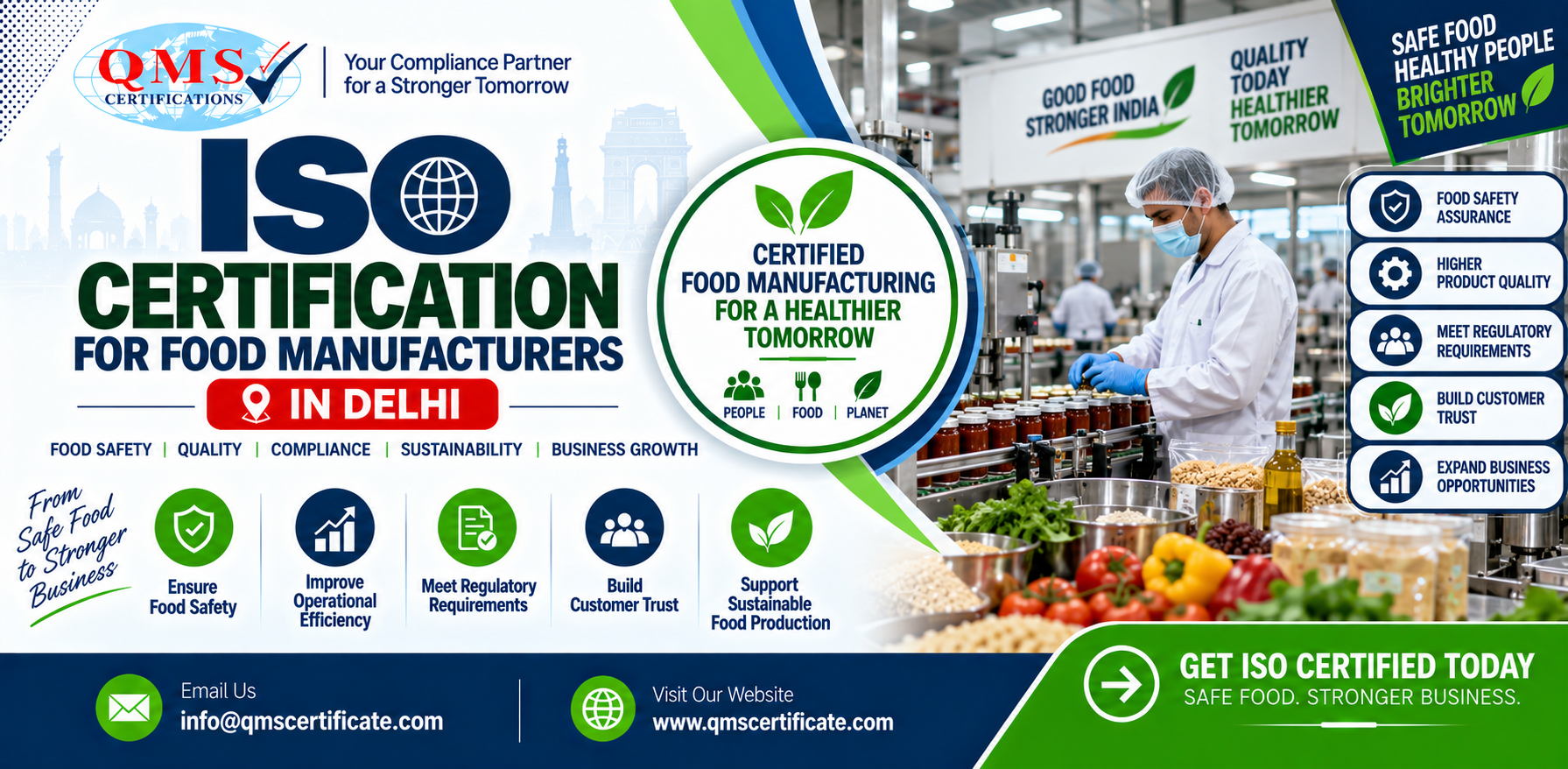
ISO Certification for Food Manufacturers Delhi
Introduction
For a food manufacturing business, quality is not only about taste, packaging, or shelf life. It is also about food safety, hygiene, process control, traceability, regulatory compliance, and customer confidence.
Whether you manufacture packaged foods, dairy products, beverages, spices, bakery items, frozen foods, snacks, edible oils, ready-to-eat meals, or food ingredients, a structured management system can make daily operations more reliable.
This is where ISO certification for food manufacturers in Delhi becomes valuable.
For many food businesses, ISO 22000 is the most relevant standard because it focuses on a Food Safety Management System (FSMS). ISO explains that ISO 22000 is designed for organizations throughout the food chain and combines food safety management with hazard-control principles, including HACCP-based approaches and prerequisite programmes.
For example, a Delhi-based packaged snack manufacturer may already have good production equipment and experienced workers. But if supplier approval, allergen controls, cleaning schedules, batch records, corrective actions, and traceability are handled inconsistently, problems can still occur. An effective ISO-based system helps bring these activities under controlled processes.
What Is ISO Certification for Food Manufacturers?
ISO certification means an organization's management system has been assessed against the requirements of a particular ISO standard by an independent certification body.
For food manufacturers, the most relevant standards may include:
ISO 22000 – Food Safety Management
ISO 22000:2018 specifies requirements for a Food Safety Management System applicable to organizations involved directly or indirectly in the food chain.
It can help businesses systematically identify, control, monitor, and improve food safety processes.
ISO 9001 – Quality Management System
ISO 9001 can complement food safety controls by helping manufacturers establish consistent processes, monitor performance, manage customer requirements, and continually improve operations.
ISO 14001 – Environmental Management
Food manufacturing can generate wastewater, organic waste, packaging waste, emissions, and high energy consumption. ISO 14001 can help organizations manage environmental aspects systematically.
ISO 45001 – Occupational Health & Safety
Food factories involve machinery, boilers, electrical equipment, chemicals, cold storage, lifting operations, and other workplace risks. ISO 45001 can support a structured occupational health and safety management system.
In many cases, businesses choose an integrated management system when quality, food safety, environmental performance, and workplace safety need to be managed together.
Important: ISO itself does not issue certificates to companies. Certification is carried out by independent certification bodies.
Why Choose QMS Certificate for Food Manufacturing ISO Certification?
Choosing the right certification support can make the process much easier, especially when your team is already busy with production and compliance responsibilities.
QMS Certificate provides certification-focused support for businesses looking to establish and demonstrate management-system compliance.
Our approach is designed around practical business operations rather than unnecessary paperwork.
What businesses can expect from professional support:
- Guidance based on the selected ISO standard
- Assistance in understanding applicable requirements
- Documentation and process guidance
- Support for implementation
- Audit preparation
- Identification of common compliance gaps
- Certification coordination
- Post-certification guidance
The objective is simple: help your organization develop a management system that works with your existing operations.
Key Benefits of ISO Certification for Food Manufacturers in Delhi
1. Stronger Food Safety Controls
ISO 22000 encourages a systematic approach to identifying and controlling food safety hazards across relevant stages of the food chain.
This can help manufacturers improve controls related to raw materials, processing, storage, handling, sanitation, and distribution.
2. Better Product Quality
A controlled production system reduces dependence on individual employees and helps establish repeatable processes.
This is particularly useful when a manufacturer handles multiple batches, SKUs, suppliers, or production shifts.
3. Improved Customer Confidence
Retailers, institutional buyers, distributors, and other B2B customers often want evidence that suppliers follow controlled quality and food safety practices.
ISO certification can provide an additional trust signal during supplier evaluation.
4. Improved Operational Efficiency
Well-defined procedures can reduce confusion, duplication, rework, and avoidable process failures.
For example, clear procedures for raw-material inspection can help production teams identify unsuitable inputs before they enter manufacturing.
5. Better Regulatory Readiness
ISO certification does not replace statutory food licenses or applicable Indian regulations. Food businesses must continue meeting relevant FSSAI requirements. FSSAI states that food businesses are subject to registration/licensing requirements and maintains the FoSCoS system for food licensing and compliance services.
An ISO-based system can, however, help create a more organized framework for managing compliance-related processes.
6. Easier Market Expansion
A structured food safety and quality management system can strengthen the credibility of manufacturers working with larger retailers, institutional buyers, exporters, and supply-chain partners.
Step-by-Step ISO Certification Process for Food Manufacturers
The exact process depends on your organization, scope, standard, and certification body. A practical certification journey generally includes the following stages:
Step 1: Identify the Applicable Standard
First, determine whether your business needs ISO 22000, ISO 9001, ISO 14001, ISO 45001, or an integrated approach.
For most food manufacturers, food safety requirements should be a major consideration.
Step 2: Define the Certification Scope
The scope should clearly explain the activities, products, processes, and locations covered by the management system.
Step 3: Gap Assessment
Existing practices are reviewed against the applicable requirements.
This helps identify areas that need improvement before the certification audit.
Step 4: Develop Documentation
Depending on the standard and organization, documentation may include policies, procedures, objectives, process controls, records, monitoring methods, corrective-action processes, and food safety plans.
Step 5: Implement the System
Documentation alone is not enough.
Employees need to follow the defined processes and maintain appropriate records. Food safety controls should become part of normal production activities.
Step 6: Internal Review and Corrective Action
The organization evaluates whether its management system is working effectively and addresses identified gaps.
Step 7: Certification Audit
An independent certification body assesses the management system against the applicable standard.
If the requirements are satisfactorily met, certification can proceed according to the certification body's process.
Documents Required for ISO Certification
The exact documentation varies according to the standard, company size, processes, and certification scope.
Common business and management documents may include:
- Business registration or company details
- Organization profile
- Product and process information
- Organization structure
- Quality or food safety policy
- Objectives and process controls
- Production procedures
- Cleaning and sanitation records
- Supplier evaluation records
- Raw-material inspection records
- Batch or production records
- Traceability records
- Training records
- Equipment maintenance records
- Calibration records, where applicable
- Internal audit records
- Corrective-action records
- Applicable licenses and regulatory documents
- Food safety plans and hazard-control documentation, where applicable
For food manufacturers, documentation should reflect actual operations. Creating paperwork that employees do not use can make a management system difficult to maintain.
Which Food Businesses Can Benefit?
ISO certification support can be relevant to many types of food manufacturing businesses, including:
- Dairy and milk product manufacturers
- Bakery and confectionery manufacturers
- Packaged food manufacturers
- Spice and seasoning manufacturers
- Snack and namkeen manufacturers
- Beverage manufacturers
- Frozen food manufacturers
- Ready-to-eat food manufacturers
- Meat and poultry processors
- Edible oil manufacturers
- Food ingredient manufacturers
- Grain and cereal processors
- Pickle and sauce manufacturers
- Food packaging-related businesses
- Private-label food manufacturers
The appropriate certification scope should be determined according to the organization's actual activities and applicable requirements.
Internal Linking Suggestions for QMS Certificate
For stronger website architecture and topical authority, this article can internally link to relevant QMS Certificate service pages:
- ISO Certification in Delhi
- ISO 22000 Certification
- ISO 9001:2015 Certification
- ISO 14001 Certification
- QMS Certificate Homepage
Use the ISO 22000 URL only if that page is live on the website; otherwise link to the most relevant food-safety service page.
ISO 22000 and Food Safety: What Manufacturers Should Know
ISO 22000:2018 remains the published ISO standard for food safety management, with Amendment 1:2024 addressing climate-action changes. ISO also currently lists a new ISO/DIS 22000 under development, so organizations planning certification should confirm the applicable edition and transition requirements with their certification body.
This is especially important for businesses planning long-term certification rather than treating ISO as a one-time document exercise.
For Indian food manufacturers, ISO certification should also be considered alongside applicable FSSAI licensing, hygiene, sanitation, and food-safety requirements. FSSAI specifically highlights the importance of documented food safety management systems, GMP, and GHP for relevant food businesses.
External authority reference
For authoritative information about ISO 22000, refer to the official ISO 22000:2018 standard page and the Food Safety and Standards Authority of India (FSSAI).
Frequently Asked Questions
1. What is ISO certification for food manufacturers in Delhi?
ISO certification for food manufacturers in Delhi is an independent assessment of a food manufacturer's management system against a selected ISO standard. ISO 22000 is specifically designed for food safety management systems.
2. Which ISO certification is best for a food manufacturing company?
For food safety management, ISO 22000 is generally the key standard to consider. Depending on business requirements, manufacturers may also implement ISO 9001 for quality, ISO 14001 for environmental management, or ISO 45001 for occupational health and safety.
3. Is ISO 22000 certification mandatory for food manufacturers?
ISO 22000 certification itself is not universally mandatory. However, applicable statutory and regulatory requirements, including FSSAI licensing and compliance obligations, still apply to food businesses. ISO 22000 is a voluntary management-system certification unless a customer, contract, market, or other requirement makes it necessary.
4. What documents are needed for ISO 22000 certification?
Typical documents can include company information, food safety policy, process details, hazard analysis and food safety plans, supplier controls, sanitation records, traceability records, training records, monitoring records, internal audit results, corrective actions, and applicable regulatory documents.
5. How can I get ISO certification for my food manufacturing company in Delhi?
Start by identifying the appropriate ISO standard and certification scope. QMS Certificate can help you understand the requirements, prepare your management system, address implementation gaps, prepare for audit, and coordinate the certification process.
Get ISO Certified with QMS Certificate
Food manufacturing demands consistency because one weak process can affect product quality, customer confidence, and business reputation.
A properly implemented ISO management system can help your Delhi-based food manufacturing business move from informal controls to documented, measurable, and continually improving processes.
If you are planning ISO certification for food manufacturers in Delhi, speak with QMS Certificate about the standard and certification scope appropriate for your business.
Email: info@qmscertificate.com
Website: www.qmscertificate.com
Get started today and build a stronger foundation for food safety, quality, compliance, and business growth.
Conclusion
ISO certification is more than a certificate displayed on the office wall. For a food manufacturer, its real value comes from creating reliable processes that help control risks, improve consistency, strengthen documentation, and build confidence among customers and business partners.
With ISO 22000, manufacturers can establish a structured food safety management system covering relevant food-safety risks throughout their operations. Combined with appropriate quality, environmental, and occupational safety systems, ISO certification can support a more resilient and professionally managed food manufacturing business.
For businesses searching for ISO certification for food manufacturers in Delhi, QMS Certificate offers practical certification support focused on business needs and management-system implementation.
Having any Query? Talk to our Experts
Our Projects are fully tested, background checked, license validated and insured
with a 100% satisfaction guarantee.
Contact Info
 qmscertify@gmail.com
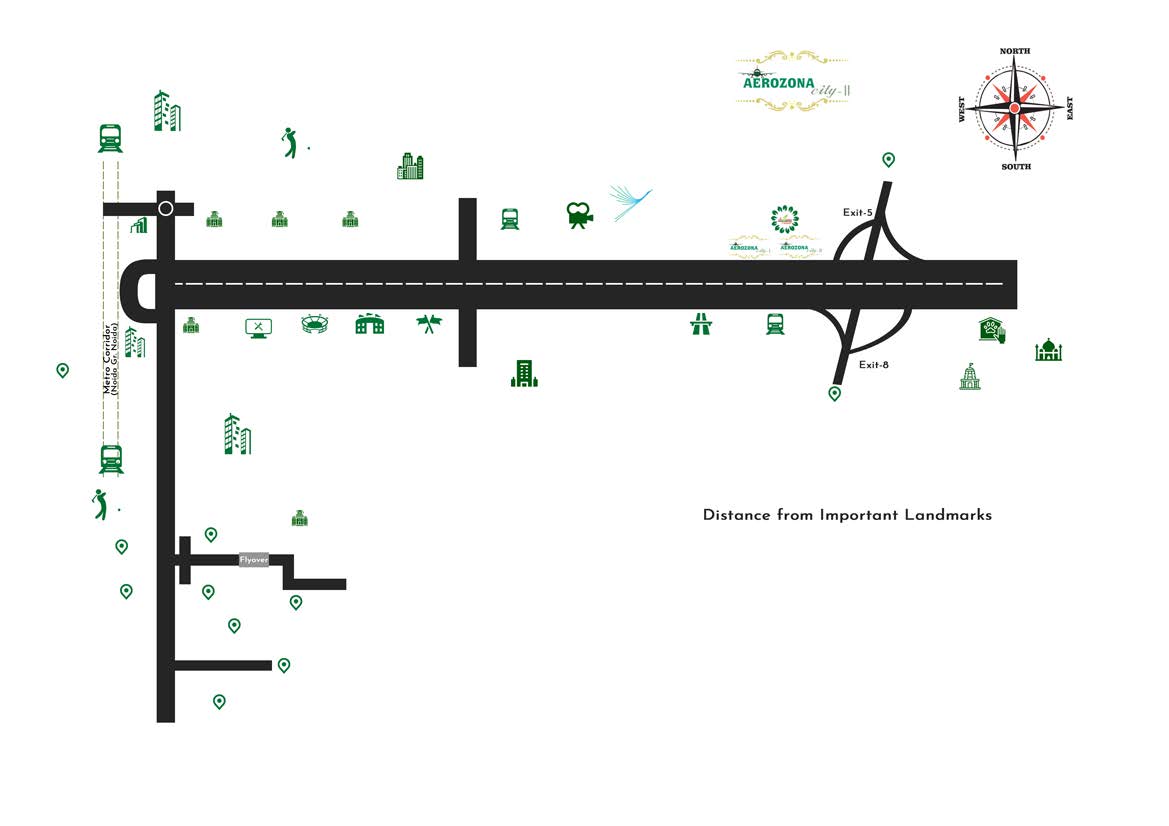 View Location Map