

ISO Certification for Electrical Manufacturers Delhi
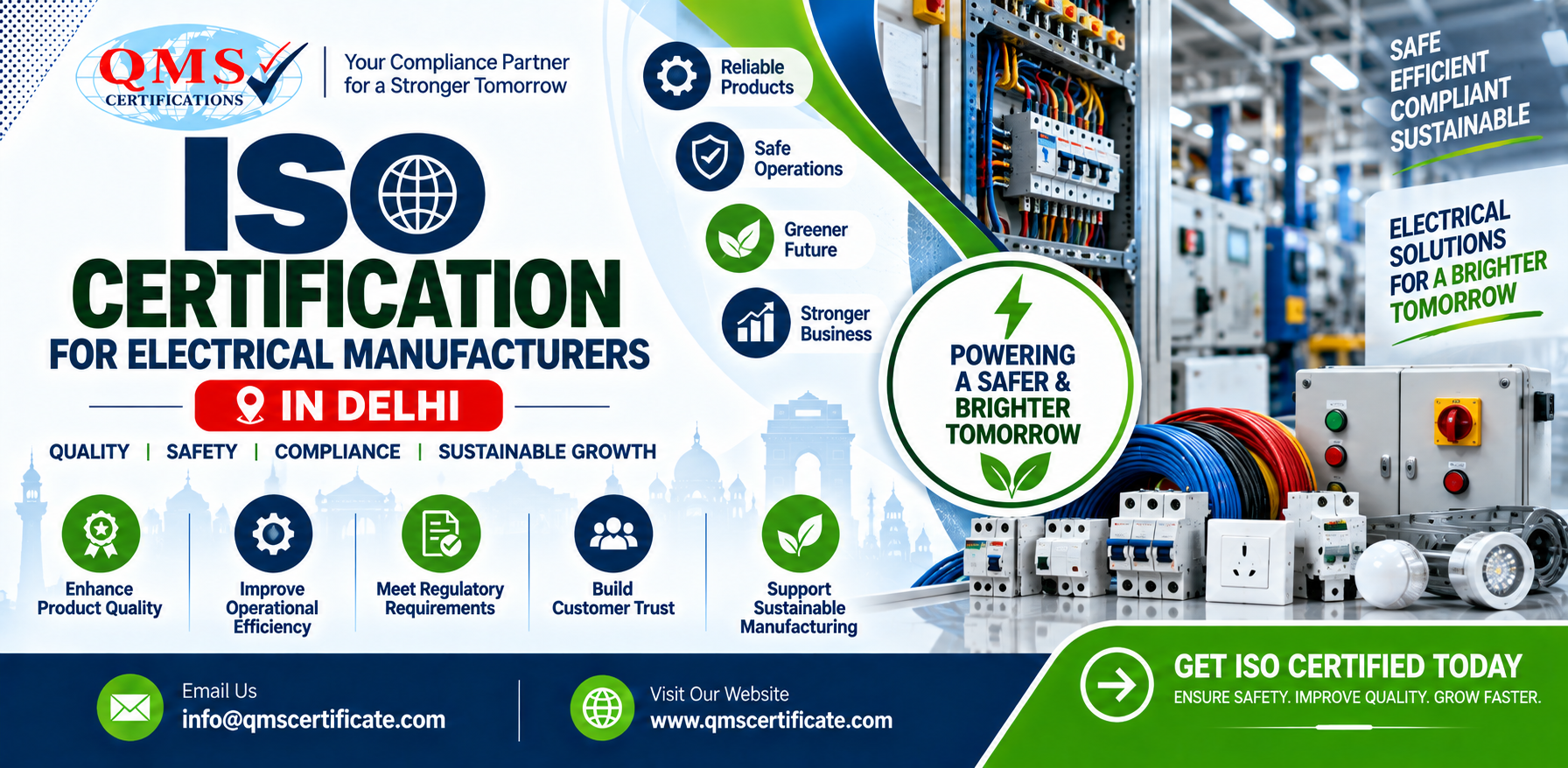
ISO Certification for Electrical Manufacturers Delhi
Introduction
The electrical manufacturing industry demands accuracy, consistency and dependable processes. A manufacturer producing control panels, electrical components, cables, switches, transformers, wiring accessories, industrial electrical equipment or other products must maintain reliable production and inspection practices.
For businesses supplying contractors, OEMs, infrastructure companies, distributors or industrial customers, inconsistent quality can quickly lead to rejected products, rework, complaints and lost business.
This is why ISO certification for electrical manufacturers in Delhi can be a valuable business investment.
ISO certification provides a structured management-system framework that helps an organization control its processes, monitor performance and improve consistently. ISO 9001 is commonly used for quality management, while ISO 14001 and ISO 45001 can support environmental and occupational health and safety management.
ISO 9001 is designed for organizations of different sizes and sectors. Its requirements cover areas such as leadership, planning, support, operations, performance evaluation and improvement.
For an electrical manufacturer, the important point is simple: ISO certification should not be treated merely as a certificate. It should help the company create better-controlled and repeatable business processes.
What Is ISO Certification for Electrical Manufacturers?
ISO certification involves an assessment of an organization's management system against the requirements of a particular ISO standard by an independent certification body.
For an electrical manufacturing company, the management system may cover:
- Raw material purchasing and inspection
- Supplier evaluation
- Production planning
- Assembly and manufacturing processes
- In-process inspection
- Final product inspection
- Testing and measurement
- Equipment maintenance
- Calibration, where applicable
- Product identification and traceability
- Non-conforming product control
- Customer complaint handling
- Employee competence and training
- Corrective action
- Internal audits
- Management review
For example, an electrical component manufacturer supplying products to an infrastructure contractor may need to consistently meet specified dimensions, materials, performance requirements and delivery schedules. A properly implemented quality management system can help the business define how these requirements are received, controlled, checked and improved.
Which ISO Standards Are Suitable for Electrical Manufacturers?
There is no single ISO certification that every electrical manufacturer must obtain. The appropriate standard depends on the company's operations, customers, risks and objectives.
ISO 9001 Certification for Electrical Manufacturers
ISO 9001 certification for electrical manufacturers focuses on the Quality Management System (QMS).
It can help manufacturers establish systematic controls around customer requirements, production processes, supplier management, monitoring, inspection and continual improvement.
ISO describes ISO 9001 as a globally recognized quality management standard applicable to organizations across sectors and sizes.
For electrical manufacturers, ISO 9001 can be relevant to businesses producing:
- Electrical panels
- Switchgear
- Switches and sockets
- Cables and wires
- Transformers
- Electrical connectors
- Control equipment
- Industrial electrical components
- Power distribution equipment
- Wiring accessories
ISO 14001 Certification
Electrical manufacturing can involve energy consumption, material use, packaging waste, scrap and other environmental aspects.
ISO 14001 certification provides a framework for establishing an environmental management system and systematically managing relevant environmental aspects.
This can be particularly useful for manufacturers that want to improve resource efficiency and demonstrate stronger environmental management.
ISO 45001 Certification
Electrical factories may involve machinery, electrical hazards, material handling, assembly equipment and other workplace risks.
ISO 45001 certification helps organizations establish a structured occupational health and safety management system.
It can support systematic identification of workplace hazards, risk controls, employee awareness and continual improvement.
Integrated Management System
Some electrical manufacturers may benefit from integrating:
ISO 9001 + ISO 14001 + ISO 45001
Instead of managing three systems independently, common activities such as document control, internal audits, corrective actions and management reviews can be coordinated within an integrated framework.
Why Choose QMS Certificate?
An ISO consultant should understand that certification is ultimately about the organization's processes—not simply documentation.
QMS Certificate focuses on ISO certification support for businesses seeking structured management-system certification. For an electrical manufacturer, the approach should begin by understanding the company's products, manufacturing activities, workforce, locations and customer requirements.
Key reasons to consider QMS Certificate:
Business-focused guidance
The certification approach can be aligned with the organization's actual operations rather than using unnecessary generic procedures.
Documentation support
Relevant policies, procedures, objectives and records can be developed according to the applicable management-system requirements.
Implementation guidance
Employees need to understand how the system affects their daily work. Practical implementation is therefore as important as documentation.
Audit preparation
Proper preparation can help management and employees understand the certification assessment process.
End-to-end assistance
From identifying the applicable standard to preparing for certification, a structured approach can make the process easier to manage.
The strongest management systems are those that employees can actually use in day-to-day operations.
Key Benefits of ISO Certification for Electrical Manufacturers
1. Improve Product Quality
Defined production and inspection processes can help manufacturers achieve greater consistency in product output.
2. Reduce Defects and Rework
A systematic approach to non-conformities and root-cause analysis can help identify recurring problems and reduce unnecessary rework.
3. Strengthen Process Control
Clearly documented responsibilities and controlled processes can make manufacturing activities easier to monitor.
4. Improve Supplier Performance
Electrical manufacturers rely on materials and components from suppliers. A structured supplier evaluation process can help businesses monitor supplier performance and incoming material quality.
5. Increase Customer Confidence
Certification can provide customers with additional confidence that the organization has established a formal management system.
6. Support B2B Business Growth
Large customers, procurement departments and certain tenders may request management-system certification. Having an appropriate certification can strengthen a company's eligibility where such requirements apply.
7. Improve Operational Efficiency
ISO 9001 encourages organizations to monitor processes, evaluate performance and identify opportunities for improvement. ISO identifies process improvement, customer confidence and continual optimization among the potential business benefits of ISO 9001.
8. Build a Culture of Continual Improvement
Instead of fixing the same problems repeatedly, the organization can use data, audits, customer feedback and corrective actions to improve its processes over time.
Step-by-Step ISO Certification Process
The ISO certification process for electrical manufacturers in Delhi generally follows a structured sequence.
Step 1: Initial Consultation
The first stage is understanding your business.
This may include reviewing:
- Products manufactured
- Production processes
- Number of employees
- Locations
- Existing quality controls
- Customer requirements
- Desired certification scope
This information helps determine the appropriate ISO standard.
Step 2: Gap Analysis
Existing processes are compared against the applicable ISO requirements.
The purpose is to identify what is already in place and what needs improvement.
Step 3: Documentation Preparation
Relevant policies, procedures, objectives, process controls and records are established.
Documentation should be appropriate to the business and easy for employees to understand.
Step 4: Implementation
The management system is put into practice.
Employees are made aware of their responsibilities, and relevant records are maintained as part of normal operations.
Step 5: Internal Audit
An internal audit evaluates whether the management system has been implemented effectively.
Identified gaps or non-conformities are addressed through corrective action.
Step 6: Management Review
Top management reviews the performance and effectiveness of the management system.
This may include customer feedback, objectives, audit results, process performance, non-conformities and improvement opportunities.
Step 7: Certification Audit
An independent certification body evaluates the organization's management system against the applicable ISO requirements.
If conformity is demonstrated through the certification process, certification may be issued according to the certification body's procedures.
ISO itself develops and publishes ISO 9001; it does not directly certify organizations. Certification, when chosen, is performed by independent certification bodies.
Documents Required for ISO Certification
The exact documentation depends on the selected standard, certification scope and complexity of the electrical manufacturing operation.
Common information and records may include:
- Business registration documents
- Company profile
- Certification scope
- Organization structure
- Applicable management-system policy
- Quality objectives
- Process information
- Supplier evaluation records
- Purchase records
- Incoming material inspection records
- Production records
- Product inspection and testing records
- Equipment maintenance records
- Calibration records, where applicable
- Employee training records
- Competency records
- Customer complaint records
- Non-conformity records
- Corrective-action records
- Internal audit records
- Management review records
- Applicable statutory and regulatory information
The objective is not to create paperwork for its own sake. ISO 9001 emphasizes documented information alongside operational control, performance evaluation and improvement.
ISO Certification for Different Electrical Manufacturing Businesses
ISO certification for electrical manufacturers in Delhi can be relevant to many types of electrical businesses, including:
- Electrical equipment manufacturers
- Switchgear manufacturers
- Control panel manufacturers
- Cable and wire manufacturers
- Transformer manufacturers
- Electrical component manufacturers
- Switch and socket manufacturers
- Industrial electrical equipment manufacturers
- Power distribution equipment manufacturers
- Electrical accessories manufacturers
- Control and automation equipment manufacturers
The certification scope should accurately reflect the organization's actual activities.
Internal Linking Suggestions for QMS Certificate
For better topical SEO and user navigation, add contextual internal links to relevant pages on QMS Certificate:
- ISO Certification in Delhi
- ISO 9001 Certification
- ISO 14001 Certification
- ISO 45001 Certification
- ISO Certification Cost in Delhi
- ISO Certification Consultant in Delhi
- ISO Certification Services
- Contact QMS Certificate
Use descriptive anchor text rather than repeatedly using the exact same keyword. This creates a stronger internal topic cluster around ISO certification, manufacturing and Delhi.
External Authority Reference
For authoritative information, reference the official International Organization for Standardization (ISO) website when explaining ISO standards.
The official ISO 9001 information explains that the standard applies across sectors and organizational sizes and provides requirements for establishing, implementing, maintaining and continually improving a quality management system.
Important 2026 publishing note: ISO currently lists the sixth edition of ISO 9001 as under publication for September 2026, with ISO 9001:2015 being replaced. If this page is published or updated after the new edition becomes effective, update the ISO 9001 terminology and transition information accordingly.
Frequently Asked Questions
1. What is ISO certification for electrical manufacturers in Delhi?
ISO certification for electrical manufacturers in Delhi is an independent assessment of an electrical manufacturer's management system against the requirements of an applicable ISO standard. ISO 9001 is commonly used for quality management, while ISO 14001 and ISO 45001 address environmental and occupational health and safety management.
2. Which ISO certification is best for electrical manufacturers?
ISO 9001 certification is generally a suitable starting point for electrical manufacturers that want to improve quality management, process control, customer satisfaction and continual improvement. ISO 14001 and ISO 45001 may be added when environmental management or workplace safety is an important business objective.
3. Is ISO certification mandatory for electrical manufacturers in Delhi?
ISO certification is not universally mandatory for every electrical manufacturer. However, particular customers, contracts, procurement requirements or tenders may request an applicable ISO certification. Manufacturers should check the requirements associated with their specific products and markets.
4. How long does ISO certification take for an electrical manufacturer?
The timeframe depends on the company's size, number of employees, certification scope, operational complexity and existing management practices. An organization with established processes and records may require less preparation than a company developing a management system for the first time.
5. Can a small electrical manufacturing company obtain ISO certification?
Yes. ISO 9001 is designed to be applicable to organizations of different sizes and sectors. A small electrical manufacturer can establish a management system appropriate to its operations without creating unnecessarily complicated processes.
Conclusion
For electrical manufacturers, quality is not limited to the final inspection of a product. It begins with understanding customer requirements and continues through purchasing, production, testing, delivery, complaint handling and continual improvement.
ISO certification for electrical manufacturers in Delhi can help bring these activities into a more structured management system.
Whether you manufacture electrical panels, cables, switchgear, transformers, control equipment, switches or industrial electrical components, the right ISO standard can strengthen process control, improve consistency and support customer confidence.
The real value of certification comes from implementing a system that works inside the factory and across the organization, not simply displaying a certificate.
Ready to Start Your ISO Certification?
QMS Certificate can help you understand the appropriate ISO standard, certification scope, documentation requirements and preparation process for your electrical manufacturing business.
📧 Email: info@qmscertificate.com
🌐 Website: www.qmscertificate.com
Contact QMS Certificate today to discuss ISO certification for your electrical manufacturing company in Delhi and take the next step toward stronger quality, compliance and business growth.
Having any Query? Talk to our Experts
Our Projects are fully tested, background checked, license validated and insured
with a 100% satisfaction guarantee.
Contact Info
 qmscertify@gmail.com
 View Location Map