

ISO Certification for Construction Material Manufacturers
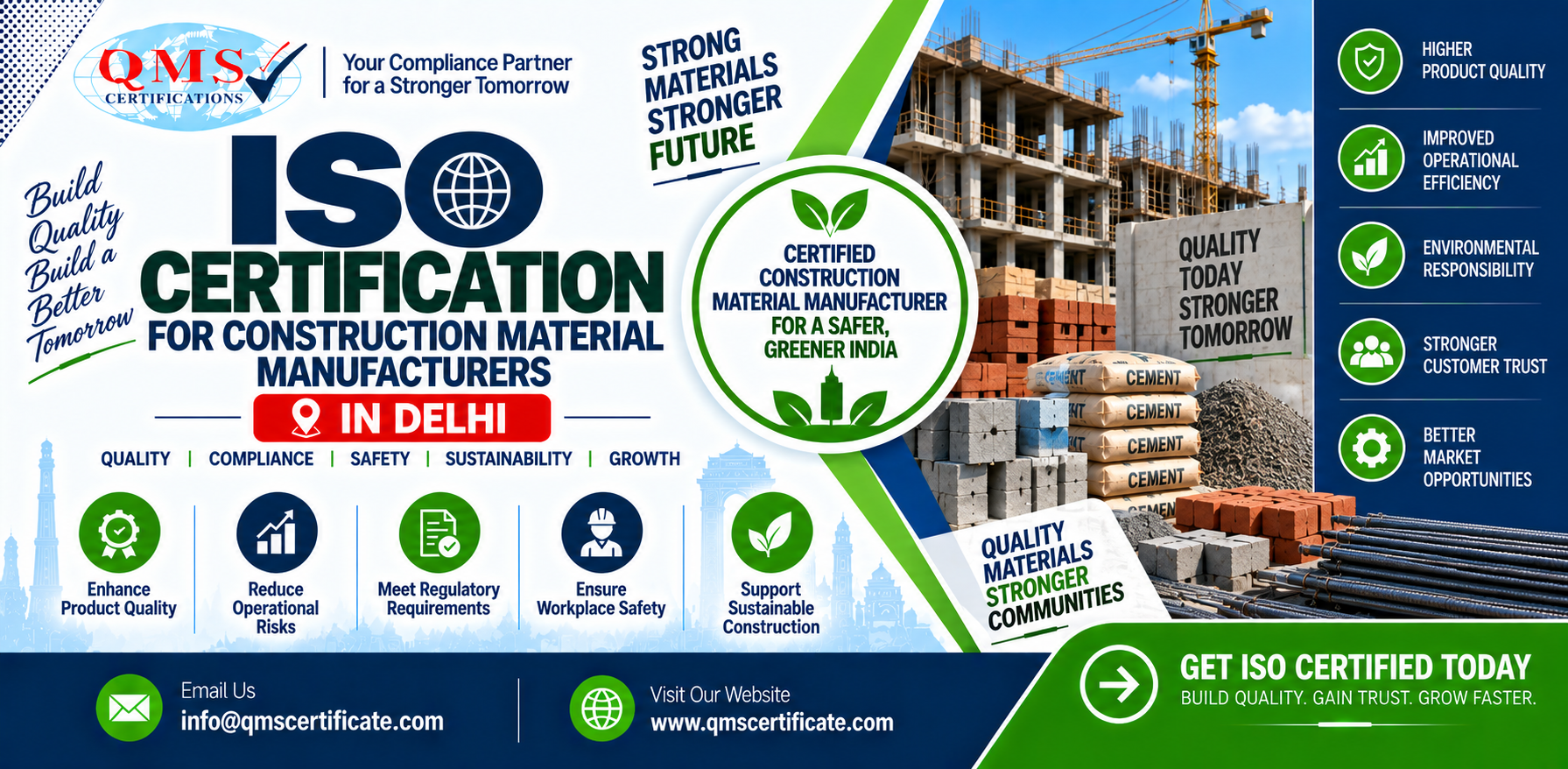
ISO Certification for Construction Material Manufacturers
Introduction
Construction materials are the foundation of every building, road, bridge, factory, and infrastructure project. From cement and concrete to bricks, blocks, pipes, tiles, steel products, glass, adhesives, paints, and precast components, consistent quality is essential.
For manufacturers, maintaining that consistency becomes more challenging as production volumes increase, product ranges expand, and customers demand stronger quality assurance.
This is where ISO certification for construction material manufacturers in Delhi can provide a structured approach to quality and process management.
The most common starting point is ISO 9001, the internationally recognized quality management system standard. ISO explains that ISO 9001 provides a framework for organizations to consistently deliver products and services that meet customer and applicable regulatory expectations while continually improving their processes.
For example, a Delhi manufacturer producing concrete blocks may have excellent machinery but still face inconsistent raw-material quality, production variations, testing delays, customer complaints, or weak documentation. A properly implemented QMS helps bring these activities under controlled and measurable processes.
What Is ISO Certification for Construction Material Manufacturers?
ISO certification is an independent assessment of an organization's management system against the requirements of a selected ISO standard.
For construction material manufacturers, ISO 9001 is often highly relevant because it focuses on quality management, customer requirements, process control, monitoring, corrective action, and continual improvement.
Depending on the company's operations and business objectives, other standards may also be useful:
ISO 9001 – Quality Management
Helps manufacturers establish controlled processes for production, purchasing, inspection, customer requirements, nonconformities, and continual improvement.
ISO 14001 – Environmental Management
Can be useful for businesses managing environmental aspects such as energy use, emissions, waste, water consumption, and resource efficiency.
ISO 45001 – Occupational Health & Safety
Relevant to factories where employees work around heavy machinery, furnaces, material-handling equipment, chemicals, production lines, or other workplace hazards.
Integrated Management Systems
Some manufacturers may choose to integrate quality, environmental, and occupational health and safety systems instead of managing each separately.
It is also important to distinguish ISO certification from product certification. ISO 9001 certification evaluates the management system; it does not automatically certify a particular cement, brick, pipe, steel product, or concrete product against an Indian product standard.
Why Choose QMS Certificate?
Construction material manufacturing involves technical processes, production controls, testing requirements, suppliers, machinery, storage, transportation, and customer specifications.
QMS Certificate helps businesses approach ISO certification with a practical focus rather than treating certification as paperwork alone.
Our support can include:
- Understanding the applicable ISO standard
- Defining the certification scope
- Reviewing existing processes
- Identifying management-system gaps
- Documentation guidance
- Implementation support
- Internal audit preparation
- Corrective-action guidance
- Certification audit preparation
- Certification coordination
The objective is to help manufacturers establish a system that fits their actual factory operations, workforce, products, and business requirements.
Key Benefits of ISO Certification for Construction Material Manufacturers in Delhi
1. Improve Product Quality
Construction projects depend heavily on material consistency.
A structured quality management system can help manufacturers control production processes, inspections, testing, specifications, and nonconforming products more systematically.
This is especially useful when supplying contractors, builders, infrastructure companies, distributors, or government-related projects.
2. Better Process Control
Manufacturing problems often originate from inconsistent processes rather than one major equipment failure.
ISO-based process control can help businesses define responsibilities, establish procedures, monitor performance, and identify where improvements are needed.
3. Stronger Customer Confidence
A builder purchasing thousands of concrete blocks or a contractor sourcing structural products needs confidence that the supplier can consistently meet agreed specifications.
ISO certification can strengthen a manufacturer's credibility during vendor evaluation and B2B negotiations.
4. Reduce Waste and Rework
Better control over raw materials, production parameters, inspection, and nonconformities can help identify recurring causes of defects.
Reducing rework can save both material and production time.
5. Better Supplier Management
Construction-material manufacturers often depend on suppliers for cement inputs, aggregates, chemicals, additives, metals, packaging, or other raw materials.
A QMS can establish more consistent methods for supplier selection, evaluation, purchasing, incoming inspection, and performance monitoring.
6. Support Regulatory and Industry Requirements
ISO certification does not replace mandatory product regulations, BIS requirements, building codes, or other applicable legal obligations.
However, a well-managed QMS can help a company organize processes and records used to demonstrate control.
BIS maintains extensive Indian Standards covering construction materials such as cement, aggregate, concrete, reinforcing steel, bricks, blocks, and other building products.
For example, BIS lists IS 383:2016 for coarse and fine aggregate for concrete, while its product-certification scheme includes several cement varieties under applicable compulsory certification requirements.
Manufacturers should therefore determine which product-specific BIS or regulatory requirements apply to their products separately from ISO management-system certification.
7. Create Opportunities for Business Growth
Large customers increasingly evaluate suppliers on more than price.
A documented and independently assessed quality management system can help demonstrate that the manufacturer takes process consistency, customer requirements, and continual improvement seriously.
Step-by-Step ISO Certification Process
Step 1: Select the Appropriate ISO Standard
First, determine whether ISO 9001 is the primary requirement or whether your business would benefit from ISO 14001, ISO 45001, or an integrated management system.
Step 2: Define the Certification Scope
The scope should clearly describe the manufacturing activities, products, locations, and processes covered by the management system.
For example, the scope could cover the manufacture and supply of precast concrete products at a specific manufacturing facility.
Step 3: Conduct a Gap Assessment
Existing practices are compared with the requirements of the selected standard.
This helps identify gaps in areas such as:
- Production controls
- Quality objectives
- Supplier management
- Inspection and testing
- Equipment maintenance
- Training
- Customer complaints
- Corrective actions
- Internal audits
Step 4: Prepare the Required Documentation
The organization develops or updates policies, procedures, process controls, records, objectives, and other documented information relevant to its operations.
Step 5: Implement the QMS
The system must be put into practice.
Employees should understand their responsibilities, follow approved procedures, maintain appropriate records, and report nonconformities through defined processes.
Step 6: Internal Audit and Management Review
Internal audits help determine whether the QMS is being followed effectively.
Management review then provides an opportunity to evaluate performance, risks, objectives, customer feedback, audit findings, and improvement opportunities.
Step 7: Certification Audit
An independent certification body assesses the organization's management system.
If the applicable requirements are satisfactorily met, certification can proceed according to the certification body's process.
Documents Required for ISO Certification
The exact documents depend on the company's size, products, processes, certification scope, and selected standard.
Common documentation may include:
- Company registration details
- Organization profile
- Organization structure
- Product and process information
- Quality policy
- Quality objectives
- Production procedures
- Inspection and testing records
- Raw-material inspection records
- Supplier evaluation records
- Purchase records
- Equipment maintenance records
- Calibration records, where applicable
- Employee training records
- Customer complaint records
- Nonconformity records
- Corrective-action records
- Internal audit records
- Management review records
- Applicable statutory and regulatory documents
- Relevant product specifications and standards
The important point is that documentation should represent how the factory actually operates. A practical QMS is much easier to maintain than a collection of documents created only for an audit.
Which Construction Material Manufacturers Can Benefit?
ISO certification can be relevant to manufacturers and suppliers of many construction-related products, including:
- Cement manufacturers
- Ready-mix concrete manufacturers
- Precast concrete manufacturers
- Concrete blocks and AAC blocks
- Bricks and masonry products
- Tiles and flooring materials
- Steel and reinforcement products
- Pipes and fittings
- Construction chemicals
- Adhesives and sealants
- Waterproofing products
- Paints and coatings
- Glass products
- Gypsum products
- Insulation materials
- Roofing materials
- Aggregates and related materials
BIS's construction-material resources cover a broad range of categories, including cement and concrete, masonry units, building chemicals, glass, gypsum products, paints, polymers, steel, structural sections, waterproofing materials, and other products.
ISO 9001 and BIS Certification: Are They the Same?
No.
This is an important distinction for construction material manufacturers.
ISO 9001 certification assesses the organization's quality management system.
BIS product certification relates to conformity of applicable products with relevant Indian Standards and schemes.
A manufacturer may need to address both depending on the product, customer requirements, and applicable regulations.
BIS also maintains the National Building Code of India, which provides a comprehensive framework covering areas including building requirements, fire safety, materials, structural design, construction, sustainability, and related services.
Therefore, manufacturers should identify their product-specific obligations separately instead of assuming that ISO certification replaces BIS or statutory requirements.
Internal Linking Suggestions
For stronger topical SEO and easier navigation, this article can internally link to:
- ISO Certification in Delhi: https://www.qmscertificate.com/iso-certification-in-delhi
- ISO 9001:2015 Certification: https://www.qmscertificate.com/iso-9001-2015
- ISO 14001 Certification: https://www.qmscertificate.com/iso-14001-2015.php
- ISO 13485 Certification: https://www.qmscertificate.com/delhi/delhi/iso-13485-certification
- QMS Certificate Homepage: https://www.qmscertificate.com/
Recommended anchor text includes “ISO certification in Delhi,” “ISO 9001 certification,” and “ISO certification for manufacturers.”
Frequently Asked Questions
1. What is ISO certification for construction material manufacturers in Delhi?
ISO certification for construction material manufacturers in Delhi is an independent assessment of a manufacturer's management system against a selected ISO standard. ISO 9001 is commonly used to establish a structured quality management system.
2. Which ISO certification is best for construction material manufacturers?
ISO 9001 is generally the key standard for quality management. Depending on the organization's environmental and workplace-safety objectives, ISO 14001 and ISO 45001 may also be appropriate.
3. Is ISO 9001 certification mandatory for construction material manufacturers?
ISO 9001 certification itself is not universally mandatory. However, manufacturers must comply with applicable product-specific laws, regulations, Indian Standards, customer requirements, and certification schemes. BIS requirements can vary significantly by product.
4. Does ISO 9001 replace BIS certification?
No. ISO 9001 focuses on the organization's quality management system, while applicable BIS certification concerns product conformity with relevant Indian Standards and certification schemes. A manufacturer may need both depending on its products and obligations.
5. How can I get ISO certification for construction material manufacturing in Delhi?
Start by identifying the applicable standard and certification scope. The next steps generally involve a gap assessment, QMS documentation, implementation, internal audit, management review, and an independent certification audit.
Get ISO Certified with QMS Certificate
Quality problems in construction materials can lead to rejected batches, project delays, customer complaints, rework, and reputational damage.
A properly implemented ISO management system can help manufacturers establish consistent processes, stronger quality controls, better documentation, and continual improvement.
If you are searching for ISO certification for construction material manufacturers in Delhi, QMS Certificate can help you understand the certification requirements and prepare your organization for the certification process.
Contact QMS Certificate
📧 Email: info@qmscertificate.com
🌐 Website: www.qmscertificate.com
Take the next step toward stronger quality management, better customer confidence, and sustainable business growth. Contact QMS Certificate today.
Conclusion
For construction material manufacturers, quality is closely connected with the performance and reliability of the projects where their products are used.
Whether you manufacture cement, concrete, blocks, tiles, pipes, steel products, construction chemicals, or other building materials, a structured quality management system can make production more consistent and business processes easier to control.
ISO 9001 provides a recognized framework for managing quality, customer requirements, process performance, corrective action, and continual improvement.
Having any Query? Talk to our Experts
Our Projects are fully tested, background checked, license validated and insured
with a 100% satisfaction guarantee.
Contact Info
 qmscertify@gmail.com
 View Location Map