

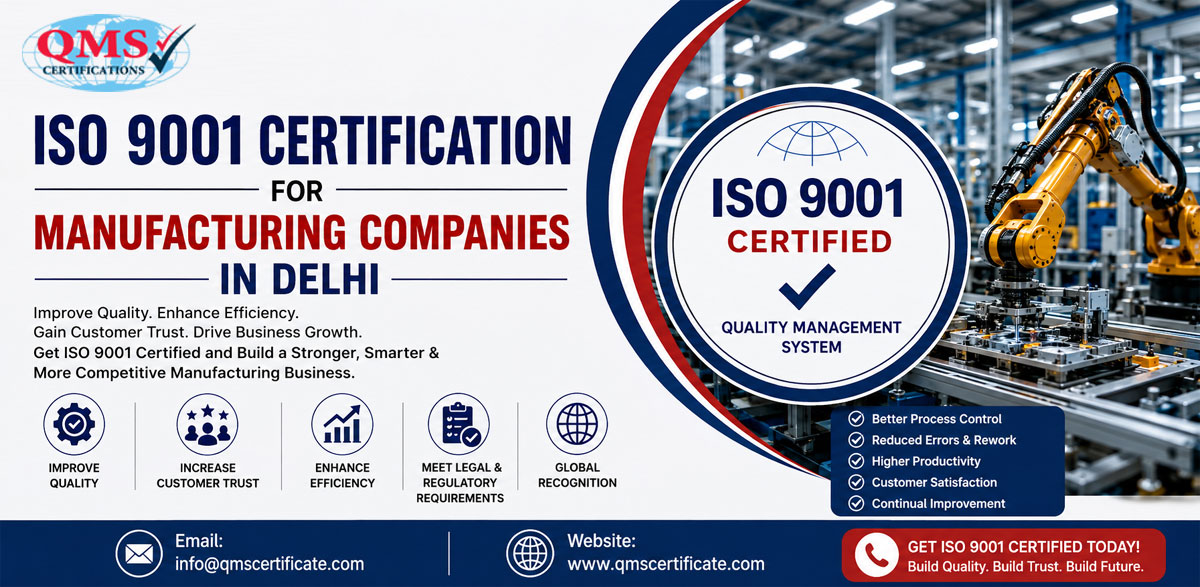
ISO 9001 Certification for Manufacturing Companies in Delhi
ISO 9001 Certification for Manufacturing Companies in Delhi
Introduction
Manufacturing companies operate through a chain of connected activities, from purchasing raw materials and production to inspection, packaging, storage and final delivery. When these processes are not properly controlled, businesses can face inconsistent quality, rework, customer complaints, production delays and unnecessary costs.
This is where ISO 9001 Certification for Manufacturing Companies in Delhi can make a practical difference.
ISO 9001 is an internationally recognized standard for a Quality Management System (QMS). It provides a structured framework for organizations to manage processes, understand customer requirements, evaluate performance and continually improve their operations. ISO confirms that ISO 9001 applies across sectors and is suitable for organizations of different sizes, including manufacturing businesses.
For a Delhi-based manufacturer, ISO 9001 certification can also strengthen credibility when dealing with customers, suppliers, business partners and procurement requirements.
What Is ISO 9001 Certification for Manufacturing Companies?
ISO 9001 certification demonstrates that an organization's quality management system has been independently assessed against the requirements of ISO 9001.
It is important to understand that ISO itself does not issue ISO 9001 certificates. Certification is carried out by independent certification bodies, and accredited certification can provide an additional level of confidence to customers and other stakeholders.
For manufacturers, the focus is not simply on preparing documents. The QMS should reflect the company's real activities and help control important processes such as:
-
Raw material procurement
-
Supplier evaluation
-
Production planning
-
Manufacturing operations
-
Inspection and testing
-
Equipment and measurement control
-
Nonconformity handling
-
Customer complaints
-
Corrective action
-
Internal audits
-
Management review
-
Continual improvement
A good quality management system connects these activities instead of treating quality as the responsibility of only one department.
Why Choose ISO 9001 for Your Manufacturing Business?
Manufacturing companies in Delhi face pressure to maintain consistent quality while controlling costs and meeting customer delivery expectations. ISO 9001 gives businesses a systematic way to manage these challenges.
For example, imagine an engineering manufacturer supplying components to multiple B2B customers. If every production batch follows different practices, the company may struggle with inconsistent output. A process-based QMS can establish defined responsibilities, inspection criteria, records and corrective-action methods.
ISO explains that the standard supports consistent products and services, customer satisfaction, process management, performance evaluation and continual improvement.
Key Benefits of ISO 9001 Certification
1. Better Quality Control
ISO 9001 encourages manufacturers to identify and control processes that affect product quality. This can create greater consistency across production activities.
2. Improved Customer Confidence
A recognized quality management certification can demonstrate that the company has established a structured approach to managing quality.
3. Reduced Errors and Rework
When organizations identify the root causes of nonconformities and take corrective action, recurring problems can be addressed more effectively.
4. Greater Operational Efficiency
Clear procedures, responsibilities and performance measurements can help employees work with greater consistency.
5. Stronger Supplier Management
Manufacturers depend heavily on suppliers. A structured approach to supplier evaluation and monitoring can help improve control over incoming materials and services.
6. Better Decision-Making
ISO 9001 emphasizes monitoring, measurement, analysis and evaluation. This encourages businesses to make decisions using relevant evidence rather than assumptions.
7. Support for Business Growth
ISO 9001 certification may help businesses demonstrate their commitment to quality during supplier evaluations, tenders, contracts and B2B opportunities. However, specific tender or customer requirements should always be checked individually.
ISO 9001 Requirements for Manufacturing Companies
ISO 9001 covers several important areas of a quality management system, including organizational context, leadership, planning, support, operations, performance evaluation and improvement.
For a manufacturing company, these requirements can translate into practical activities such as:
-
Understanding customer and business requirements
-
Identifying operational risks and opportunities
-
Establishing quality objectives
-
Defining employee responsibilities
-
Maintaining relevant documented information
-
Controlling production processes
-
Monitoring product quality
-
Evaluating suppliers
-
Conducting internal audits
-
Reviewing QMS performance
-
Addressing nonconformities
-
Implementing continual improvement
The objective is to create a QMS that works within the actual manufacturing environment rather than a collection of documents that employees never use.
Step-by-Step ISO 9001 Certification Process in Delhi
The ISO 9001 certification process for manufacturing companies in Delhi generally involves the following stages:
Step 1: Initial Consultation
The first step is to understand the company's products, processes, locations, employees and certification requirements.
Step 2: Define the Certification Scope
The scope determines which activities, locations and processes are covered by the QMS.
Step 3: Gap Assessment
Existing processes are reviewed against applicable ISO 9001 requirements. This identifies areas that need development or improvement.
Step 4: QMS Documentation
Relevant policies, procedures, process information, quality objectives, records and work instructions are developed or updated according to the organization's actual operations.
Step 5: Implementation
The QMS is implemented across relevant departments. Employees should understand their roles and follow the established processes.
Step 6: Internal Audit
An internal audit checks whether the QMS is implemented effectively and identifies potential nonconformities or improvement opportunities.
Step 7: Management Review
Top management reviews the performance of the quality management system, including objectives, audit findings, customer feedback and improvement opportunities.
Step 8: Certification Audit
An independent certification body evaluates the management system against the applicable ISO 9001 requirements.
Step 9: Certification and Continual Improvement
After successful completion of the certification process, the organization receives its certificate from the certification body. Maintaining certification requires the QMS to remain effective and continue improving.
Documents Required for ISO 9001 Certification
The exact documentation depends on the company's size, processes, certification scope and existing management system.
Commonly requested information may include:
-
Business registration proof
-
Company or organization profile
-
Business activity details
-
Certification scope
-
Organization structure
-
Quality policy
-
Quality objectives
-
Process information
-
Relevant procedures and work instructions
-
Supplier evaluation records
-
Inspection and testing records
-
Customer feedback or complaint records
-
Internal audit records
-
Corrective-action records
-
Management review information
QMS Certificate's website also identifies business registration proof, letterhead or visiting card, invoice details and business description among its commonly requested information.
The actual documentation should be determined after understanding the organization's processes rather than using a generic document package.
Why Choose QMS Certificate?
Selecting the right ISO certification partner can simplify the certification journey, particularly for manufacturers that are implementing a formal QMS for the first time.
QMS Certificate states that it works with multiple sectors, including industrial and manufacturing, automotive, electrical and electronics, construction, food and safety, healthcare, power and utilities and other industries. Its website also lists ISO 9001:2015 among its services.
For businesses seeking ISO 9001 Certification in Delhi, QMS Certificate can provide guidance around the certification journey, including understanding requirements, documentation, implementation and audit preparation.
The key objective should be practical: build a quality management system that fits your manufacturing operations and supports consistent improvement.
ISO 9001 for Different Manufacturing Industries
The standard can be applied to a wide range of manufacturing businesses, including:
-
Engineering manufacturers
-
Automobile and auto-component manufacturers
-
Machinery manufacturers
-
Electrical and electronic manufacturers
-
Plastic manufacturers
-
Chemical manufacturers
-
Pharmaceutical manufacturers
-
Packaging manufacturers
-
Textile manufacturers
-
Food manufacturers
-
Metal and steel manufacturers
-
Construction-material manufacturers
The specific QMS processes should be adapted to the organization's products, risks, customer requirements and operational environment.
Frequently Asked Questions
1. What is ISO 9001 Certification for Manufacturing Companies in Delhi?
It is an independent assessment of a manufacturing company's Quality Management System against ISO 9001 requirements. The certification demonstrates conformity with the standard for the defined scope.
2. Is ISO 9001 suitable for manufacturing companies?
Yes. ISO 9001 is designed to be applicable across sectors and is widely used by manufacturers to structure quality management, control processes, monitor performance and support continual improvement.
3. How can a manufacturing company get ISO 9001 certification in Delhi?
A company generally needs to define its scope, assess its existing processes, establish and implement the QMS, conduct internal audits and management review, and complete an independent certification audit.
4. What documents are required for ISO 9001 certification?
Requirements vary by organization. Typical information includes business registration details, company profile, scope, quality policy and objectives, process documentation, records, internal audit information and management review evidence.
5. How much does ISO 9001 certification cost in Delhi?
There is no universal price. The cost can depend on factors such as company size, number of employees, locations, certification scope, process complexity and audit requirements. A customized quotation is more appropriate than a fixed generic price.
Conclusion
ISO 9001 Certification for Manufacturing Companies in Delhi is not simply about obtaining a certificate. The real value comes from establishing a quality management system that helps the organization control its processes, understand customer requirements, reduce recurring problems and continually improve performance.
For a manufacturer planning to strengthen quality management, improve customer confidence or meet specific business requirements, ISO 9001 can provide a recognized framework for building a more consistent and process-driven organization.
If you are planning ISO 9001 Certification in Delhi, speak with QMS Certificate to understand the applicable requirements for your manufacturing business.
QMS Certificate
Email: info@qmscertificate.com
Website: www.qmscertificate.com
Contact the team to discuss your manufacturing activities, certification scope and ISO 9001 requirements.
QMS Certificate currently has a dedicated ISO Certification in Delhi page and lists ISO 9001:2015, ISO 14001:2015, ISO 45001:2018, ISO 22000:2018, ISO 27001:2013 and ISO 13485:2016 among its services.
Having any Query? Talk to our Experts
Our Projects are fully tested, background checked, license validated and insured
with a 100% satisfaction guarantee.
Contact Info
 qmscertify@gmail.com
 View Location Map