
ISO 9001:2026 vs ISO 9001:2015: What Has Changed?
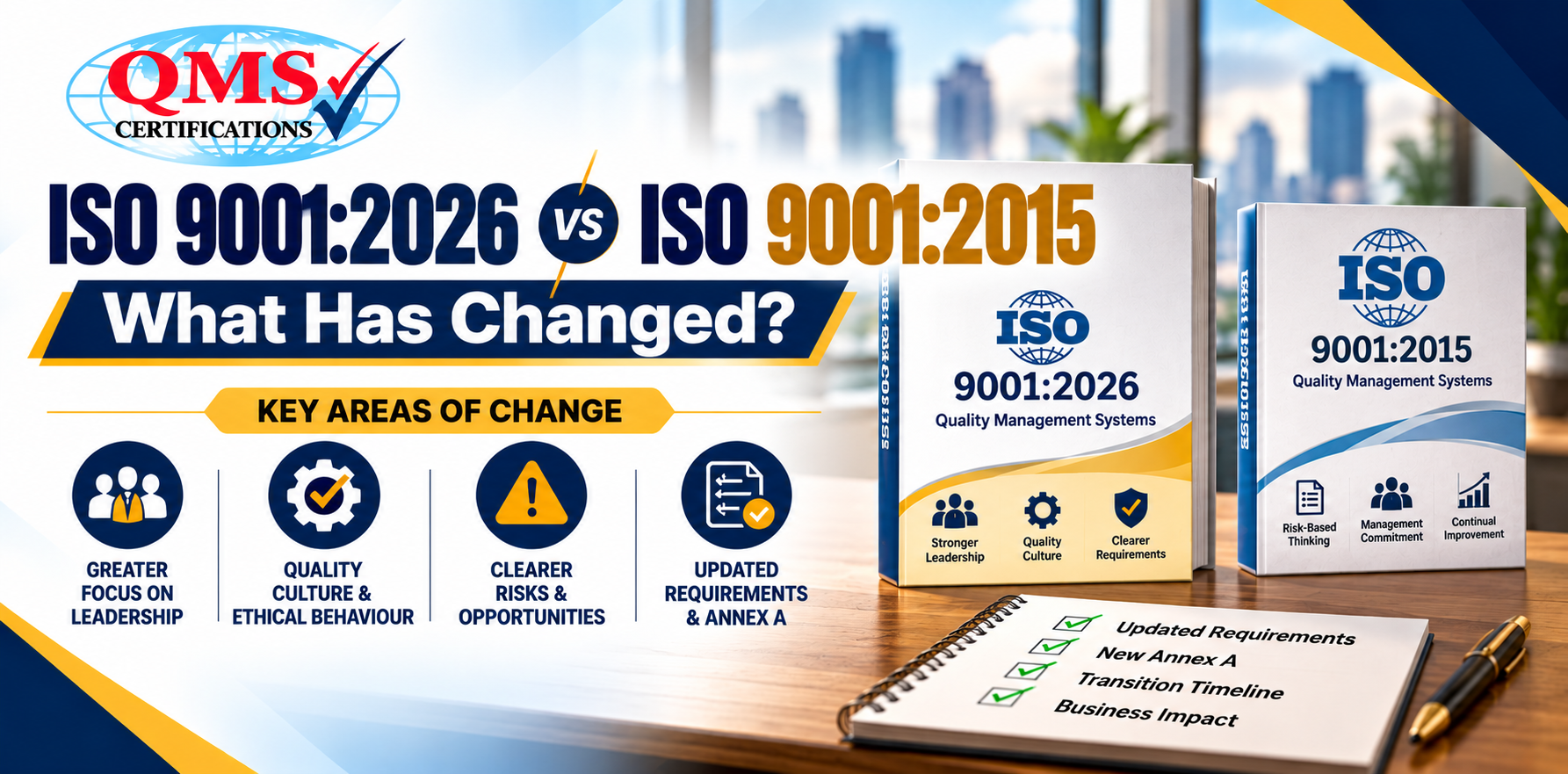
ISO 9001:2026 vs ISO 9001:2015: What Has Changed?
Introduction
Quality plays a major role in business growth. Customers expect consistent products, reliable services and timely delivery. For Indian manufacturers, suppliers and service providers, a strong Quality Management System (QMS) helps meet these expectations.
The comparison of ISO 9001:2026 vs ISO 9001:2015 is particularly important because ISO published the revised standard on 16 September 2026. The 2026 edition replaces the 2015 edition and introduces targeted updates while retaining the established quality management framework.
The revision places greater emphasis on leadership, quality culture, accountability and clearer consideration of risks and opportunities. It also introduces a new Annex A to help organisations understand the intent of the requirements.
For example, a manufacturing company in Delhi may already inspect finished products but still experience repeat defects. A stronger quality culture encourages teams to investigate the causes, improve processes and prevent the same issue from recurring.
This guide explains the differences, benefits, certification process and documents Indian businesses should prepare.
ISO 9001:2026 vs ISO 9001:2015: Key Differences
The main purpose of both editions is to help organisations consistently meet customer requirements and improve their processes. The 2026 edition focuses on making requirements clearer and more relevant to modern business needs.
| Comparison area | ISO 9001:2015 | ISO 9001:2026 |
|---|---|---|
| Leadership | Establishes management responsibility and commitment | Places stronger emphasis on leadership, accountability and quality culture |
| Risks and opportunities | Requires organisations to address risks and opportunities | Provides greater clarity on considering risks and opportunities |
| Quality culture | Supports employee involvement and continual improvement | Gives greater emphasis to quality culture and ethical behaviour |
| Understanding requirements | Uses the established QMS framework | Introduces a new Annex A to clarify terminology and requirement intent |
| Management system integration | Uses the established ISO structure | Aligns with the latest Harmonized Structure for easier integration |
| Transition | Previous edition | Certified organisations must plan their transition to the 2026 edition |
These updates do not mean every organisation must rebuild its QMS. Businesses should review the published standard, identify relevant gaps and make targeted improvements.
What Are the Main Changes in ISO 9001:2026?
1. Stronger leadership and accountability
Quality is not only the responsibility of an inspection team. Senior management must support quality objectives and encourage employees to follow effective processes.
For example, an Indian auto-parts manufacturer can improve accountability by assigning clear responsibilities for production checks, supplier issues and customer complaints.
2. Greater focus on quality culture
A quality culture encourages employees to report problems, learn from mistakes and suggest improvements instead of focusing only on completing tasks.
This can help reduce repeat errors and improve cooperation between departments.
3. Clearer consideration of risks and opportunities
Businesses need to understand what could prevent them from achieving their objectives and where improvements could produce better results.
A food packaging manufacturer, for instance, may identify unreliable raw-material supplies as a risk and develop alternative supplier arrangements to reduce disruption.
4. Improved clarity and usability
The revised edition includes clearer wording and a new Annex A to explain key concepts and the intent behind requirements. This can help organisations interpret requirements more consistently.
5. Easier integration with other ISO standards
The 2026 edition follows the latest Harmonized Structure used by ISO management system standards. This supports organisations that operate integrated systems, such as quality management alongside environmental or occupational health and safety management.
Key Benefits of ISO 9001:2026
Preparing for ISO 9001:2026 can provide practical benefits beyond maintaining certification.
-
Better process consistency: Standardised workflows help reduce errors and rework.
-
Improved customer satisfaction: Effective complaint handling and corrective action can improve customer experience.
-
Stronger risk management: Businesses can identify operational weaknesses before they cause major problems.
-
Greater employee accountability: Clear roles help teams understand their responsibilities.
-
Improved business credibility: ISO 9001 certification can support customer confidence and supplier evaluations.
-
Smoother transition planning: Early preparation gives organisations time to update processes, train employees and coordinate audits.
Certification does not guarantee new contracts or eliminate every quality issue. The real value comes from implementing and maintaining an effective management system.
Step-by-Step ISO 9001:2026 Certification Process
Whether you are applying for certification for the first time or transitioning from ISO 9001:2015, a structured approach helps.
Step 1: Define the scope
Identify your products, services, business locations and activities covered by the QMS.
Step 2: Conduct a gap analysis
Compare existing processes with the applicable ISO 9001:2026 requirements. Existing certificate holders should identify which controls and documents need updating.
Step 3: Prepare QMS documentation
Develop or revise relevant quality policies, objectives, procedures, risk assessments and operational records.
Step 4: Implement the system
Make sure employees understand their responsibilities and follow the documented processes in daily operations.
Step 5: Conduct an internal audit
Evaluate whether the QMS meets the requirements and operates effectively. Record nonconformities and take corrective action.
Step 6: Complete management review
Management should review audit findings, customer feedback, quality objectives, process performance and improvement opportunities.
Step 7: Arrange the certification audit
Select a competent certification body and confirm its accreditation, scope and audit arrangements. Certification is granted following the applicable conformity assessment process.
Step 8: Maintain and improve the QMS
Monitor performance, address problems and prepare for required surveillance audits and future reviews.
ISO 9001:2026 Transition Deadline
Organisations certified to ISO 9001:2015 have until 30 September 2029 to complete their transition under the published transition requirements. The transition may be assessed during a scheduled surveillance or recertification audit, or through a separate transition audit.
Businesses should contact their certification body early to agree on a suitable transition plan.
Documents Required for ISO 9001:2026
The exact documentation depends on your business activities, size, risks and applicable requirements. Commonly useful documents and records include:
-
Company registration and business identification documents.
-
QMS scope and organisational context.
-
Quality policy and measurable quality objectives.
-
Process maps, procedures and work instructions, where needed.
-
Risk and opportunity assessment records.
-
Customer requirements and order-review records.
-
Supplier evaluation and purchasing records.
-
Production, inspection or service-delivery records.
-
Employee competence and training records.
-
Equipment maintenance and calibration records, where applicable.
-
Customer feedback and complaint records.
-
Internal audit reports and findings.
-
Management review records.
-
Nonconformity and corrective-action records.
Avoid preparing unnecessary paperwork. Documentation should support actual business operations and demonstrate conformity with the applicable standard.
Why Choose QMS Certificate?
QMS Certificate supports businesses seeking to understand ISO certification requirements and organise their quality management systems.
Our support can help businesses:
-
Understand applicable ISO 9001 requirements.
-
Identify documentation and implementation gaps.
-
Prepare relevant quality management records.
-
Plan internal audits and management reviews.
-
Understand certification-body selection and transition arrangements.
-
Prepare a practical action plan for their business operations.
The appropriate approach depends on your industry, organisation size, existing QMS and certification objectives. Always verify the certification body's competence, accreditation and scope before proceeding.
Frequently Asked Questions
1. What is the difference between ISO 9001:2026 and ISO 9001:2015?
ISO 9001:2026 is the revised edition of the quality management standard. It strengthens the emphasis on leadership, quality culture and accountability, clarifies risks and opportunities, and introduces a new Annex A while retaining the familiar QMS framework.
2. When is the ISO 9001:2026 transition deadline?
The published transition deadline for organisations certified to ISO 9001:2015 is 30 September 2029. Confirm the required audit arrangements with your certification body.
3. Is ISO 9001:2026 certification mandatory in India?
ISO 9001 certification is generally voluntary. However, specific tenders, customer contracts or procurement requirements may require a business to hold certification.
4. Do companies need to create a new QMS for ISO 9001:2026?
No. Organisations can build on their existing systems, conduct a gap analysis and update the processes and documents that need improvement.
5. How can I prepare my business for ISO 9001:2026?
Review the published standard, assess your existing QMS, identify gaps, train employees, update relevant documentation and coordinate the transition with your certification body.
Conclusion
Understanding ISO 9001:2026 vs ISO 9001:2015 helps businesses prepare for the revised quality management requirements without making unnecessary changes.
The best starting point is to assess your existing processes, strengthen leadership involvement, improve risk management and plan your transition well before the deadline.
Need help with ISO 9001:2026 certification or transition planning?
Contact QMS Certificate to discuss your business requirements and identify the next steps.
Email: info@qmscertificate.com
Website: https://www.qmscertificate.com/
Build a more consistent, accountable and customer-focused quality management system with a practical approach to ISO certification.
Having any Query? Talk to our Experts
Our Projects are fully tested, background checked, license validated and insured
with a 100% satisfaction guarantee.
Contact Info
 qmscertify@gmail.com
 View Location Map
Select Your Location

Up
Gurgaon Haryana
Andhra pradesh
Arunachal pradesh
Chhattisgarh
Himachal pradesh
Jharkhand
Karnataka
Kerala
Madhya pradesh
Maharashtra
Manipur
Meghalaya
Odisha
Punjab
Tamil nadu
Telangana
Tripura
Uttarakhand

- Organize Site Visit
- +91 9990 555 879
- Call
- Enquire
- Instant Call Back
- Free Site Visit
- Unmatched Price
 Register For FREE Sample!!


