
ISO 9001:2026 vs ISO 9001:2015: Key Differences, Changes and Transition Guide
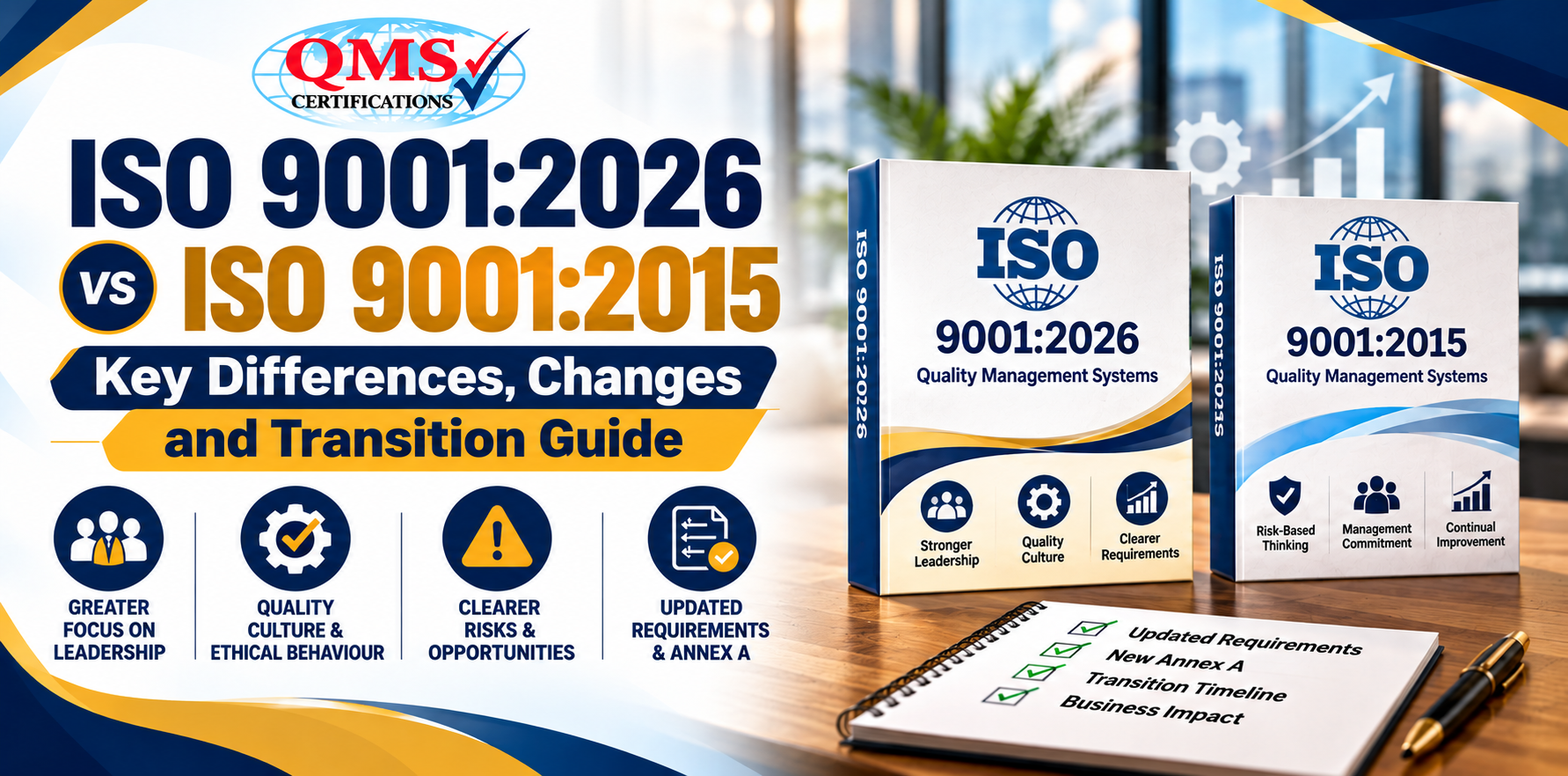
ISO 9001:2026 vs ISO 9001:2015: Key Differences, Changes and Transition Guide
Introduction
Quality is one of the biggest factors that determines whether a business earns customer trust and maintains long-term growth. For Indian manufacturers, service providers, exporters and MSMEs, maintaining consistent product and service quality is essential. This is where ISO 9001 certification plays an important role.
The latest edition, ISO 9001:2026, was officially published on 16 September 2026, replacing ISO 9001:2015. The revised standard builds on the existing Quality Management System (QMS) framework while introducing improvements in leadership, quality culture, risk management and organizational performance.
Understanding ISO 9001:2026 vs ISO 9001:2015 is important for businesses that already hold certification and organizations planning to obtain ISO certification for the first time.
The good news is that businesses do not need to rebuild their entire quality management system. They can improve their existing processes and make the necessary adjustments to meet the updated requirements.
ISO 9001:2026 vs ISO 9001:2015: Key Differences
Both editions focus on customer satisfaction, process control and continual improvement. However, ISO 9001:2026 provides greater clarity and strengthens several important areas.
Here are the major changes businesses should understand:
1. Greater Focus on Leadership and Quality Culture
ISO 9001:2026 places stronger emphasis on leadership responsibility, accountability, ethical behaviour and developing a quality-focused working environment.
For example, a manufacturing company in Delhi should ensure that quality is not treated as the responsibility of only its inspection department. Management, supervisors and production employees should all contribute to maintaining product quality.
2. Improved Risk and Opportunity Management
The revised standard provides greater clarity on identifying and addressing risks separately from pursuing opportunities.
For example, an automobile component manufacturer may identify machine breakdowns as a business risk while recognizing automation as an opportunity to improve production efficiency.
This approach encourages better planning and decision-making.
3. Stronger Organizational Awareness
Employees should understand how their activities contribute to product and service quality.
Businesses must encourage awareness of quality culture and ethical behaviour rather than limiting employee training to basic work instructions.
4. Better Alignment with Business Strategy
The revised requirements reinforce the connection between quality objectives, organizational direction and leadership decisions.
A company should ensure that its quality policy supports its actual business goals, such as reducing product defects, improving delivery performance and increasing customer satisfaction.
5. Improved Guidance Through Annex A
The new edition introduces an updated Annex A to explain important concepts and clarify the intent behind requirements.
This helps organizations understand how to apply the standard more consistently.
Comparison at a Glance
| Area | ISO 9001:2015 | ISO 9001:2026 |
|---|---|---|
| Leadership | Leadership commitment | Stronger focus on accountability and quality culture |
| Risk management | Risk-based thinking | Clearer distinction between risks and opportunities |
| Employee awareness | Quality awareness | Greater attention to quality culture and ethical behaviour |
| Quality policy | Supports organizational direction | Stronger strategic alignment |
| Guidance | Previous Annex A | Updated explanatory Annex A |
| Management systems | Harmonized structure | Updated alignment with the latest structure |
Key Benefits of ISO 9001:2026 Certification
Obtaining ISO 9001 certification is not simply about receiving a certificate. It helps businesses establish better processes and improve their overall performance.
Some important benefits include:
-
Improved customer satisfaction: Consistent quality helps build stronger customer relationships.
-
Better operational efficiency: Organized processes help reduce errors, delays and unnecessary costs.
-
Increased business opportunities: ISO certification can support vendor registration, tender participation and supplier approval requirements.
-
Improved employee performance: Clearly defined responsibilities help employees understand their roles.
-
Better risk management: Businesses can identify potential problems before they affect operations.
-
International recognition: ISO 9001 is internationally recognized and can strengthen business credibility.
-
Continual improvement: Regular monitoring and internal audits help organizations improve their performance.
For example, an Indian MSME supplying components to a large automobile company can use its ISO 9001 Quality Management System to demonstrate a structured approach to quality and process control.
Step-by-Step ISO 9001:2026 Certification Process
Businesses planning to obtain ISO 9001:2026 certification can follow a structured approach.
Step 1: Understand the Requirements
Identify the requirements of ISO 9001:2026 according to your business activities, products and services.
Step 2: Conduct a Gap Analysis
Review existing business processes and identify areas that need improvement to meet the standard.
Step 3: Prepare QMS Documentation
Develop the necessary quality policies, objectives, procedures and records.
Step 4: Implement the Quality Management System
Apply the documented processes across relevant departments and ensure employees understand their responsibilities.
Step 5: Conduct an Internal Audit
Review the effectiveness of the implemented system, identify nonconformities and take corrective action.
Step 6: Management Review
Management should evaluate QMS performance, customer feedback, audit results, risks and improvement opportunities.
Step 7: Certification Audit
An appropriately accredited certification body conducts an independent assessment of the organization's quality management system.
Step 8: Certification Decision
After successful evaluation and closure of applicable nonconformities, the certification body makes its certification decision and issues the certificate.
Documents Required for ISO 9001:2026 Certification
The documentation depends on the organization's size, activities and certification scope.
Generally, businesses should prepare:
-
Business registration proof, such as GST registration, Udyam registration or incorporation documents.
-
Company letterhead or visiting card.
-
Invoice or business details.
-
Description of business activities.
-
Quality policy and quality objectives.
-
Process information and relevant operational records.
-
Employee roles and responsibilities.
-
Internal audit and management review records.
-
Customer feedback and corrective action records, where applicable.
The organization should maintain documented information necessary to demonstrate that its quality management system is effective.
ISO 9001:2015 to ISO 9001:2026 Transition Deadline
Organizations already certified under ISO 9001:2015 should plan their transition to the new edition.
The published transition arrangements provide a three-year transition period, ending on 30 September 2029.
Important milestones include:
-
16 September 2026: ISO 9001:2026 officially published.
-
31 March 2027: Accreditation bodies to be ready to assess the revised standard.
-
30 September 2027: Accreditation body transition decisions to be completed.
-
31 March 2028: New initial accredited certifications move exclusively to ISO 9001:2026.
-
30 September 2029: Final deadline for existing certified organizations to complete their transition.
Businesses should contact their certification body to confirm applicable transition arrangements and audit requirements.
Existing certificate holders should not wait until the final deadline. Early preparation provides sufficient time to review documentation, train employees and update processes.
Why Choose QMS Certificate?
Choosing the right certification support partner makes the certification journey easier and more organized.
QMS Certificate provides ISO certification-related assistance to businesses across different industries in India.
Reasons to choose QMS Certificate include:
-
Professional guidance throughout the certification process.
-
Assistance with understanding ISO 9001 requirements.
-
Support with QMS documentation and preparation.
-
Guidance for gap analysis and audit readiness.
-
Industry-oriented certification assistance.
-
Support for businesses seeking initial certification or transition guidance.
Our objective is to help businesses understand quality management requirements and prepare for certification through a structured approach.
Frequently Asked Questions (FAQs)
1. What is the difference between ISO 9001:2026 and ISO 9001:2015?
ISO 9001:2026 builds on the 2015 edition with clearer requirements and greater emphasis on leadership, quality culture, ethical behaviour, risk and opportunity management, and improved guidance through Annex A.
2. Is ISO 9001:2026 mandatory for Indian businesses?
ISO 9001 certification is generally voluntary in India. However, certain customers, tenders and vendor requirements may make certification necessary for particular business opportunities.
3. What is the last date to transition from ISO 9001:2015 to ISO 9001:2026?
The final transition deadline is 30 September 2029. Organizations holding ISO 9001:2015 certification should complete the transition before this date.
4. Do businesses need to start the ISO 9001 certification process again?
No. Existing certified organizations can build on their current Quality Management System, review the revised requirements, make necessary improvements and complete the transition assessment through their certification body.
5. How long does it take to obtain ISO 9001:2026 certification?
The timeline depends on the organization's size, operational complexity, existing QMS and audit readiness. Businesses with established quality processes may require less preparation than organizations implementing a QMS for the first time.
Conclusion: Prepare Your Business for ISO 9001:2026
The transition from ISO 9001:2015 to ISO 9001:2026 is an opportunity for Indian businesses to strengthen their quality management systems, improve operational performance and build customer confidence.
Whether you are a manufacturer, service provider, startup or established enterprise, understanding the new requirements will help you prepare for the future.
Need assistance with ISO 9001:2026 certification or transition?
Connect with QMS Certificate for professional guidance on ISO 9001 certification, documentation and transition preparation.
Contact QMS Certificate
-
Email: info@qmscertificate.com
-
Website: https://www.qmscertificate.com/
Take the next step towards a stronger Quality Management System and prepare your business for ISO 9001:2026.
Having any Query? Talk to our Experts
Our Projects are fully tested, background checked, license validated and insured
with a 100% satisfaction guarantee.
Contact Info
 qmscertify@gmail.com
 View Location Map
Select Your Location

Up
Gurgaon Haryana
Andhra pradesh
Arunachal pradesh
Chhattisgarh
Himachal pradesh
Jharkhand
Karnataka
Kerala
Madhya pradesh
Maharashtra
Manipur
Meghalaya
Odisha
Punjab
Tamil nadu
Telangana
Tripura
Uttarakhand

- Organize Site Visit
- +91 9990 555 879
- Call
- Enquire
- Instant Call Back
- Free Site Visit
- Unmatched Price
 Register For FREE Sample!!


