
Common ISO 9001 2026 Implementation Mistakes and How to Avoid Them
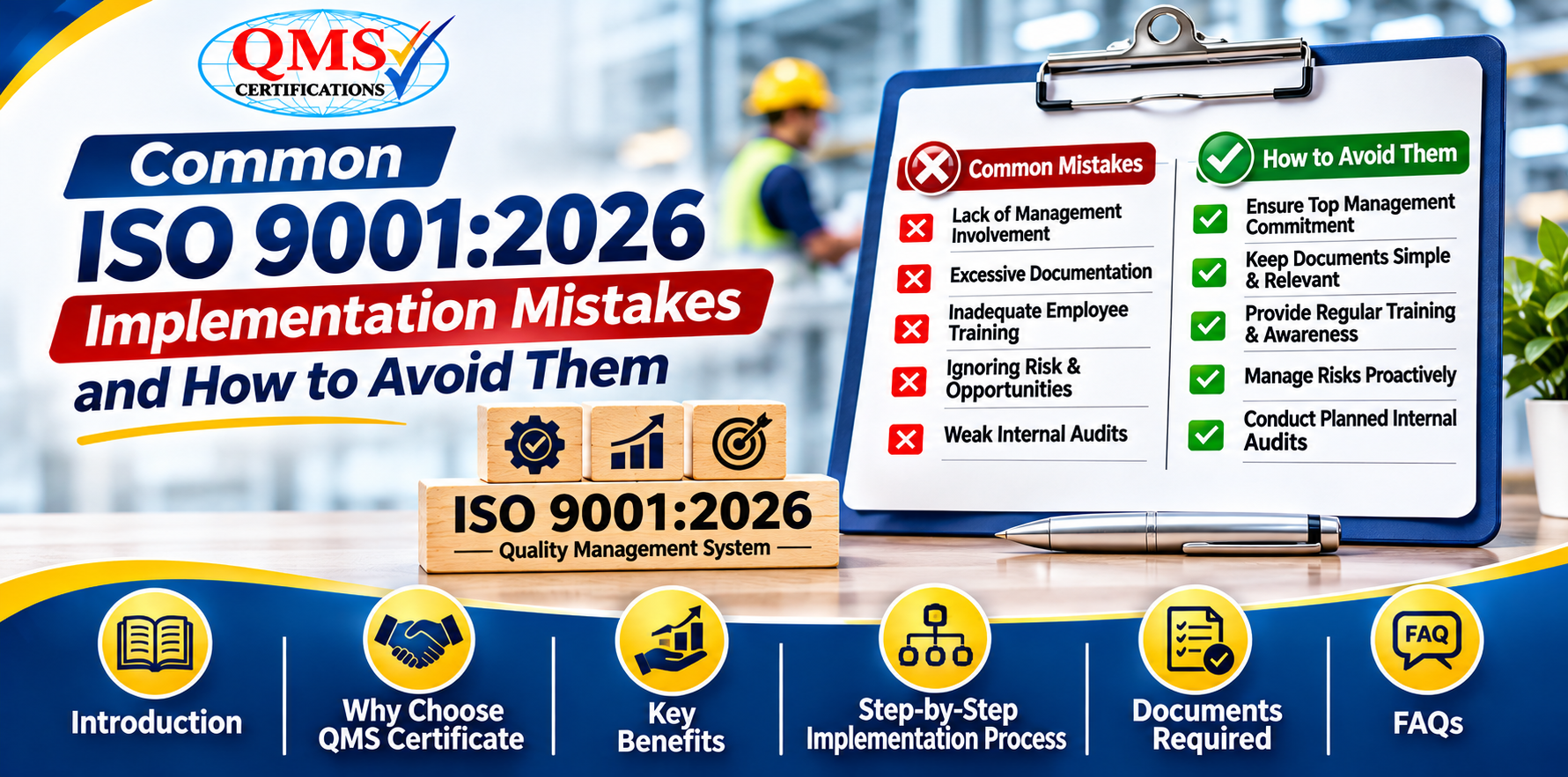
Common ISO 9001 2026 Implementation Mistakes and How to Avoid Them
Introduction
Implementing a Quality Management System (QMS) is an important step for businesses that want to improve product quality, customer satisfaction and operational efficiency. However, obtaining ISO certification is not simply about preparing documents and passing an audit. It requires businesses to establish practical processes that consistently meet customer and applicable regulatory requirements.
With the publication of ISO 9001:2026, organizations must understand the updated quality management requirements and ensure their systems remain effective. The latest edition places greater emphasis on leadership, quality culture, accountability, risk and opportunity management, and continual improvement.
Many Indian businesses, particularly MSMEs, manufacturing companies and service providers, make avoidable mistakes during ISO implementation. These mistakes can create documentation gaps, operational difficulties and audit nonconformities.
In this guide, we explain the most common ISO 9001:2026 implementation mistakes, how to avoid them, the certification process and the documents required for successful implementation.
10 Common ISO 9001:2026 Implementation Mistakes and How to Avoid Them
1. Implementing ISO 9001 Only to Obtain a Certificate
One of the biggest mistakes is treating ISO 9001 certification as a formality. Some organizations prepare documents only because a customer or tender requires an ISO certificate.
How to avoid it: Focus on improving actual business operations. Establish quality objectives, monitor performance and involve employees in maintaining the QMS.
2. Poor Understanding of ISO 9001:2026 Requirements
Businesses sometimes continue following outdated procedures without reviewing the latest standard. This can create gaps between existing practices and updated requirements.
How to avoid it: Study the ISO 9001:2026 requirements, conduct a gap analysis and identify the changes needed in your existing Quality Management System.
3. Lack of Top Management Involvement
Quality management cannot be the responsibility of one quality manager alone. Without management commitment, employees may not receive the resources, training or direction required.
How to avoid it: Management should participate in quality planning, policy development, performance reviews and improvement decisions.
4. Preparing Unnecessary Documentation
Creating excessive paperwork is another common ISO 9001 implementation mistake. Businesses sometimes prepare complicated procedures that employees cannot easily understand or follow.
How to avoid it: Maintain simple, relevant and controlled documentation. Keep records that demonstrate how important business processes are managed and monitored.
5. Ignoring Employee Training and Awareness
Even a well-designed QMS can fail if employees do not understand their responsibilities. For example, a manufacturing employee who does not follow inspection procedures may allow defective products to reach customers.
How to avoid it: Conduct regular employee training, explain job responsibilities and maintain training records to demonstrate competence.
6. Weak Risk and Opportunity Management
Organizations often identify risks only during audits instead of managing them proactively.
How to avoid it: Identify operational, supplier, customer and process-related risks. Evaluate their possible impact and establish suitable actions. Also identify opportunities that can improve business performance.
7. Not Monitoring Supplier Performance
Poor supplier management can affect raw material quality, production schedules and customer satisfaction.
How to avoid it: Establish supplier evaluation criteria, maintain approved supplier records and periodically review supplier performance.
8. Ignoring Internal Audits
Some businesses conduct internal audits only before the external certification audit. This approach makes it difficult to identify and correct problems in time.
How to avoid it: Establish a planned internal audit programme. Check whether processes follow documented procedures and whether the QMS achieves its intended results.
9. Failing to Address Customer Complaints
Customer complaints are valuable sources of information about product and service quality. Ignoring repeated complaints can damage customer relationships.
How to avoid it: Maintain a customer complaint register, investigate root causes, implement corrective actions and monitor whether the problem has been resolved.
10. Poor Preparation for the Certification Audit
Incomplete records, untrained employees and inconsistent processes can result in audit nonconformities.
How to avoid it: Conduct an internal audit, review corrective actions, verify documentation and ensure employees understand their responsibilities before the certification audit.
Why Choose QMS Certificate for ISO 9001:2026 Certification?
Choosing the right ISO consultancy and certification support partner can make implementation easier and more systematic.
At QMS Certificate, we support businesses across different industries with ISO-related consultation, documentation guidance, audit preparation and certification assistance.
Our approach focuses on understanding your business activities rather than recommending unnecessary documentation.
Why businesses choose us:
-
Professional guidance throughout the ISO implementation journey.
-
Industry-oriented documentation support.
-
Assistance with identifying implementation gaps.
-
Practical guidance for internal audit preparation.
-
Cost-effective ISO consultancy solutions.
-
Support for businesses across different Indian locations.
-
Assistance with understanding ISO 9001:2026 transition requirements.
Note: Certification is issued by an independent certification body following its applicable assessment process. ISO itself does not issue certificates.
Key Benefits of ISO 9001:2026 Certification
Implementing an effective Quality Management System offers several advantages:
-
Improved product and service quality: Standardized processes help reduce errors and maintain consistent output.
-
Higher customer satisfaction: Better complaint handling and quality monitoring improve customer confidence.
-
Better operational efficiency: Identifying process gaps helps reduce waste, delays and unnecessary costs.
-
Improved employee accountability: Clearly defined responsibilities help employees understand their roles.
-
Stronger supplier management: Regular supplier evaluation supports consistent incoming material quality.
-
Business growth opportunities: ISO certification can help organizations meet customer and tender requirements.
-
Continual improvement: Performance monitoring and corrective actions support long-term business development.
Step-by-Step ISO 9001:2026 Certification Process
Businesses can follow these steps to implement a Quality Management System and prepare for certification.
Step 1: Initial Consultation
Understand your business activities, operational processes, company size and certification requirements.
Step 2: Gap Analysis
Compare existing business practices with ISO 9001:2026 requirements and identify areas that need improvement.
Step 3: QMS Documentation
Prepare relevant quality policies, procedures, objectives, records and process-related documents.
Step 4: Implementation and Employee Training
Introduce the documented processes into daily operations and train employees according to their responsibilities.
Step 5: Internal Audit
Evaluate the effectiveness of the implemented QMS and identify nonconformities.
Step 6: Corrective Actions and Management Review
Resolve identified issues, evaluate QMS performance and review opportunities for improvement.
Step 7: External Certification Audit
An independent certification body conducts the required audit to assess conformity with ISO 9001:2026.
Step 8: Certification Decision
After satisfactory completion of the certification process and closure of applicable findings, the certification body makes its certification decision.
Documents Required for ISO 9001:2026 Certification
The documentation required depends on the organization's size, scope and business activities.
Commonly required documents include:
-
Business registration proof.
-
Company PAN details, where applicable.
-
GST registration, where applicable.
-
Company letterhead or visiting card.
-
Description of business activities.
-
Scope of the Quality Management System.
-
Quality policy and quality objectives.
-
Process-related procedures and work instructions, where required.
-
Employee responsibilities and training records.
-
Supplier evaluation records.
-
Customer feedback and complaint records.
-
Inspection and quality control records.
-
Internal audit reports.
-
Management review records.
-
Corrective action records.
Not every organization needs identical documentation. The QMS should reflect actual business operations and applicable ISO 9001:2026 requirements.
Frequently Asked Questions (FAQs)
1. What are the most common ISO 9001:2026 implementation mistakes?
The most common mistakes include poor management involvement, unnecessary documentation, inadequate employee training, weak risk management, ineffective internal audits and failure to address customer complaints.
2. Is ISO 9001:2026 different from ISO 9001:2015?
Yes. ISO 9001:2026 introduces targeted updates involving leadership, quality culture, accountability, risk and opportunity management, clarity of requirements and alignment with other management system standards.
3. How long does ISO 9001:2026 certification take?
The duration depends on company size, business complexity, existing processes, documentation readiness and audit arrangements. Organizations with established quality systems may require less implementation time.
4. What documents are required for ISO 9001:2026 certification?
Common documents include business registration proof, quality policy, quality objectives, process records, employee training records, supplier evaluation records, internal audit reports and management review records.
5. Can an existing ISO 9001:2015 certified company transition to ISO 9001:2026?
Yes. Existing certified organizations can build on their current QMS, conduct a gap analysis, update relevant processes and documentation, and complete the transition audit through their certification body within the applicable transition period.
Conclusion: Avoid Implementation Mistakes and Build a Strong QMS
ISO 9001:2026 implementation should not be treated as a paperwork exercise. It is an opportunity to strengthen business processes, improve customer satisfaction and establish a consistent quality management culture.
By avoiding common implementation mistakes, involving employees, maintaining appropriate documentation and conducting regular internal audits, businesses can make their QMS more effective and prepare confidently for certification.
Looking for professional ISO 9001:2026 certification guidance in India?
Connect with QMS Certificate for consultation and assistance with your ISO implementation and certification requirements.
Contact QMS Certificate
Website: https://www.qmscertificate.com/
Email: info@qmscertificate.com
Take the next step towards better quality management and long-term business growth.
Having any Query? Talk to our Experts
Our Projects are fully tested, background checked, license validated and insured
with a 100% satisfaction guarantee.
Contact Info
 qmscertify@gmail.com
 View Location Map
Select Your Location

Up
Gurgaon Haryana
Andhra pradesh
Arunachal pradesh
Chhattisgarh
Himachal pradesh
Jharkhand
Karnataka
Kerala
Madhya pradesh
Maharashtra
Manipur
Meghalaya
Odisha
Punjab
Tamil nadu
Telangana
Tripura
Uttarakhand

- Organize Site Visit
- +91 9990 555 879
- Call
- Enquire
- Instant Call Back
- Free Site Visit
- Unmatched Price
 Register For FREE Sample!!


