

ISO 45001 Certification for Manufacturing Companies Delhi
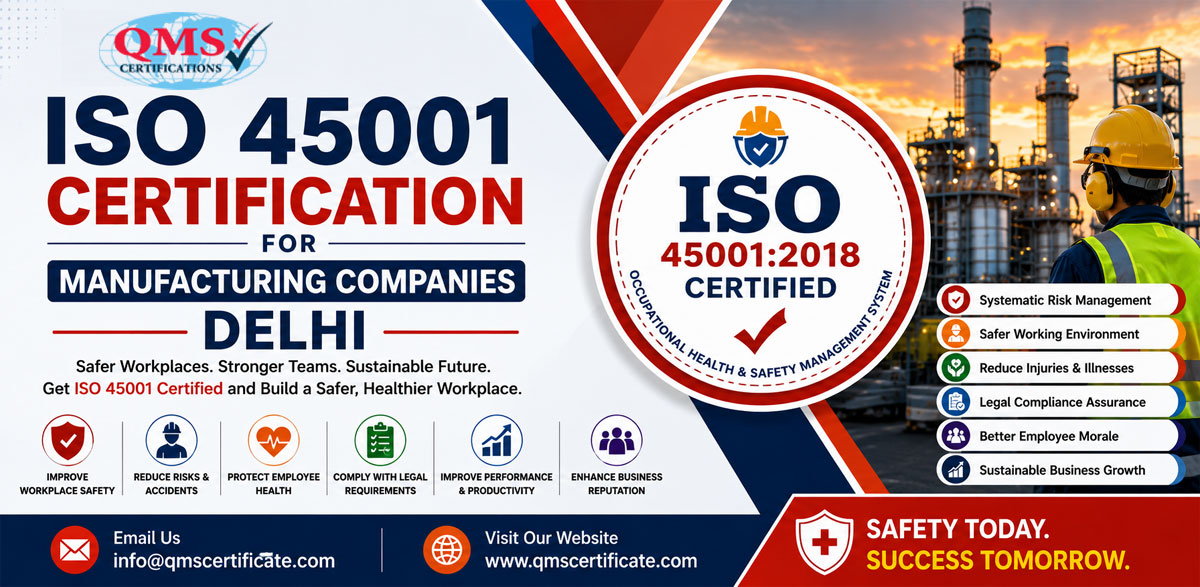
ISO 45001 Certification for Manufacturing Companies Delhi
Introduction
Manufacturing environments involve machinery, electrical equipment, chemicals, material handling, welding, working at height, maintenance activities and other workplace hazards. Managing these risks effectively is essential for protecting workers and maintaining reliable operations.
This is where ISO 45001 Certification for Manufacturing Companies Delhi becomes valuable.
ISO 45001 is the international standard for an Occupational Health and Safety (OH&S) Management System. It provides a framework for organizations to identify workplace hazards, manage OH&S risks, meet applicable requirements, involve workers and continually improve safety performance. ISO states that the standard applies to organizations of all sizes and sectors and is particularly relevant to higher-risk industries such as manufacturing.
For a manufacturing company in Delhi, ISO 45001 can help turn workplace safety from a collection of individual precautions into a structured management process.
What Is ISO 45001 Certification for Manufacturing Companies?
ISO 45001 certification involves an independent assessment of an organization's Occupational Health and Safety Management System against the requirements of ISO 45001.
For manufacturers, an effective OHSMS can cover areas such as:
- Machine and equipment safety
- Electrical safety
- Chemical handling
- Personal protective equipment
- Fire and emergency preparedness
- Material handling
- Workplace inspections
- Contractor and visitor safety
- Maintenance activities
- Incident and near-miss reporting
- Hazard identification
- Risk assessment
- Worker training and awareness
- Corrective action
ISO 45001 emphasizes leadership, worker participation, hazard identification, risk assessment, legal and regulatory requirements, emergency preparedness, incident investigation, auditing and continual improvement.
The objective is not to create paperwork for its own sake. The system should help the manufacturer identify risks before they result in injury, illness, disruption or other unwanted outcomes.
Why ISO 45001 Matters for Manufacturers in Delhi
A manufacturing unit can have excellent production equipment and still face significant operational risk if safety procedures are inconsistent.
Consider a Delhi engineering factory where several teams operate cutting machines, welding equipment and lifting equipment. If machine inspections, PPE requirements and emergency procedures are not consistently managed, one overlooked hazard can create serious consequences.
ISO 45001 provides a systematic framework for identifying hazards, assessing risks and establishing controls.
ISO identifies benefits such as a systematic approach to managing OH&S risks, reduced workplace incidents and injuries, improved compliance, greater organizational resilience and continual improvement of OH&S performance.
For manufacturers, this can also support a stronger safety culture in which employees and management share responsibility for workplace health and safety.
Key Benefits of ISO 45001 Certification
1. Systematic Hazard Identification
Manufacturers can identify hazards associated with machinery, production processes, chemicals, electricity, manual handling and other activities.
2. Better Risk Management
Risk assessment helps organizations determine which hazards require attention and what controls are appropriate.
3. Safer Working Conditions
A structured OHSMS can help establish consistent procedures for workplace safety, inspections, training and operational controls.
4. Reduced Workplace Incidents
A well-implemented system focuses on prevention rather than waiting for an incident to happen before taking action.
ISO specifically identifies reducing workplace incidents and injuries as one of the benefits associated with ISO 45001.
5. Improved Worker Participation
ISO 45001 places emphasis on worker participation. Employees who perform manufacturing activities often have valuable practical knowledge about workplace hazards and potential improvements.
6. Stronger Emergency Preparedness
Manufacturers can establish and test appropriate responses for emergencies relevant to their operations.
7. Better Compliance Management
An OHSMS can provide a systematic approach to identifying applicable occupational health and safety requirements and evaluating compliance.
8. Improved Business Credibility
Independent certification can demonstrate that the organization's OH&S management system has been assessed against the applicable standard.
ISO 45001 Requirements for Manufacturing Companies
An effective ISO 45001 management system should be integrated into the manufacturer's everyday operations.
Important areas include:
Hazard Identification and Risk Assessment
The organization needs to identify hazards arising from its activities and assess relevant OH&S risks.
Examples include:
- Moving machinery
- Electrical work
- Welding and cutting
- Chemical exposure
- Noise
- Dust
- Slips and falls
- Manual handling
- Vehicle movement
- Work at height
- Maintenance activities
OH&S Objectives
Manufacturers can establish measurable objectives based on their safety priorities.
Examples may include:
- Improving safety inspection completion
- Reducing near-miss recurrence
- Increasing employee safety training
- Improving PPE compliance
- Reducing workplace incidents
Operational Controls
Appropriate controls should be established for significant workplace hazards.
Worker Training and Awareness
Employees should understand relevant hazards, controls, emergency procedures and their OH&S responsibilities.
Emergency Preparedness
The organization should prepare for emergencies relevant to its operations and periodically evaluate the effectiveness of its response arrangements.
Incident Investigation and Corrective Action
When an incident or nonconformity occurs, the organization should investigate it appropriately and take corrective action to prevent recurrence.
Monitoring and Continual Improvement
OH&S performance should be monitored and reviewed so that the organization can identify opportunities for improvement.
ISO 45001 follows the Plan-Do-Check-Act (PDCA) approach, providing a continual cycle for managing and improving occupational health and safety.
ISO 45001 Certification Process in Delhi
The ISO 45001 certification process for manufacturing companies in Delhi generally follows a structured sequence.
Step 1: Initial Consultation
The organization's manufacturing activities, workforce, locations, processes and safety objectives are reviewed.
This helps determine the appropriate certification scope.
Step 2: Gap Assessment
Existing OH&S practices are compared with the applicable ISO 45001 requirements.
Potential gaps may relate to:
- Hazard identification
- Risk assessment
- Legal requirements
- Safety objectives
- Worker participation
- Emergency preparedness
- Training
- Internal audits
- Corrective action
Step 3: OHSMS Documentation
Relevant policies, procedures, risk assessments, records and operational controls are developed or updated.
The documentation should reflect the company's actual workplace conditions.
Step 4: Implementation
The OH&S management system is implemented across applicable manufacturing processes.
Employees and relevant contractors should understand the controls that apply to their work.
Step 5: Internal Audit
An internal audit evaluates whether the management system is implemented and operating effectively.
Step 6: Management Review
Top management reviews OH&S performance, objectives, audit results, incidents, worker feedback and improvement opportunities.
Step 7: Certification Audit
An independent certification body evaluates the organization's OH&S management system against ISO 45001 requirements.
ISO confirms that organizations can obtain ISO 45001 certification through third-party certification bodies; certification itself is not mandatory for implementing the standard.
Step 8: Certification and Continual Improvement
Following successful completion of the assessment, the certification body issues the certificate.
The organization should then continue monitoring and improving its OH&S management system.
Documents Required for ISO 45001 Certification
Documentation requirements vary according to the organization's size, activities, hazards, workforce and certification scope.
Commonly relevant information may include:
- Business registration proof
- Company profile
- Manufacturing activity details
- OHSMS scope
- OH&S policy
- Hazard identification records
- Risk assessment records
- Legal and regulatory requirements
- Safety objectives
- Emergency preparedness information
- Training and competency records
- Workplace inspection records
- Incident and near-miss records
- PPE-related records
- Corrective-action records
- Internal audit records
- Management review records
QMS Certificate's Delhi certification page also lists business registration proof, letterhead or visiting card, invoice details and business description among commonly requested business information.
The final documentation should be based on the organization's actual operations rather than a generic document package.
Why Choose QMS Certificate?
QMS Certificate provides ISO certification services in Delhi and lists ISO 45001:2018 Occupational Health & Safety Management among its services. Its Delhi service page states that it supports organizations across sectors including manufacturing and provides a structured consultation and certification process.
For manufacturers looking for ISO 45001 Certification in Delhi, professional guidance can help with:
- Understanding applicable requirements
- Defining certification scope
- Identifying documentation needs
- Preparing the OHSMS
- Supporting implementation
- Preparing for internal audits
- Preparing for certification assessment
The goal should be more than obtaining a certificate. Your OH&S management system should fit your workplace and help your organization manage safety risks consistently.
Which Manufacturing Companies Can Benefit from ISO 45001?
ISO 45001 can be applied to many manufacturing and industrial businesses, including:
- Engineering companies
- Automobile manufacturers
- Auto-component manufacturers
- Machinery manufacturers
- Electrical manufacturers
- Electronics manufacturers
- Plastic manufacturers
- Chemical manufacturers
- Pharmaceutical manufacturers
- Textile manufacturers
- Packaging manufacturers
- Metal and steel manufacturers
- Food manufacturers
- Construction-material manufacturers
- General production units
ISO confirms that ISO 45001 is applicable regardless of organizational size, industry or geographic location.
ISO 45001 vs ISO 9001 for Manufacturers
These standards have different primary purposes.
ISO 9001 focuses on quality management, customer requirements, process control and continual improvement.
ISO 45001 focuses on occupational health and safety, including hazard identification, risk management, worker participation and OH&S performance.
Manufacturers can implement both systems when appropriate. ISO notes that ISO 45001 can be integrated with other management-system standards, including ISO 9001 and ISO 14001, because they share common management-system structures and concepts.
Frequently Asked Questions
1. What is ISO 45001 Certification for Manufacturing Companies Delhi?
It is independent certification of a manufacturer's Occupational Health and Safety Management System against ISO 45001 requirements. It provides a structured framework for managing workplace hazards and improving OH&S performance.
2. Is ISO 45001 suitable for manufacturing companies?
Yes. ISO 45001 is applicable to organizations of all sizes and sectors and is particularly relevant to higher-risk industries such as manufacturing.
3. What are the benefits of ISO 45001 certification for manufacturers?
Benefits can include systematic hazard management, improved workplace safety, stronger worker participation, better emergency preparedness, improved compliance processes and continual improvement of OH&S performance.
4. Is ISO 45001 certification mandatory in India?
ISO 45001 certification itself is voluntary. However, specific customers, tenders, contracts or supply-chain requirements may request certification. Separate legal and regulatory safety obligations still apply regardless of whether a company holds ISO 45001 certification.
5. How much does ISO 45001 certification cost in Delhi?
There is no universal price. Cost can depend on factors such as the number of employees, locations, manufacturing activities, certification scope, hazard complexity and audit requirements. QMS Certificate's published Delhi cost guide lists ISO 45001 certification charges as approximate and subject to business requirements.
Conclusion
ISO 45001 Certification for Manufacturing Companies Delhi can help manufacturers establish a more systematic approach to occupational health and safety.
The real benefit is not simply displaying a certificate. A properly implemented OHSMS helps an organization identify hazards, assess risks, establish controls, involve workers, prepare for emergencies, investigate incidents and continually improve workplace safety.
For Delhi manufacturers operating machinery, handling materials or chemicals, managing production processes or working in other higher-risk environments, ISO 45001 can provide a practical framework for improving OH&S management.
If you are planning ISO 45001 Certification in Delhi, QMS Certificate can help you understand the applicable requirements and prepare for the certification process.
Contact QMS Certificate
Email: info@qmscertificate.com
Website: www.qmscertificate.com
Discuss your manufacturing activities, workforce, safety requirements and certification scope with the QMS Certificate team.
Having any Query? Talk to our Experts
Our Projects are fully tested, background checked, license validated and insured
with a 100% satisfaction guarantee.
Contact Info
 qmscertify@gmail.com
 View Location Map