

How to Choose the Right ISO Certification Body in India: A Business Owner's Guide
How to Choose the Right ISO Certification Body in India: A Business Owner's Guide
Introduction
Getting ISO certification is an important step for businesses that want to improve their management systems, build customer confidence and explore new business opportunities. However, choosing the right ISO Certification Body in India is just as important as selecting the appropriate ISO standard.
Many business owners focus only on certification prices or promises of quick certificate issuance. They may overlook important factors such as accreditation, auditor competence, certification scope and certificate verification.
For example, an engineering manufacturer in Pune may need ISO 9001 certification to meet an international customer's supplier requirements. A food processing company in Delhi may require ISO 22000 to strengthen its food safety management system.
In both cases, choosing a competent certification body is essential.
This guide explains how to select a reliable ISO certification body in India, verify its accreditation, compare audit charges and understand the certification process before making a decision.
What Is an ISO Certification Body?
An ISO certification body is an independent organisation that audits a company's management system against the requirements of a selected ISO standard.
If the organisation successfully meets the applicable requirements, the certification body makes the certification decision and issues the certificate.
It is important to understand that ISO itself does not issue certificates to companies. Independent certification bodies perform certification activities.
ISO Consultant vs ISO Certification Body
These two roles are different:
-
ISO Consultant: Helps businesses understand requirements, prepare documentation, implement management systems and prepare for audits.
-
Certification Body: Independently audits the management system and decides whether certification can be granted.
A consultant cannot replace the independent certification audit.
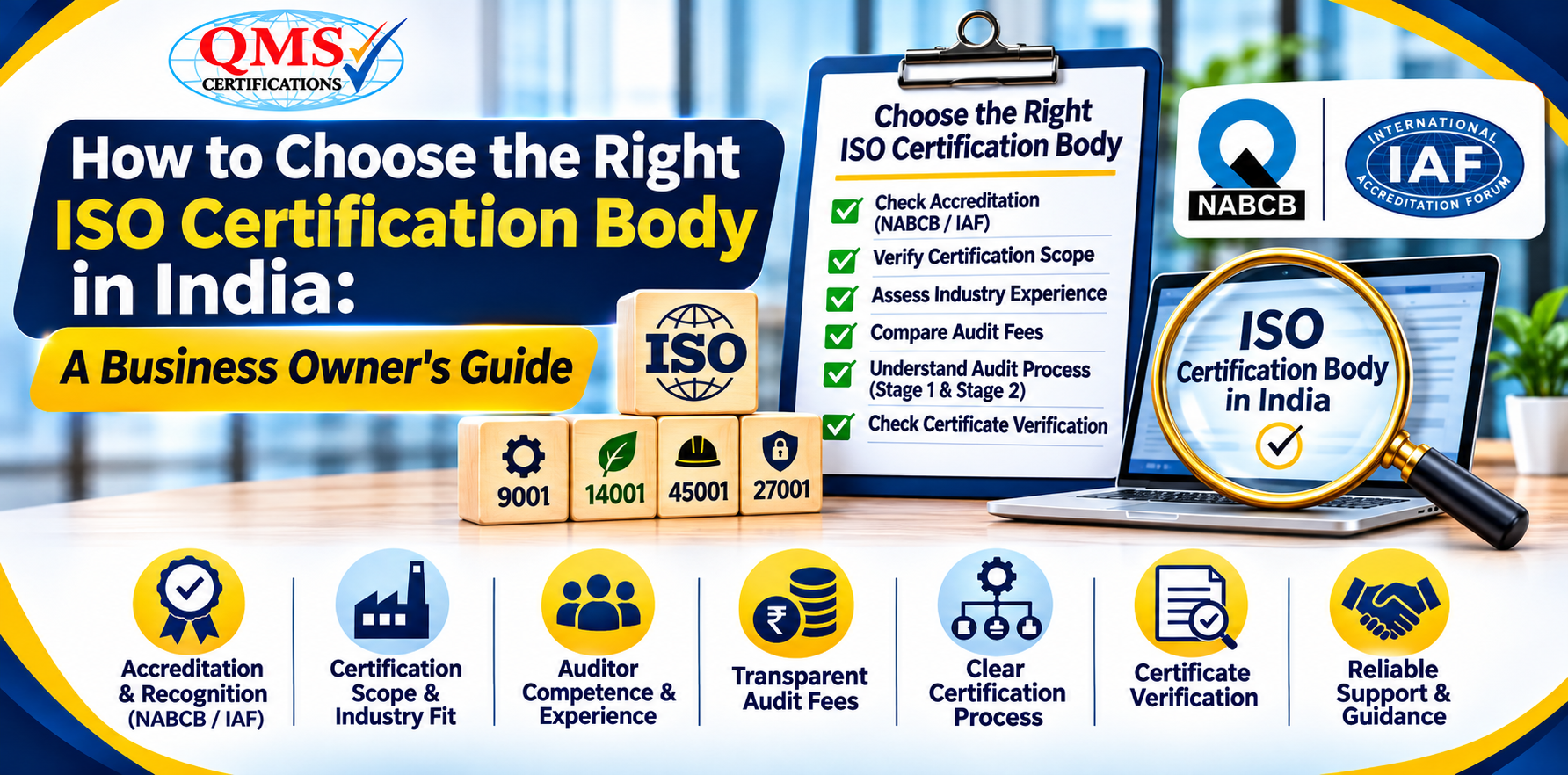
7 Important Factors to Choose the Right ISO Certification Body in India
Before selecting an ISO certification agency, evaluate the following factors.
1. Check Accreditation and Recognition
Accreditation is one of the most important factors when selecting an ISO certification body.
In India, the National Accreditation Board for Certification Bodies (NABCB), under the Quality Council of India, provides accreditation to eligible certification bodies for specified management system standards and scopes.
Check:
-
Whether the certification body has valid accreditation.
-
Which accreditation body granted it.
-
Whether the accreditation covers your required ISO standard.
-
Whether your industry falls within its approved scope.
-
Whether the accreditation is currently valid.
If international recognition matters to your business, check whether the accreditation body is a signatory to the relevant IAF Multilateral Recognition Arrangement (MLA).
Do not assume that every certificate displaying an accreditation or IAF-related logo is automatically accredited.
2. Verify the Certification Scope
Every certification body has a defined scope of accreditation.
For example, a company manufacturing electrical equipment should check whether the certification body's accredited scope covers the relevant industrial sector.
A certification body's accreditation for ISO 9001 does not automatically mean it is accredited for ISO 14001, ISO 45001 or ISO 27001.
Always verify the exact standard and industry scope before proceeding.
3. Check Industry Experience
Choose a certification body with suitable technical competence for your business activities.
For example:
-
Food manufacturers should look for relevant food-sector audit competence.
-
Engineering companies should check manufacturing-sector experience.
-
IT companies should consider auditors familiar with information security management.
-
Construction businesses should check relevant construction-sector competence.
Industry knowledge helps auditors understand actual business processes and operational risks.
4. Compare Certification and Audit Fees
The cheapest quotation is not necessarily the best option.
Ask for a detailed quotation covering:
-
Application or registration charges.
-
Stage 1 audit fees.
-
Stage 2 audit fees.
-
Auditor travel expenses, where applicable.
-
Certificate-related charges.
-
Annual surveillance audit charges.
-
Recertification audit fees.
Audit duration and fees can vary according to employee strength, operational complexity, locations and selected ISO standard.
A transparent quotation helps prevent unexpected expenses later.
5. Understand the Certification Audit Process
A professional certification body should explain its audit procedure before accepting your application.
For management system certification, the initial certification process generally includes two stages:
Stage 1 Audit: Reviews documentation, management system readiness, scope and relevant organisational information.
Stage 2 Audit: Evaluates whether the management system has been properly implemented and meets the applicable ISO requirements.
The certification body should also explain how non-conformities are reported and how corrective actions are evaluated.
6. Verify Certificate Authenticity
Before selecting a certification body, check whether it offers a reliable certificate verification facility.
After certification, verify important details such as:
-
Certificate number.
-
Organisation name.
-
Applicable ISO standard.
-
Certification scope.
-
Issue and expiry dates.
-
Certification body's identity.
-
Accreditation information, where applicable.
You can also check the certification body's current status through the relevant accreditation body's official directory.
7. Evaluate Customer Support and Transparency
Certification involves several stages, so clear communication is important.
Choose a provider that explains the application, audit schedule, documentation expectations, fees and post-certification requirements.
Avoid organisations that promise certification without a genuine independent audit or guarantee approval regardless of compliance.
Key Benefits of Choosing the Right ISO Certification Body
Selecting a competent certification body offers several advantages.
-
Credible certification: Helps demonstrate that your management system has undergone an independent assessment.
-
Customer confidence: Supports supplier approval and business relationships.
-
International acceptance: Relevant accreditation arrangements can improve recognition across participating markets.
-
Industry suitability: Ensures the certification scope matches your actual business activities.
-
Transparent audit process: Helps businesses understand audit requirements and responsibilities.
-
Long-term compliance: Supports proper surveillance and recertification arrangements.
-
Better business opportunities: Can help meet ISO certification conditions specified in certain tenders and customer contracts.
Step-by-Step Process to Obtain ISO Certification in India
Once you have selected a suitable certification arrangement, follow these steps.
Step 1: Identify the Required ISO Standard
Choose the appropriate standard according to your business requirements, such as ISO 9001, ISO 14001, ISO 45001, ISO 22000 or ISO 27001.
Step 2: Define the Certification Scope
Identify the activities, departments, locations and services that will be included.
Step 3: Submit the Application
Provide company information, employee details, business activities and relevant documentation.
Step 4: Prepare the Management System
Develop the required policies, procedures, objectives and supporting records.
Step 5: Implement and Conduct an Internal Audit
Ensure that employees follow the management system and that internal audits are completed.
Step 6: Complete the Certification Audit
The independent certification body conducts the applicable audit stages and records its findings.
Step 7: Close Non-Conformities
If findings are raised, the organisation must complete appropriate corrective actions and provide required evidence.
Step 8: Certification Decision and Issuance
After successful assessment and review, the certification body makes the certification decision and issues the certificate.
Documents Required for ISO Certification
Common documents and information include:
-
Company incorporation or business registration certificate.
-
PAN card of the organisation.
-
GST registration certificate, where applicable.
-
Business address proof.
-
Company profile.
-
Business activity details.
-
Employee information.
-
Organisational structure.
-
Relevant management system policy.
-
Management system objectives.
-
Process procedures and work instructions, where applicable.
-
Risk assessment records.
-
Employee training records.
-
Internal audit reports.
-
Management review records.
-
Corrective action records.
Additional documents depend on the selected ISO standard and business activities.
Why Choose QMS Certificate?
Selecting the right ISO certification support provider can make the process easier for startups, MSMEs and established businesses.
At QMS Certificate, we assist organisations in understanding ISO requirements and preparing for independent certification.
Our support includes:
-
Guidance on selecting the appropriate ISO standard.
-
Assistance with certification applications.
-
ISO documentation and SOP preparation.
-
Management system implementation guidance.
-
Internal audit preparation.
-
Certification audit coordination.
-
Guidance on accreditation and certification requirements.
-
Support for manufacturing, industrial and service businesses.
We focus on understanding your business activities and explaining the certification requirements before recommending a suitable approach.
Our goal is to make the certification journey clear, practical and transparent.
Frequently Asked Questions (FAQs)
1. How do I choose the best ISO certification body in India?
Check the certification body's current accreditation, applicable ISO standard, industry scope, auditor competence, audit fees, certificate verification facility and customer support. Ensure that its accreditation meets your business or tender requirements.
2. What is an NABCB accredited ISO certification body?
An NABCB accredited certification body is an organisation assessed and accredited by the National Accreditation Board for Certification Bodies for specified certification activities and scopes. Always verify its current accreditation status and approved standards.
3. Is IAF accreditation mandatory for ISO certification in India?
No. IAF accreditation is not universally mandatory for every ISO certificate. However, when accredited certification is required, check whether the accreditation body is an IAF MLA signatory and whether the certification body's scope covers your required standard.
4. What is the difference between an ISO consultant and a certification body?
An ISO consultant helps with documentation, implementation and audit preparation. A certification body independently audits the management system and makes the certification decision. These are separate responsibilities.
5. How can I verify whether an ISO certificate is genuine?
Check the certificate number, organisation name, ISO standard, certification scope, issue date and certification body. Verify the body's accreditation through the relevant accreditation body's official directory and use the certificate verification facility where available.
Conclusion
Choosing the right ISO Certification Body in India is an important business decision. A credible certification arrangement helps ensure that your management system is assessed by a competent and appropriately accredited organisation.
Before selecting a provider, verify accreditation, industry scope, audit charges, auditor competence and certificate authenticity. Do not make your decision based only on low prices or quick certificate promises.
Whether you operate a startup, MSME, manufacturing unit, engineering company or IT business, selecting the appropriate ISO certification route can support your long-term business objectives.
Get ISO Certification Assistance from QMS Certificate
Planning to obtain ISO 9001, ISO 14001, ISO 45001, ISO 22000 or ISO 27001 certification?
QMS Certificate can help you understand the applicable requirements, prepare documentation and coordinate the certification process with an independent certification body.
Contact QMS Certificate
Website: https://www.qmscertificate.com/
Email: info@qmscertificate.com
Call/WhatsApp: +91 9990 555 879
Contact our team today to discuss your business requirements and get guidance on the right ISO certification approach.
Having any Query? Talk to our Experts
Our Projects are fully tested, background checked, license validated and insured
with a 100% satisfaction guarantee.
Contact Info
 qmscertify@gmail.com
 View Location Map


