

How to Check Whether an ISO Certificate Is Genuine or Fake?
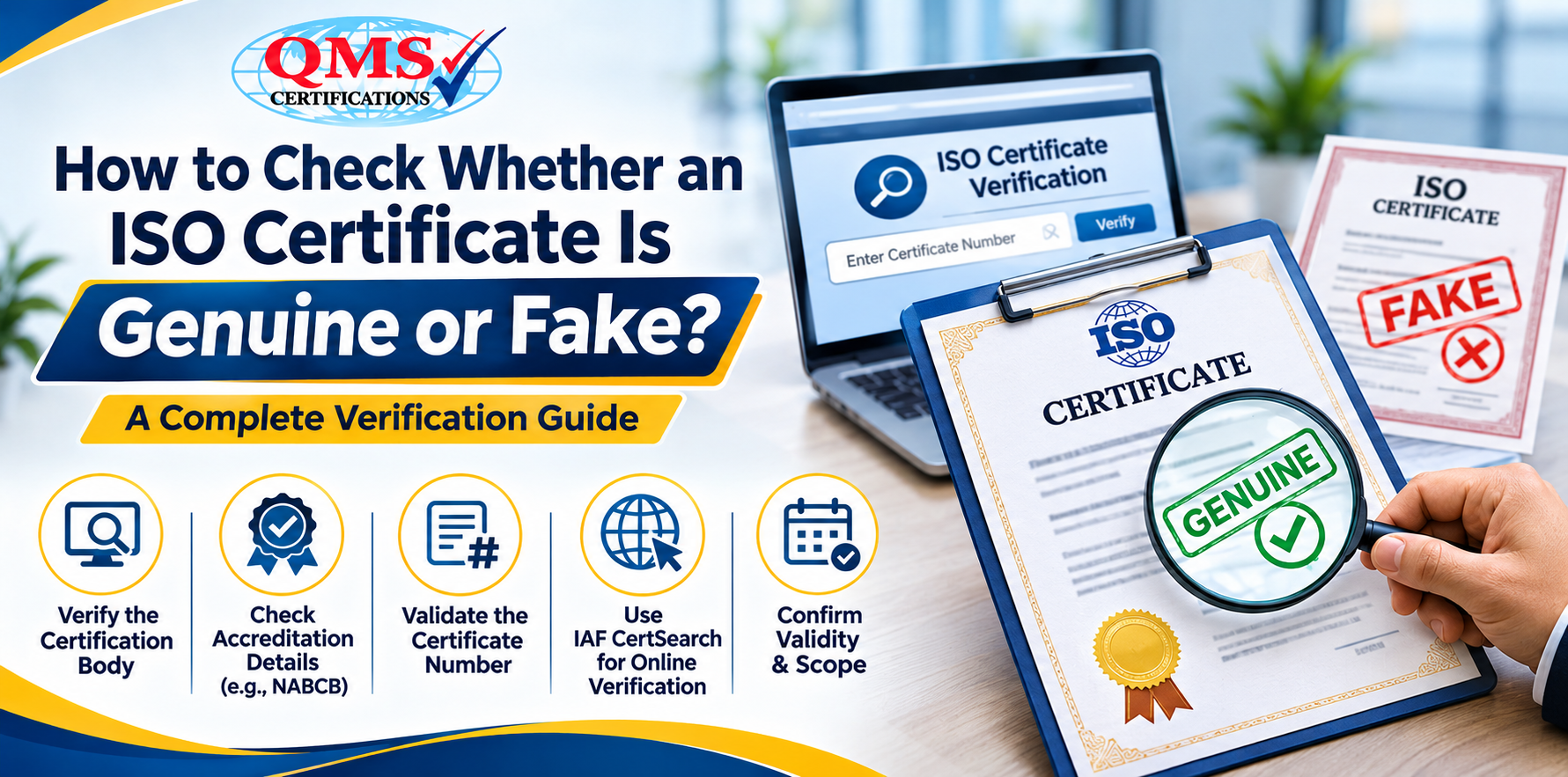
How to Check Whether an ISO Certificate Is Genuine or Fake?
Introduction
ISO certification plays an important role in building business credibility, improving customer confidence and meeting quality requirements. In India, many manufacturing companies, service providers, exporters and small businesses obtain ISO certification to demonstrate that their management systems follow internationally recognised standards.
However, one important question business owners often face is: How to Check Whether an ISO Certificate Is Genuine or Fake?
Not every document displaying an ISO logo is proof of valid certification. Some certificates may be issued by organisations without appropriate accreditation, while others may contain incorrect certificate numbers, expired validity dates or misleading information.
Accepting a fake ISO certificate can create problems during vendor assessments, government tenders, customer audits and international business transactions.
The good news is that checking an ISO certificate does not have to be complicated. By examining a few important details and verifying the issuing certification body, you can make a more informed decision.
In this guide, we explain how to identify a genuine ISO certificate, recognise warning signs and understand the correct verification process.
Why Is It Important to Verify an ISO Certificate?
Before accepting an ISO certificate from a supplier, manufacturer or business partner, verification helps protect your organisation from unnecessary risks.
For example, imagine a manufacturing company in Delhi receives an ISO 9001 certificate from a supplier. The supplier claims to follow international quality management practices. However, during a customer audit, the certificate cannot be verified with the issuing certification body.
This can affect the supplier's credibility and delay business approvals.
Verifying an ISO certificate helps businesses:
-
Avoid fake or misleading certification documents.
-
Confirm whether a certificate is active, suspended or expired.
-
Check whether the certification body is properly accredited for the relevant standard.
-
Build trust with customers, vendors and business partners.
-
Meet supplier qualification and tender requirements.
-
Reduce compliance-related risks during audits.
How to Check Whether an ISO Certificate Is Genuine or Fake?
There are several practical ways to verify an ISO certificate in India. Follow these steps before accepting or relying on any certification document.
1. Check the Certification Body's Name
Start by identifying the organisation that issued the ISO certificate. A genuine certificate should clearly mention the certification body's legal name and contact information.
Visit its official website and check whether the organisation provides certification services for the relevant ISO standard.
Do not assume that every organisation offering ISO certificates is an accredited certification body.
2. Verify the Accreditation Details
Accreditation is an important factor when checking ISO certification credibility.
Look for the accreditation body mentioned on the certificate. Then confirm whether that accreditation body is recognised and whether its scope covers the relevant certification standard.
In India, you can refer to the National Accreditation Board for Certification Bodies (NABCB) under the Quality Council of India.
Its official website provides information about accredited management system certification bodies, including ISO 9001, ISO 14001 and ISO 45001.
Visit: NABCB – Management System Certification.
Remember that accreditation and certification are different. ISO develops standards, certification bodies conduct audits and issue certificates, while accreditation bodies assess the competence of certification bodies.
3. Check the ISO Certificate Number
Every certificate should have a unique identification or registration number.
Locate the certificate number and contact the issuing certification body through its official website or published contact details.
Ask the organisation to confirm:
-
Whether the certificate number exists.
-
Which company received the certification.
-
Which ISO standard is covered.
-
Whether the certificate is currently valid.
-
Whether the certificate has been suspended or withdrawn.
If the certificate number does not match the issuing body's records, investigate further before accepting it.
4. Verify the Certificate Through IAF CertSearch
Another useful option is IAF CertSearch.
It is a global database designed to help users verify accredited management system certifications.
You can search for an organisation and review available certification information, including its status and applicable standard.
Common certificate statuses include:
-
Active: The certificate is currently valid.
-
Suspended: Certification has temporarily been made inactive.
-
Withdrawn: The certification has been permanently withdrawn.
-
Expired: The certificate's validity period has ended.
One important point: a certificate not appearing in the database does not automatically mean it is fake. Database coverage and certificate uploads can vary. Contact the certification body and relevant accreditation body for further confirmation.
IAF CertSearch User Guide+1
5. Examine the Certificate's Details
Carefully review the document for inconsistencies. A genuine ISO certificate should normally contain:
-
Registered company or organisation name.
-
Complete certified site address or applicable locations.
-
ISO standard and its correct version.
-
Scope of certification.
-
Certificate identification number.
-
Original certification or issue date.
-
Expiry date or validity information.
-
Certification body's name and authorised approval details.
-
Applicable accreditation marks, where relevant.
For example, if a company operates a manufacturing unit in Noida but the certificate mentions an unrelated business address, ask the issuing body to clarify the discrepancy.
6. Contact the Certification Body Directly
If online verification does not provide a clear result, contact the certification body using independently verified contact details.
Share a copy of the certificate and request written confirmation of its authenticity and current status.
Do not depend only on a phone number, email address or QR code printed on a questionable certificate. These details could also be misleading.
Warning Signs of a Fake ISO Certificate
Watch out for these common red flags:
|
Warning sign |
Why it matters |
|---|---|
|
Missing certificate number |
Verification becomes difficult |
|
Incorrect company details |
The document may not belong to the business |
|
No clear issuing body |
Certification authority is unclear |
|
Misleading accreditation logo |
Accreditation claims may be false |
|
Expired validity |
Certification may no longer be active |
|
No evidence of an audit |
The certification process needs investigation |
|
Unrealistically quick certification promises |
Proper assessment may have been skipped |
A single warning sign does not prove fraud. However, multiple inconsistencies should be investigated before accepting the certificate.
Key Benefits of Genuine ISO Certification
Obtaining valid ISO certification offers practical advantages to Indian businesses when the standard is relevant to their operations.
-
Improved business credibility: Demonstrates that the organisation has been assessed against specified management system requirements.
-
Better operational control: Encourages documented procedures, responsibility and process monitoring.
-
Customer confidence: Helps customers evaluate suppliers against recognised requirements.
-
Tender opportunities: Can support eligibility where ISO certification is specifically required.
-
Continuous improvement: Encourages organisations to review performance, identify problems and take corrective action.
For example, a packaging manufacturer implementing ISO 9001 can improve production monitoring, complaint handling and product quality control.
Why Choose QMS Certificate?
Choosing the right ISO certification guidance provider can make the certification journey easier for your business.
QMS Certificate provides ISO-related consultancy and certification support for businesses across different industries in India.
Our website highlights the following service advantages:
-
Industry-focused consultation.
-
Support with ISO documentation and preparation.
-
Guidance throughout the certification process.
-
Cost-effective service options.
-
Dedicated customer support.
-
Assistance for businesses across multiple locations.
Whether you operate a manufacturing unit, trading company, consultancy or service organisation, our team can help you understand the applicable ISO requirements and the steps involved.
Visit QMS Certificate to explore available certification services.
Step-by-Step ISO Certification Process
After understanding how to check whether an ISO certificate is genuine or fake, it is equally important to know how to obtain valid certification for your own business.
Here is a typical ISO certification process:
Step 1: Select the Appropriate ISO Standard
Identify the standard according to your business activities. For example, ISO 9001 for quality management, ISO 14001 for environmental management and ISO 45001 for occupational health and safety.
Step 2: Initial Consultation and Gap Assessment
Understand the standard's requirements and compare them with your existing business processes. Identify areas that need improvement.
Step 3: Documentation Preparation
Prepare relevant policies, procedures, records and other documents according to the selected standard and your organisation's activities.
Step 4: Implement the Management System
Put the documented procedures into practice. Train employees and maintain evidence that the system is being followed.
Step 5: Internal Audit and Management Review
Evaluate the effectiveness of your management system, identify nonconformities and take corrective action.
Step 6: External Certification Audit
An appropriate certification body conducts the certification audit to assess whether your organisation meets the applicable requirements.
Step 7: Certification Decision and Issuance
If the audit requirements are satisfactorily met and the certification decision is positive, the certification body issues the certificate.
Certification is not simply a document purchase. It involves an assessment of the organisation's management system.
Documents Required for ISO Certification
The documents required may vary depending on the selected ISO standard, business type and certification scope.
Generally, businesses may need the following:
-
Business registration certificate or other proof of business.
-
Company letterhead or visiting card.
-
Business address and contact details.
-
Description of products or services.
-
Organisational structure and employee details.
-
Relevant quality policies and procedures.
-
Operational records and process documents.
-
Internal audit and management review records, where applicable.
For example, a manufacturing company may need production records, inspection reports and equipment calibration records, depending on its management system requirements.
Frequently Asked Questions (FAQs)
1. How can I check whether an ISO certificate is genuine or fake?
Check the certificate number, company name, issuing certification body, accreditation details, validity period and certification scope. You can also use IAF CertSearch and contact the issuing certification body for confirmation.
2. Can I verify an ISO certificate online in India?
Yes. You can check available certification information through IAF CertSearch and consult the NABCB website for accredited certification bodies in India. You should also verify the certificate directly with its issuing organisation.
3. What is the difference between an ISO certificate and an accredited ISO certificate?
An ISO certificate confirms that an organisation's management system has been certified against a particular standard. An accredited certificate is issued by a certification body whose competence has been assessed by an accreditation body for the relevant scope.
4. Does an ISO certificate have an expiry date?
Yes. Management system certificates commonly have a three-year certification cycle, subject to surveillance audits and continued compliance. The exact validity and status should be confirmed with the issuing certification body.
5. What should I do if I receive a fake ISO certificate?
Do not rely on or submit the questionable document. Contact the issuing certification body using independently verified contact details and request written confirmation. If deliberate fraud is suspected, retain the evidence and consider reporting it to the appropriate authority.
Conclusion: Always Verify Before Trusting an ISO Certificate
Knowing how to check whether an ISO certificate is genuine or fake is essential for businesses that work with suppliers, manufacturers, exporters and corporate clients.
A certificate should never be accepted simply because it contains an ISO logo or looks professionally designed. Always verify its issuing body, accreditation status, certificate number, scope and validity.
If your organisation is planning to obtain ISO certification, selecting the appropriate standard and following a genuine certification process are equally important.
Need professional guidance for ISO certification?
QMS Certificate can help you understand ISO requirements, documentation and the certification process for your business.
Get in touch with our team:
-
Email: info@qmscertificate.com
-
Website: www.qmscertificate.com
Contact QMS Certificate today to discuss your ISO certification requirements and take the next step towards improving your business management system.
Having any Query? Talk to our Experts
Our Projects are fully tested, background checked, license validated and insured
with a 100% satisfaction guarantee.
Contact Info
 qmscertify@gmail.com
 View Location Map


